- What Is Headless Commerce?
- Why Headless Commerce Is Growing in 2026
- How We Compared These Headless Commerce Platforms
- Top 10 Headless Commerce Platforms in 2026
- Quick Comparison of the Top Headless Commerce Platforms in 2026
- Which Headless Commerce Platform Is Best for B2B?
- What About Headless Commerce Architecture?
- When Should You Invest in Headless Commerce Development Services?
- Headless Commerce and PWAs: Why the Combination Matters
- How to Choose the Right Headless Commerce Platform
- Final Verdict
Headless commerce has moved well beyond being a niche architecture choice for large enterprise brands. In 2026, it has become a practical option for businesses that want more control over customer experience, faster storefront performance, and the flexibility to connect commerce with content, apps, and multiple digital touchpoints.
If you are evaluating the best headless commerce platforms this year, the challenge is no longer finding a platform that “supports headless.” Most modern commerce systems do. The real challenge is choosing one that matches your business model, team structure, budget, and long-term growth plans.
Some platforms are ideal for fast-growing DTC brands that want a reliable backend with a custom frontend. Others are built for enterprise headless commerce projects with complex integrations, multi-store operations, and B2B workflows. And then there are open-source options for teams that want full control over the stack.
In this guide, we will compare the top 10 headless commerce platforms in 2026, look at their strengths and trade-offs, and help you decide which one is right for your business.
What Is Headless Commerce?
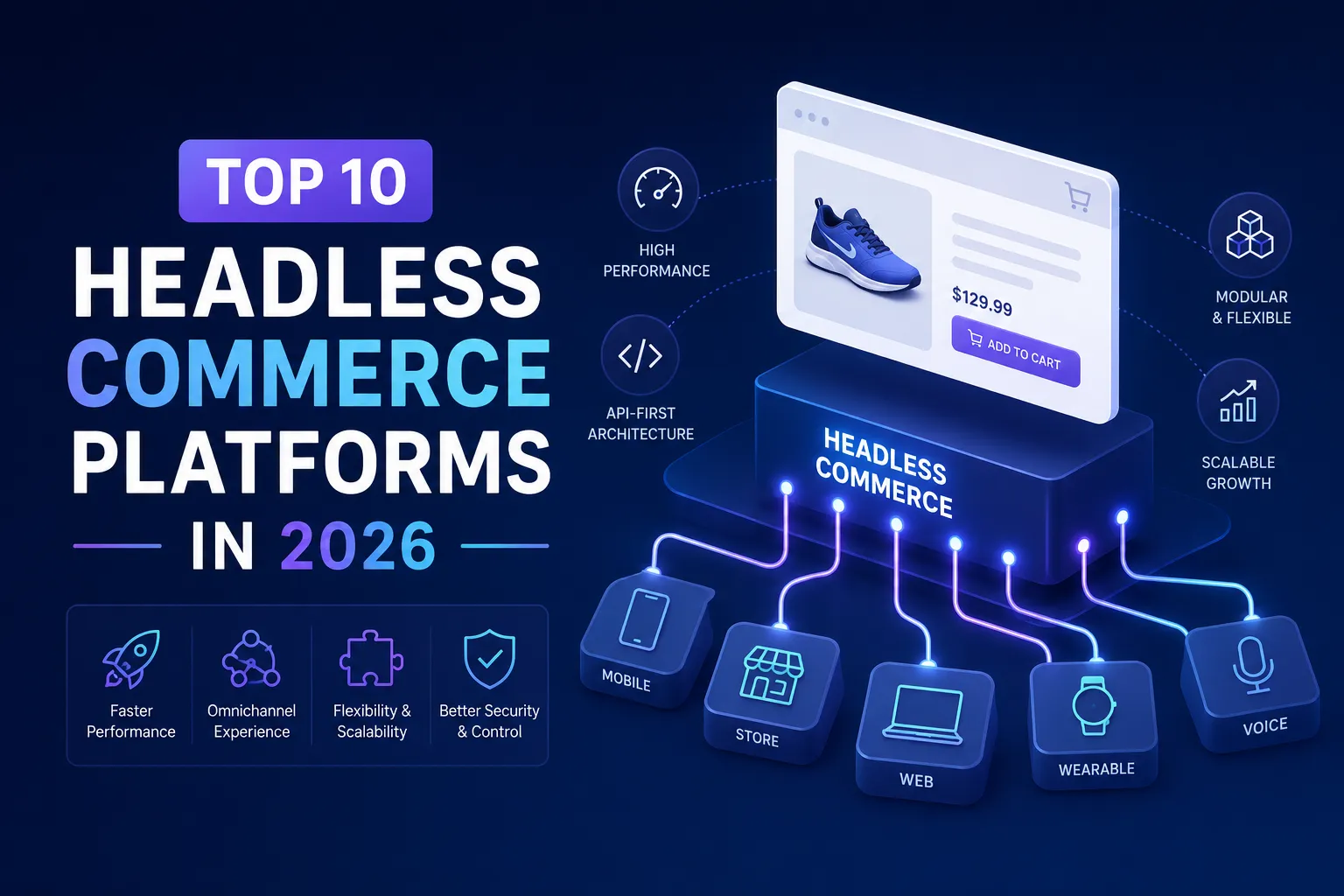
Before comparing platforms, it helps to answer a basic question: what is headless commerce? Headless commerce is an ecommerce architecture where the frontend presentation layer is separated from the backend commerce engine. In a traditional ecommerce setup, the storefront and the backend are tightly connected. In a headless setup, they are decoupled and communicate through APIs.
That means your team can build the customer-facing experience using modern frontend frameworks like React, Next.js, Vue, or a progressive web app, while the backend platform continues to manage products, pricing, inventory, checkout, and orders.
This separation gives businesses more freedom to create faster, more flexible, and more personalized shopping experiences across websites, mobile apps, kiosks, marketplaces, and other channels. If you want a more detailed breakdown of the model, architecture, and use cases, this guide on headless commerce development is a useful starting point.
Why Headless Commerce Is Growing in 2026
The rise of headless commerce is closely tied to how ecommerce has changed. Brands are no longer selling through a single storefront. They are managing content-rich websites, mobile-first shopping journeys, social commerce touchpoints, B2B portals, customer dashboards, and region-specific storefronts, often at the same time.
That is where a decoupled setup becomes attractive.
Some of the biggest benefits of headless commerce include:
1. Better storefront flexibility
Your frontend team is not limited by the theme system or presentation layer of the ecommerce platform. You can create custom user journeys, content-led shopping experiences, and high-performance interfaces without being boxed into default templates.
2. Faster performance
A headless storefront built with modern frameworks and optimized delivery can improve page speed, responsiveness, and Core Web Vitals. This matters for both SEO and conversion rates.
3. Easier omnichannel delivery
A headless backend can serve data to multiple channels at once, including web, mobile apps, in-store screens, and third-party systems.
4. Faster frontend iteration
Marketing and product teams often want to launch campaigns, landing pages, or design changes quickly. Headless architecture makes it easier to evolve the frontend without rebuilding the entire commerce engine.
5. Better integration potential
Headless commerce architecture works well when you need to connect a commerce engine with CMS platforms, PIMs, ERPs, CRMs, loyalty tools, search engines, or custom business systems.
6. A more future-proof setup
When brands talk about future proof headless commerce, they usually mean having the flexibility to evolve the frontend, add channels, and swap supporting tools without being forced into a full replatform every time the business changes.
That said, headless is not automatically the right choice for every store. If your business has a simple catalog, limited customization needs, and no major omnichannel or B2B requirements, a traditional setup may still be more practical. The value of headless increases when complexity, scale, and customer experience requirements increase.
How We Compared These Headless Commerce Platforms
To make this list useful, I looked at each platform through a practical lens rather than just listing features from vendor pages. The comparison focuses on:
- Headless readiness and API flexibility
- Suitability for B2C, enterprise, and headless commerce for B2B
- Ease of customization and frontend freedom
- Scalability for multi-store and multi-region operations
- Ecosystem maturity, developer experience, and integration options
- Whether the platform is SaaS, open source, or composable
- Overall fit for businesses investing in long-term headless commerce solutions
Top 10 Headless Commerce Platforms in 2026
1) Shopify Plus
Shopify Plus continues to be one of the strongest choices for brands that want a reliable commerce backend with a modern headless frontend. In 2026, Shopify’s headless story is built around the Storefront API, Hydrogen, and Oxygen, making it especially attractive for DTC and mid-market brands that want to move fast without taking on enterprise-level complexity.
Why it stands out
If someone asks about headless commerce Shopify, this is the benchmark example. Shopify gives merchants a stable backend for products, checkout, payments, and operations, while allowing developers to build custom storefronts on top.
Best for
- DTC brands
- Mid-market retailers
- Businesses already using Shopify and planning a headless upgrade
- Brands that want a balance of flexibility and operational simplicity
Strengths
- Strong developer tooling for Shopify-based headless builds
- Fast time to market compared to many enterprise platforms
- Reliable backend operations and checkout infrastructure
- Large app ecosystem and broad partner support
Limitations
- It is still Shopify-centric, so businesses wanting deep backend-level customization may feel constrained
- Costs can rise when you add custom frontend development, third-party CMS tools, and ongoing maintenance
For businesses already on Shopify, a headless rebuild can be a smart step if the goal is better performance, richer content experiences, or a more customized storefront without leaving the Shopify ecosystem.
2) Adobe Commerce
Adobe Commerce remains one of the most capable platforms for businesses with complex requirements, especially large catalogs, deep customization needs, and B2B workflows. When people talk about Magento headless commerce, Adobe Commerce is still one of the first platforms in the conversation. CSSChopper’s own headless guide also highlights Magento as a strong fit for scalable headless implementations.
Why it stands out
Adobe Commerce gives teams significant control over the backend and supports sophisticated product structures, customer segmentation, pricing rules, and enterprise integrations. In a headless setup, that flexibility becomes even more valuable because the frontend is no longer tied to Magento’s traditional theme layer.
Best for
- Large enterprises
- Complex B2B and B2C operations
- Multi-store and multi-region businesses
- Brands with strong in-house development teams or agency support
Strengths
- Powerful catalog and backend customization
- Strong B2B capabilities
- Works well in integration-heavy environments
- Good fit for custom enterprise storefronts and content-commerce experiences
Limitations
- Implementation complexity is higher than SaaS alternatives
- Total cost of ownership can be significant
- It usually requires an experienced development team or a reliable headless commerce development company
If your business has advanced operational requirements, Adobe Commerce can still be one of the most flexible foundations for enterprise headless commerce.
3) commercetools
Commercetools is one of the clearest examples of a platform built for composable and API-first commerce from the ground up. It is often the right fit for large businesses that want to assemble a modern commerce stack around services rather than rely on a single all-in-one platform.
Why it stands out
This is a strong option when the business needs a true enterprise-grade, API-first commerce engine with the freedom to choose separate tools for CMS, search, payments, personalization, and other functions.
Best for
- Large enterprise businesses
- Global brands with multiple storefronts and regions
- Organizations investing in composable commerce
- Complex B2B and hybrid commerce models
Strengths
- Built for API-first and composable architecture
- Highly scalable and enterprise-ready
- Strong fit for complex pricing, workflows, and integrations
- Good choice for organizations that want flexibility beyond monolithic systems
Limitations
- Not ideal for teams looking for a quick, low-complexity launch
- Requires a mature technical team and a clear architecture plan
- Costs and implementation effort can be substantial
For large organizations building a long-term digital commerce ecosystem rather than just a storefront, commercetools is one of the strongest options available.
4) BigCommerce
BigCommerce has steadily strengthened its position in the headless market by combining SaaS convenience with a fairly open API-driven architecture. It is often a strong middle ground for businesses that want more flexibility than a traditional storefront setup but do not want the full complexity of a composable enterprise stack.
Why it stands out
BigCommerce is attractive because it supports headless builds without forcing brands into a completely custom backend path. It works well with popular frontend frameworks and CMS tools, making it a practical option for content-heavy or hybrid ecommerce experiences.
Best for
- Mid-market and upper mid-market brands
- Growing ecommerce businesses that need flexibility without extreme complexity
- Brands blending content and commerce
- Some B2B use cases
Strengths
- API-first capabilities with SaaS simplicity
- Strong integration flexibility
- Lower operational burden than many enterprise systems
- Good fit for businesses that want to go headless gradually
Limitations
- Not as deep as Adobe Commerce for very complex backend customization
- Enterprise composable scenarios may still be better served by platforms designed specifically for that model
- If Shopify feels too limiting and Adobe or Commercetools feels too heavy, BigCommerce often lands in the sweet spot.
5) Salesforce Commerce Cloud
Salesforce Commerce Cloud remains a major player in enterprise commerce, and it can support headless implementations for brands that are already deeply invested in the Salesforce ecosystem.
Why it stands out
For organizations using Salesforce across CRM, service, and marketing operations, keeping commerce within the same ecosystem can be strategically useful. In a headless setup, Commerce Cloud can act as the commerce engine while frontend teams build more customized experiences externally.
Best for
- Enterprise businesses already using Salesforce
- Multi-brand or global organizations
- Businesses with strong customer data and CRM-driven commerce strategies
Strengths
- Strong enterprise ecosystem
- Good integration potential with Salesforce products
- Scalable for large operations
- Useful for brands with complex customer journeys and loyalty ecosystems
Limitation
- It can be expensive and implementation-heavy
- Less appealing if you are not already committed to Salesforce
- Customization and partner dependency can add complexity
Salesforce Commerce Cloud is not the simplest route into headless commerce, but for enterprise teams already inside the Salesforce world, it can make strategic sense.
6) Saleor
Saleor has become one of the most interesting headless commerce open source options for teams that want modern architecture and developer control without relying on a legacy platform. It is especially appealing to engineering-led teams that are comfortable building around GraphQL and custom frontends.
Why it stands out
Saleor is designed as a headless-first commerce platform rather than a traditional platform retrofitted for headless use. That gives it a cleaner fit for teams that want to build a modern stack from the ground up.
Best for
- Engineering-led businesses
- Startups and scale-ups with custom commerce needs
- Teams comfortable managing a more technical implementation path
- Businesses looking for open-source flexibility
Strengths
- Headless-first architecture
- Strong GraphQL API model
- Flexible for custom storefronts and workflows
- Good option for businesses that want ownership and extensibility
Limitations
- Less turnkey than SaaS platforms
- May require more engineering investment than mainstream commerce tools
- Not every business needs this level of technical freedom
Saleor is a serious option if your team wants a modern, customizable headless foundation and is comfortable trading convenience for flexibility.
7) Medusa
Medusa has gained attention as another open-source headless platform that gives developers a flexible backend foundation without the overhead of some larger enterprise systems. It is particularly attractive to JavaScript and TypeScript-focused teams.
Why it stands out
Medusa is often chosen by businesses that want to own more of the stack while keeping the architecture modern and modular.
Best for
- Startups and growing digital brands
- Development teams comfortable with custom builds
- Businesses exploring open-source headless commerce
- Teams that want a flexible backend that they can extend over time
Strengths
- Open-source and developer-friendly
- Good flexibility for custom workflows and storefronts
- Fits well into modern frontend stacks
- Lower platform lock-in than many SaaS systems
Limitations
- Requires technical ownership
- Merchant-facing tooling and ecosystem maturity may not match larger commercial platforms
- More suited to teams with engineering bandwidth
If you want to build a tailored commerce stack without starting from scratch, Medusa is one of the more practical open-source options on the market.
8) VTEX
VTEX is often discussed in the context of enterprise and marketplace commerce, and it has become a relevant option for brands that need flexibility across multiple selling models, regions, and channels.
Why it stands out
VTEX combines enterprise commerce capabilities with support for headless and marketplace-driven strategies, which can be valuable for larger retailers and brands operating across complex ecosystems.
Best for
- Enterprise retailers
- Marketplace and multi-seller models
- Businesses expanding across regions
- Organizations needing a mix of B2C, B2B, and marketplace capabilities
Strengths
- Strong enterprise orientation
- Useful for omnichannel and marketplace commerce
- Good fit for businesses with multi-region complexity
- Supports modern frontend flexibility
Limitations
- Not always the easiest choice for smaller businesses
- Platform fit depends heavily on your use case and regional needs
- Implementation still needs careful planning
VTEX is worth considering when the business is not just selling products online but building a broader commerce ecosystem.
9) Elastic Path
Elastic Path has positioned itself as a composable commerce platform for brands that want modular, API-driven commerce without being tied to a traditional monolith.
Why it stands out
Its value is strongest for businesses that want to combine commerce with multiple services and touchpoints while keeping the architecture modular and scalable.
Best for
- Enterprise organizations
- Businesses pursuing composable commerce
- Companies with complex product or customer journeys
- Teams that need flexible integration across channels
Strengths
- API-first and modular
- Good fit for composable architecture
- Flexible for complex use cases
- Enterprise-friendly approach to headless commerce
Limitations
- Better suited to mature teams than small merchants
- Requires planning, integration work, and architecture clarity
- Not the fastest path for a simple ecommerce launch
Elastic Path is usually not the first choice for a straightforward online store, but it becomes relevant when commerce needs to plug into a broader digital product ecosystem.
10) Fabric
Fabric has built its reputation around modular commerce services and enterprise flexibility. It is often considered by businesses that want to modernize legacy commerce systems without committing to a single rigid platform model.
Why it stands out
Fabric’s modular approach makes it useful for companies that want to replace or upgrade specific commerce capabilities while still moving toward a more modern headless architecture.
Best for
- Mid-market to enterprise businesses
- Brands modernizing legacy commerce systems
- Organizations looking for modular commerce services
- Teams with custom architecture requirements
Strengths
- Flexible service-based model
- Useful for gradual modernization
- Can support custom enterprise use cases
- Suitable for brands moving toward composable commerce
Limitations
- Requires thoughtful implementation planning
- Best suited to businesses with clear technical direction
- May be more than smaller brands need
Fabric is worth exploring if your goal is not just launching a new storefront but reworking how commerce capabilities fit into a broader digital stack.
Quick Comparison of the Top Headless Commerce Platforms in 2026
Here is a simplified view of where each platform fits best:
| Platform | Best For | Type | Strongest Use Case |
| Shopify Plus | DTC and mid-market brands | SaaS | Fast, reliable headless storefronts |
| Adobe Commerce | Large and complex businesses | Enterprise / open-core | Custom enterprise and B2B commerce |
| commercetools | Global enterprises | Composable SaaS | API-first enterprise commerce |
| BigCommerce | Mid-market and hybrid brands | SaaS | Flexible headless without heavy complexity |
| Salesforce Commerce Cloud | Salesforce-led enterprises | Enterprise SaaS | CRM-connected enterprise commerce |
| Saleor | Engineering-led teams | Open source | Modern headless-first custom commerce |
| Medusa | Developer-first growing brands | Open source | Flexible custom builds with ownership |
| VTEX | Retailers and marketplace businesses | Enterprise SaaS | Omnichannel and marketplace commerce |
| Elastic Path | Composable enterprise commerce | Enterprise SaaS | Modular, API-driven commerce |
| Fabric | Legacy modernization and enterprise flexibility | Modular commerce platform | Service-based commerce modernization |
Which Headless Commerce Platform Is Best for B2B?
If your focus is headless commerce for B2B, the shortlist usually looks different from a standard DTC comparison.
For B2B, the most important capabilities often include:
- Customer-specific pricing
- Quote workflows
- Company accounts and buyer roles
- ERP and CRM integration
- Large catalogs and custom ordering flows
- Multi-store or multi-region account structures
In that context, the strongest candidates are usually:
- Adobe Commerce for complex B2B functionality and deep customization
- commercetools for enterprise composable B2B architecture
- BigCommerce for businesses that want a lighter SaaS route with growing B2B flexibility
- Salesforce Commerce Cloud if the business is already centered on Salesforce
If B2B ecommerce is a core priority, it is also worth reviewing this related guide on top B2B ecommerce platforms.
What About Headless Commerce Architecture?
Choosing a platform is only one part of the decision. The success of a headless implementation depends just as much on the headless commerce architecture behind it.
A typical setup may include:
- A commerce backend such as Shopify, Adobe Commerce, or commercetools
- A frontend built with React, Next.js, Vue, or another framework
- A CMS for managing editorial content
- Search and merchandising tools
- Payment, shipping, tax, and customer service integrations
- Analytics, personalization, and marketing tools
- Hosting, deployment, and performance optimization layers
This is why platform selection should never happen in isolation. A good headless stack is not just about features. It is about how well the platform fits your current systems, your team’s technical maturity, and the experience you want to deliver.
If your business is also modernizing content infrastructure at the same time, a CMS strategy matters too. That is where resources like a CMS migration guide become relevant, especially if content and commerce are tightly connected in your customer journey.
When Should You Invest in Headless Commerce Development Services?
A headless project is rarely just a platform setup. It often includes frontend engineering, API integrations, performance optimization, content modeling, deployment planning, and long-term maintenance. That is why many businesses work with a specialist team rather than trying to piece everything together internally.
You should seriously consider headless commerce development services if:
- Your storefront experience needs to be highly customized
- You are integrating ecommerce with ERP, CRM, PIM, or a custom CMS
- Your business runs multiple storefronts or channels
- You need better performance and scalability than your current stack can deliver
- You want to migrate from a monolithic ecommerce setup to a modern architecture
- You are planning a B2B or enterprise implementation where technical complexity is high
For businesses looking for implementation support, custom storefront development, or migration planning, a dedicated headless commerce development company can help reduce risk and shape the right architecture from the start.
Headless Commerce and PWAs: Why the Combination Matters
Another reason headless adoption continues to grow is its compatibility with modern frontend approaches like PWAs. A progressive web app can help brands deliver app-like performance, smoother navigation, offline-friendly experiences, and improved mobile usability.
When paired with headless architecture, PWAs can create a storefront that feels much faster and more flexible than a traditional ecommerce site. If that is part of your roadmap, this guide on progressive web apps is worth reviewing alongside your headless platform evaluation.
How to Choose the Right Headless Commerce Platform
There is no single “best” platform for everyone. The right choice depends on your business goals and operational complexity.
A simple way to narrow it down is to ask these questions:
Choose Shopify Plus if:
- You want a reliable, scalable backend with a custom storefront
- Your business is DTC or mid-market
- You want a faster launch path than a fully composable build
Choose Adobe Commerce if:
- You need deep customization and advanced B2B capabilities
- Your catalog, pricing, or workflows are complex
- You have access to strong technical implementation support
Choose commercetools if:
- You are building a long-term composable enterprise architecture
- Your organization needs flexibility across multiple systems and channels
- You have the internal maturity to manage a modern API-first stack
Choose BigCommerce if:
- You want a balanced middle ground between flexibility and ease of use
- You need headless capabilities without taking on extreme complexity
- Content, integrations, and growth flexibility are important
Choose Saleor or Medusa if:
- Your team wants open-source ownership and control
- You are comfortable investing in custom development
- You want a modern, developer-friendly stack
Final Verdict
The headless commerce market in 2026 is more mature than it was a few years ago, but that also means platform selection has become more strategic. The decision is no longer just about which platform “supports headless.” It is about which one aligns with your business model, team capabilities, integration needs, and growth plans.
For many fast-growing brands, Shopify Plus remains one of the easiest and most practical ways to adopt headless commerce. For large and complex businesses, Adobe Commerce and commercetools remain top contenders, especially when B2B or enterprise requirements are involved.
For businesses looking for a middle path, BigCommerce is a strong option. And for engineering-led teams that want ownership and flexibility, Saleor and Medusa deserve serious attention. If your business is planning a serious move toward headless commerce solutions, the best next step is not just choosing a platform. It is mapping the full architecture, customer experience goals, integration needs, and implementation plan before development begins.
That is what turns a headless build from an expensive experiment into a scalable long-term asset.
Tags
Categories
Recent Posts
Popular Posts
- How to Choose a Reliable Offshore Development Partner?
- Transforming Web Development with HTMX’s Declarative Approach for Dynamic UIs
- Top 15 Ecommerce Growth Strategies to Maximize Sales in 2026
- What is B2B Web Design? Benefits, Best Practices, and Examples
- Why Your Conversion Funnel Needs a Composable Commerce Solution?