
- What Is Medical Website Design and Development?
- Medical Website Design: Creating Confidence at First Glance
- Medical Website Development: Bringing Everything Together
- Why Design and Development Should Never Be Treated Separately
- Why a Professional Healthcare Website Matters More Than Ever
- The Building Blocks of Great Healthcare Website Design
- Healthcare Website Best Practices That Build Patient Trust
- Security and Compliance Are Non-Negotiable
- Healthcare Website Design Trends to Watch in 2026
- Medical Website Examples Worth Learning From
- Custom Website or Template: Which Is Better?
- Medical Website Design Cost: What Should You Expect?
- How to Choose the Right Medical Website Design Company
- The Medical Website Development Process
- Common Mistakes Healthcare Providers Should Avoid
- The Future of Healthcare Website Design
Healthcare has become increasingly digital, and so have patient expectations. Whether someone is looking for a family physician, a dentist, a dermatologist, or a multi-specialty hospital, their search usually starts online. Before they call your clinic or schedule an appointment, they want answers.
They want to know what services you offer, whether your doctors are experienced, where your practice is located, and if booking an appointment will be straightforward. Your website is often the first interaction patients have with your practice. A slow, outdated, or confusing website can make them question your credibility, even if you provide excellent medical care.
Today’s healthcare websites must deliver a seamless user experience while meeting high standards for accessibility, security, mobile responsiveness, and search engine optimization. If you’re planning a new medical website creation project or looking to improve an existing one, this guide covers everything you need to know.
What Is Medical Website Design and Development?
People often use the terms website design and website development interchangeably, but they refer to two different parts of building a successful healthcare website. Both are equally important, and one cannot perform well without the other.
Simply put, medical website design focuses on how your website looks and how patients interact with it. It includes everything visitors can see, such as the layout, colors, typography, images, navigation, and overall user experience.
Development is what makes those designs functional. It involves writing the code that powers your website, integrating appointment booking systems, connecting patient portals, optimizing performance, and ensuring every page works smoothly across different devices.
Imagine visiting a clinic with clear signs, organized reception, and friendly staff. Finding the right department feels effortless. A well-designed website should create that same experience online. Likewise, imagine booking an appointment only to find that the online form doesn’t work or the confirmation email never arrives. That isn’t a design issue. It’s a development problem.
Successful medical website design and development combines both disciplines to create a website that not only looks professional but also performs reliably for every visitor.
Medical Website Design: Creating Confidence at First Glance
Healthcare is built on trust, and your website should reflect that from the moment someone lands on it. Good healthcare website design isn’t about using flashy animations or following every design trend. Instead, it focuses on making patients feel comfortable and helping them find information without frustration.
A thoughtfully designed medical website usually includes:
- Simple navigation that makes important pages easy to find
- Clean layouts that don’t overwhelm visitors
- Readable fonts and accessible color choices
- Professional photography of doctors, clinics, and staff
- Clear calls to action for booking appointments or contacting the practice
- Mobile-friendly pages that work seamlessly on every device
When patients can quickly find the information they’re looking for, they’re more likely to trust your practice and schedule an appointment.
Medical Website Development: Bringing Everything Together
Once the design is ready, developers turn it into a fully functional website. This stage includes building features that improve both the patient experience and your team’s workflow.
Depending on your practice, development may involve:
- Online appointment scheduling
- Patient portals
- Telemedicine integration
- Secure contact forms
- Payment gateways
- Doctor management systems
- Content management systems (CMS)
- CRM and EHR integrations
- Performance optimization
- Website security
Many healthcare organizations also choose custom web development services instead of relying on generic website templates. A custom solution offers greater flexibility, stronger security, and the ability to integrate with existing healthcare systems as the practice grows.
Why Design and Development Should Never Be Treated Separately
One of the biggest mistakes healthcare providers make is focusing only on appearance. A beautiful website won’t help your practice if pages take several seconds to load or patients can’t complete an appointment request. Likewise, a technically advanced website won’t generate more appointments if visitors struggle to navigate it.
The best healthcare websites strike a balance between design and functionality. For example, imagine a patient searching for an orthopedic surgeon after experiencing knee pain. They arrive at your website expecting quick answers. If they immediately find your services, doctor profiles, insurance information, and an appointment button, they’re far more likely to stay on your site.
Now imagine the same patient encountering a cluttered homepage, confusing menus, and slow-loading pages. Most visitors won’t spend time figuring it out. They’ll simply return to Google and choose another provider. That’s why successful healthcare web design is always built around the patient’s journey, not just visual aesthetics.
Why a Professional Healthcare Website Matters More Than Ever
Healthcare decisions are deeply personal. Patients want reassurance before choosing a provider, and your website often becomes the place where that trust begins. Think about your own online habits. Before buying a product or booking a service, you probably read reviews, compare options, and visit the company’s website. Patients behave the same way when choosing healthcare providers.
A professional website helps answer their questions before they even pick up the phone.
It Builds Trust Before the First Visit
Patients are naturally cautious when choosing someone responsible for their health. An outdated website with broken links, blurry images, or missing information can create doubt, even if your clinic has an excellent reputation.
In contrast, a modern website that introduces your doctors, explains treatments clearly, shares patient success stories, and provides accurate contact information immediately creates confidence.
Small details matter. Professional photography, updated certifications, clinic accreditations, and genuine patient testimonials all contribute to building credibility.
Patients Expect Convenience
Healthcare websites have evolved far beyond digital brochures.
Today’s patients expect to:
- Book appointments online
- Access clinic hours instantly
- Find directions using Google Maps
- Complete patient forms before arriving
- Learn about treatments
- Read FAQs
- Contact the clinic without waiting on hold
When these tasks are simple, patients are more likely to choose your practice over one with a less convenient experience.
Your Website Supports Every Marketing Channel
Whether someone discovers your practice through Google Search, social media, paid advertising, or a referral, they’ll almost always visit your website before making a decision. That means your website becomes the foundation of your entire digital marketing strategy.
Without a strong website, even the best advertising campaigns struggle to convert visitors into patients.
Better Websites Often Perform Better in Search Results
Google’s goal is to recommend websites that provide the best experience for users. Fast loading speeds, mobile responsiveness, helpful content, clear navigation, and secure browsing all contribute to stronger search performance.
When combined with quality content and local SEO, a professionally built website can help your practice appear in front of patients searching for services in your area.
The Building Blocks of Great Healthcare Website Design
Every successful healthcare website shares a few common characteristics. While every practice has different goals, these fundamentals remain the same.
A Mobile-First Experience
More than half of healthcare-related searches now happen on mobile devices. Patients may be searching while commuting, sitting at work, or even looking for urgent care late at night. If your website isn’t easy to use on a smartphone, you’re likely losing potential patients before they even read about your services.
Buttons should be easy to tap, forms should be simple to complete, and pages should load quickly regardless of screen size.
Clear Navigation That Reduces Frustration
Healthcare information can already feel overwhelming. Your website shouldn’t add to that confusion. Visitors should be able to reach important pages within just a few clicks.
Some of the most frequently visited pages include:
- About the practice
- Meet the doctors
- Medical services
- Appointment booking
- Insurance information
- Patient resources
- Contact details
Keeping navigation simple helps visitors stay focused instead of getting lost.
Content Written for Patients, Not Just Search Engines
Medical terminology has its place, but most patients aren’t looking for textbook definitions.
Instead, they want practical answers.
For example, rather than listing the name of a procedure alone, explain:
- What the treatment is
- Who may need it
- What patients should expect
- Recovery time
- Potential benefits
- When they should consult a doctor
This approach improves readability while naturally supporting SEO.
Fast Performance Matters
People are impatient online. If your website takes too long to load, many visitors will leave before seeing your services.
Optimizing images, reducing unnecessary scripts, using reliable hosting, and following modern front-end development services best practices all contribute to a faster experience that benefits both users and search engines.
Accessibility Should Never Be an Afterthought
Healthcare websites serve people of every age and ability. Readable fonts, sufficient color contrast, descriptive image text, keyboard-friendly navigation, and properly structured headings make your website easier for everyone to use.
An accessible website isn’t just about compliance. It reflects your commitment to providing an inclusive experience for every patient.
Healthcare Website Best Practices That Build Patient Trust
A healthcare website isn’t judged only by how modern it looks. Patients pay attention to the little details. If they can’t find your phone number, struggle to book an appointment, or feel overwhelmed by medical jargon, they’ll likely leave and continue their search elsewhere.
The best healthcare websites remove friction. They answer questions quickly, guide visitors naturally, and make it easy to take action. Here are some proven healthcare website best practices that every healthcare provider should follow.
Keep Navigation Simple
Patients shouldn’t have to hunt for basic information.
Organize your website using clear categories such as:
- Services
- Doctors
- Locations
- Patient Resources
- Insurance
- About Us
- Contact
If your practice offers multiple specialties, group related services together instead of listing dozens of pages in one long menu. The easier it is to navigate your website, the longer visitors are likely to stay.
Write for Patients, Not Medical Professionals
One of the biggest mistakes healthcare websites make is assuming everyone understands medical terminology.
Instead of filling pages with technical language, explain conditions and treatments in plain English. Think about the questions patients ask during consultations and answer those questions on your website.
For example, instead of only describing a procedure, explain:
- Who the treatment is suitable for
- Common symptoms it addresses
- How patients should prepare
- Recovery expectations
- When they should seek medical advice
This approach improves readability while naturally supporting SEO.
Make Every Page Easy to Scan
Most visitors don’t read every word. They scan.
Large blocks of text can make even useful information feel overwhelming.
Use:
- Clear headings
- Short paragraphs
- Bullet points where appropriate
- Helpful visuals
- Plenty of white space
A well-structured page helps patients find answers faster.
Show the People Behind Your Practice
Healthcare is personal. Patients want to know who will be caring for them.
Instead of listing only names and qualifications, create detailed doctor profiles that include:
- Areas of specialization
- Years of experience
- Professional certifications
- Languages spoken
- Special interests
- A short, patient-friendly introduction
Professional photos also make your practice feel more approachable.
Keep Information Updated
Outdated content creates uncertainty.
Regularly review:
- Clinic hours
- Contact information
- Doctor availability
- Insurance partners
- Service pages
- Staff profiles
- Pricing, where applicable
Even small inaccuracies can frustrate patients and reduce confidence in your practice.
Security and Compliance Are Non-Negotiable
Unlike many other industries, healthcare organizations handle sensitive patient information. That means security and compliance should be considered from the very beginning of any medical website design and development project.
While the specific regulations vary by country, the underlying goal remains the same: protect patient data and provide a safe online experience.
Secure Every Connection
At a minimum, every healthcare website should use HTTPS with a valid SSL certificate. This encrypts information shared between the patient and your website, including contact forms and appointment requests.
Visitors are also more likely to trust websites that display secure connections.
Protect Patient Information
If your website collects personal or medical information, security measures become even more important.
Common best practices include:
- Secure hosting
- Regular software updates
- Strong password policies
- Multi-factor authentication
- Routine security monitoring
- Automated backups
Security is not a one-time task. It requires continuous maintenance.
Make Accessibility a Priority
An accessible website ensures patients of all abilities can use your services online.
Accessibility improvements include:
- Keyboard-friendly navigation
- Alternative text for images
- Readable font sizes
- Sufficient color contrast
- Proper heading hierarchy
- Accessible forms
Designing with accessibility in mind creates a better experience for everyone.
Healthcare Website Design Trends to Watch in 2026
Design trends come and go, but the best ones improve usability rather than simply changing how a website looks. Here are some healthcare website design trends gaining momentum in 2026.
AI-Powered Patient Assistance
Many healthcare providers now use AI chat assistants to answer common questions, help patients find specialists, and guide visitors toward appointment booking. When implemented thoughtfully, these tools improve convenience without replacing human support.
Personalized Patient Experiences
Instead of showing the same information to everyone, websites are becoming more personalized.
Returning visitors may see:
- Recently viewed services
- Nearby clinic locations
- Recommended specialists
- Relevant healthcare resources
Personalization helps patients find what they need more quickly.
Cleaner, More Minimal Interfaces
Modern healthcare website design is moving away from crowded pages filled with banners and unnecessary graphics. Simple layouts with clear typography, generous spacing, and focused messaging make websites easier to navigate while creating a more professional appearance.
Faster Performance
Patients expect websites to load almost instantly.
Performance optimization continues to be one of the most important investments for healthcare organizations because it improves both user experience and search rankings.
Interactive Appointment Booking
Appointment systems are becoming smarter.
Instead of basic contact forms, patients can now:
- View available time slots
- Select preferred doctors
- Receive instant confirmations
- Reschedule appointments online
- Receive automated reminders
These features reduce administrative work while improving the patient experience.
Medical Website Examples Worth Learning From
Studying successful healthcare websites can provide valuable ideas for your own project. While every organization has different goals, the best examples share one thing in common: they make life easier for patients.
Mayo Clinic
The Mayo Clinic website focuses on patient education.
Its medical articles explain complex conditions in easy-to-understand language while maintaining a high level of credibility. Clear navigation and comprehensive health resources make it one of the strongest medical website examples available.
What stands out
- Extensive educational content
- Excellent search functionality
- Clear navigation
- Strong credibility signals
Cleveland Clinic
Cleveland Clinic combines healthcare information with a clean, modern interface.
Visitors can easily locate specialists, explore treatment options, and access patient resources without feeling overwhelmed.
What stands out
- User-friendly navigation
- Mobile-friendly experience
- Helpful medical content
- Consistent branding
- Johns Hopkins Medicine
Johns Hopkins balances research, education, and patient care within a single website.
Despite offering thousands of pages, the information remains well organized and easy to explore.
What stands out
- Logical information architecture
- Comprehensive doctor profiles
- Strong educational resources
- Professional visual design
What These Healthcare Website Design Examples Teach Us
The best healthcare website design examples don’t rely on flashy visuals.
Instead, they prioritize:
- Patient trust
- Clear communication
- Easy navigation
- Fast performance
- Helpful educational content
- Accessible design
- Straightforward appointment booking
These principles can be applied whether you’re designing a website for a solo practitioner or a large hospital network.
Custom Website or Template: Which Is Better?
Many healthcare providers ask whether they should use a website template or invest in a custom solution.
The answer depends on your goals.
| Feature | Website Template | Custom Website |
| Initial Cost | Lower | Higher |
| Branding | Limited | Fully customized |
| Flexibility | Restricted | Highly flexible |
| Scalability | Moderate | Excellent |
| Integrations | Basic | Advanced |
| SEO Potential | Good | Excellent |
| Security | Depends on the platform | Greater control |
| Long-Term Growth | Limited | Built for expansion |
Templates can work well for smaller practices with straightforward requirements. However, hospitals, multi-location clinics, healthcare startups, and organizations with specialized workflows often benefit more from custom web development services. A custom-built website can be tailored to your branding, integrate with existing healthcare systems, and scale as your organization grows.
Just as importantly, custom solutions make it easier to implement advanced functionality without being constrained by the limitations of a pre-built theme.
Medical Website Design Cost: What Should You Expect?
One of the first questions healthcare providers ask is, “How much does a medical website cost?” The answer depends on your goals, the complexity of the project, and the functionality you need. A simple website for a private clinic will cost significantly less than a custom platform for a multi-location hospital with patient portals and telemedicine features.
Here’s a general pricing guide:
| Website Type | Estimated Cost | Best For |
| Basic informational website | $2,000–$5,000 | Individual doctors, small clinics |
| Professional healthcare website | $5,000–$15,000 | Medical practices, dental clinics, specialty centers |
| Custom healthcare website | $15,000–$40,000+ | Hospitals, healthcare groups, enterprise organizations |
These estimates can vary depending on your region, the experience of your development partner, and the scope of the project.
What Influences the Cost?
Several factors determine the final price of a medical website design and development project.
Custom Design
A unique design tailored to your brand takes more time than using a pre-built template, but it also helps your practice stand out and creates a better patient experience.
Number of Pages
A five-page clinic website requires far less effort than a website with dozens of service pages, doctor profiles, patient resources, and location-specific content.
Custom Features
Features such as appointment scheduling, patient portals, telemedicine integration, online payments, and CRM or EHR integrations increase development time and cost.
Content Creation
Many medical website design companies also provide copywriting, photography, SEO, and content migration. These services are usually priced separately but can save considerable time.
SEO and Ongoing Maintenance
Launching your website is only the beginning. Regular updates, security patches, performance monitoring, and content improvements are essential for keeping your website secure and competitive.
How to Choose the Right Medical Website Design Company
Choosing a medical website design company is one of the most important decisions you’ll make. The right partner understands both healthcare and web development, helping you create a website that meets patient expectations while supporting your business goals.
If you’re comparing agencies, look beyond attractive portfolios and ask the right questions.
Do They Have Healthcare Experience?
Healthcare websites come with unique challenges, including accessibility, patient privacy, content accuracy, and regulatory considerations. An agency with healthcare experience is more likely to understand these requirements and avoid common mistakes.
Ask to see examples of websites they’ve built for clinics, hospitals, or healthcare organizations.
Do They Offer Both Design and Development?
Some agencies focus only on design and outsource development to third parties. While this can work, having one team handle both design and development often leads to better communication and a smoother project.
A full-service healthcare website design agency can also help with branding, SEO, content strategy, and ongoing support.
Will They Provide Ongoing Support?
Healthcare websites need regular updates, security monitoring, and performance improvements.
Before signing a contract, ask about:
- Website maintenance
- Security updates
- Backup policies
- Technical support
- Content updates
- Performance monitoring
A long-term partnership is often more valuable than a one-time project.
Questions to Ask Before Hiring
Before you hire medical website design experts, consider asking:
- Have you worked with healthcare providers before?
- Can you share relevant case studies?
- How do you approach SEO during development?
- Will the website be mobile-first?
- How do you handle accessibility?
- Who owns the website after launch?
- What support do you provide post-launch?
The answers will help you choose an agency that aligns with your goals rather than simply offering the lowest quote.
The Medical Website Development Process
A successful website isn’t built overnight. It follows a structured process that keeps the project organized and ensures nothing important is overlooked.
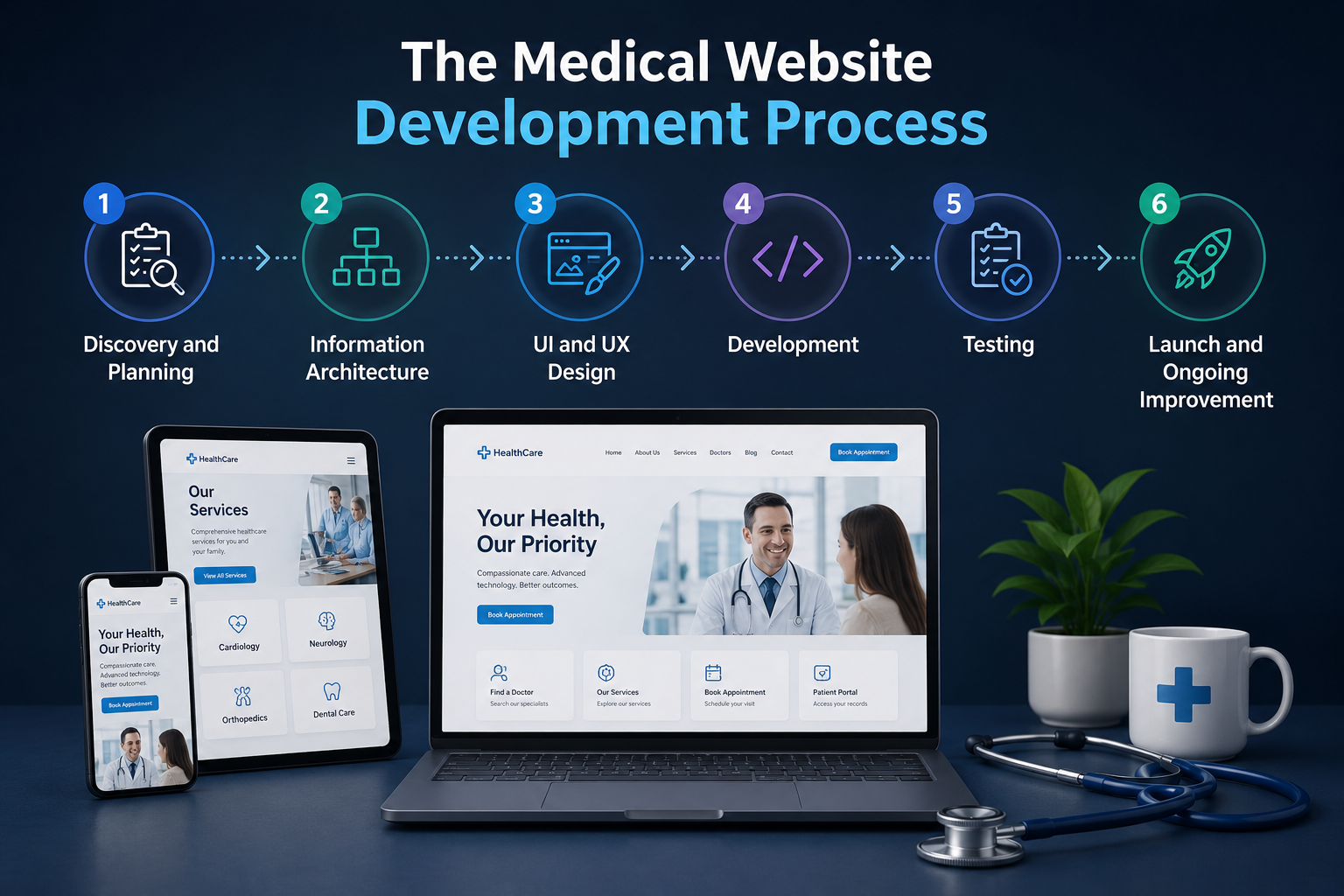
1. Discovery and Planning
Every project begins with understanding your practice, your patients, and your business objectives.
This stage includes:
- Stakeholder interviews
- Competitor research
- Patient personas
- Website goals
- Feature planning
- Content audit
A clear strategy at the beginning helps avoid costly changes later.
2. Information Architecture
Before any designs are created, the website structure is planned.
This includes organizing:
- Main navigation
- Service pages
- Doctor profiles
- Blog categories
- Patient resources
- Contact pages
A logical structure improves both user experience and SEO.
3. UI and UX Design
Designers create wireframes and visual mockups that focus on usability, accessibility, and branding.
Every design decision should answer one question:
“Will this make it easier for patients to find what they need?”
4. Development
Once the design is approved, developers begin building the website.
This phase may include:
- Front-end development services
- CMS implementation
- Appointment booking integration
- Patient portal integration
- CRM integration
- Form development
- Performance optimization
Quality development ensures the website works reliably across all browsers and devices.
5. Testing
Before launch, every feature should be thoroughly tested.
This includes checking:
- Mobile responsiveness
- Browser compatibility
- Form submissions
- Broken links
- Loading speed
- Accessibility
- Security
- SEO settings
Testing helps identify issues before patients encounter them.
6. Launch and Ongoing Improvement
Launching a website is the beginning, not the end.
After launch, monitor:
- User behavior
- Search performance
- Conversion rates
- Technical issues
- Patient feedback
Continuous improvement keeps your website relevant as patient expectations and search algorithms evolve.
Common Mistakes Healthcare Providers Should Avoid
Even well-intentioned projects can fall short if certain fundamentals are overlooked.
Prioritizing Design Over Usability
A visually impressive website is useless if patients can’t find the information they need. Navigation should always take priority over decorative elements.
Ignoring Mobile Users
A large percentage of healthcare searches happen on smartphones. If your website isn’t mobile-friendly, you’re likely losing potential patients.
Publishing Thin Content
Many healthcare websites include only a few sentences about each service.
Instead, create detailed pages that answer common patient questions, explain treatment options, and demonstrate expertise.
Forgetting About SEO
SEO should be part of the project from day one, not something added after launch. Optimized page titles, structured headings, internal linking, and quality content all contribute to better search visibility.
Neglecting Website Maintenance
Outdated plugins, expired certificates, and broken forms create security risks and damage patient trust.
Regular maintenance helps keep your website secure and performing at its best.
The Future of Healthcare Website Design
Healthcare websites will continue evolving as patient expectations and technology advance. Some trends are already shaping the next generation of digital healthcare experiences.
AI-Powered Personalization
Instead of showing identical content to every visitor, websites will increasingly recommend doctors, services, and educational resources based on user behavior.
Smarter Patient Portals
Future patient portals will offer more than appointment scheduling. Patients will be able to manage prescriptions, access lab results, complete digital forms, and communicate securely with healthcare providers from a single dashboard.
Voice Search Optimization
As voice assistants become more common, healthcare websites will need to answer conversational queries such as:
- “Where can I find a pediatrician near me?”
- “What are the symptoms of seasonal allergies?”
- “Book a dermatologist appointment.”
Creating content that answers these questions naturally will become increasingly important.
Greater Focus on Accessibility
Accessibility will continue moving from a recommendation to an expectation.
Healthcare organizations that invest in inclusive design today will be better prepared for future standards and provide a better experience for all patients.
Conclusion
A healthcare website should do more than establish an online presence. It should educate, build trust, simplify patient interactions, and support the long-term growth of your practice. Whether you’re planning a brand-new medical website creation project or redesigning an existing website, success depends on balancing design, functionality, security, accessibility, and SEO.
Every page should help patients find reliable information, navigate your services with ease, and feel confident about choosing your practice. Working with experienced medical website designers and investing in custom web development services can help create a website that not only reflects your brand but also delivers measurable business results.
Combined with reliable front-end development services, thoughtful content, and ongoing optimization, your website becomes a valuable digital asset that supports patient care and practice growth for years to come.
Tags
Categories
Recent Posts
Popular Posts
- How to Choose a Reliable Offshore Development Partner?
- Transforming Web Development with HTMX’s Declarative Approach for Dynamic UIs
- Top 15 Ecommerce Growth Strategies to Maximize Sales in 2026
- What is B2B Web Design? Benefits, Best Practices, and Examples
- Why Your Conversion Funnel Needs a Composable Commerce Solution?