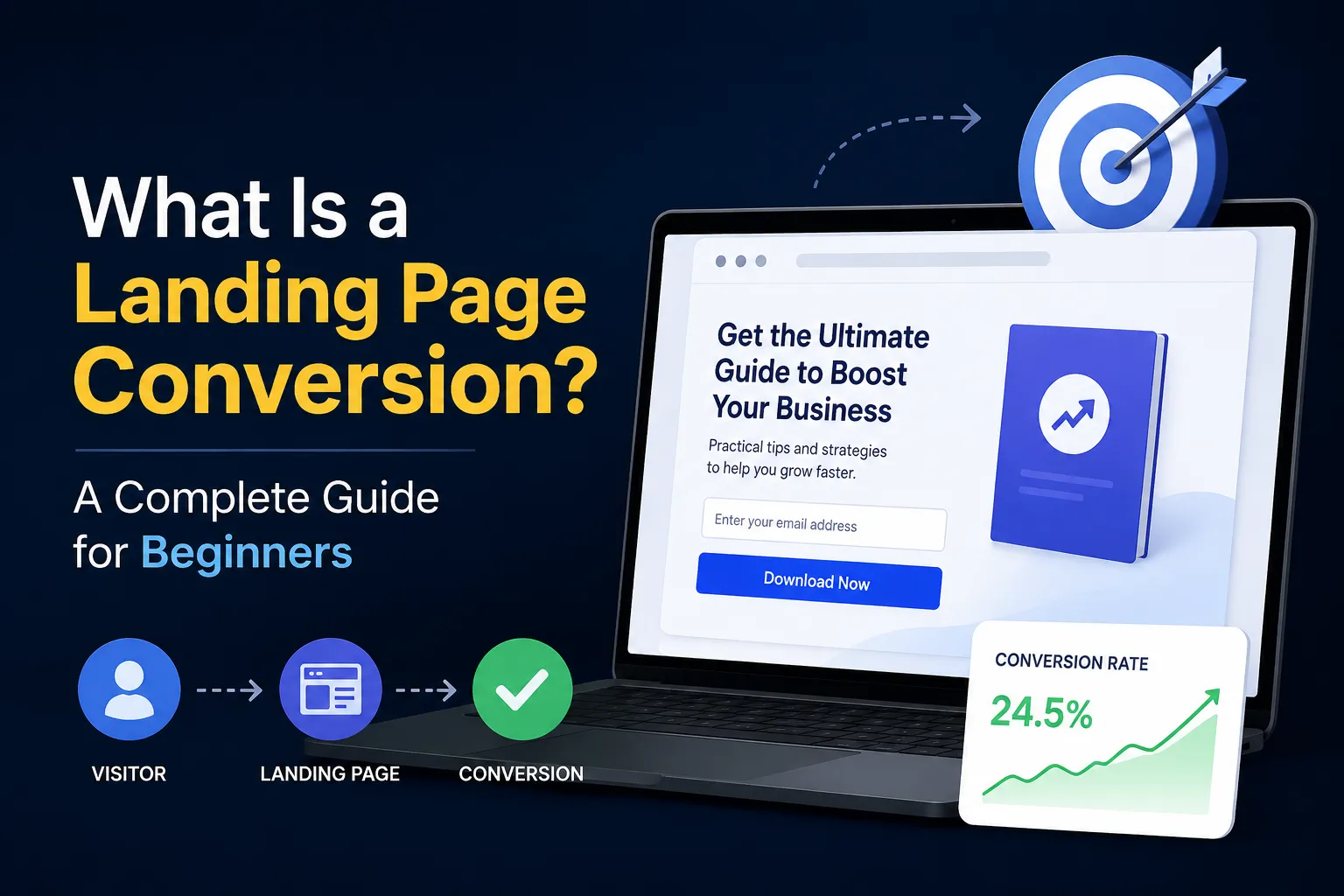
- What Is a Landing Page Conversion?
- What Is Landing Page Conversion Rate?
- What Is a Good Landing Page Conversion Rate?
- What Makes a Landing Page Convert?
- Landing Page Optimization: How to Improve Conversion Performance
- How to Optimize a Landing Page for Conversions
- Why Is My Landing Page Not Converting?
- How to A/B Test a Landing Page
- Landing Page Best Practices for Higher Conversions
- The Role of Conversion Rate Optimization (CRO)
- Final Thoughts
A landing page can attract thousands of visitors, but traffic alone does not grow a business. The real goal is to encourage visitors to take action. That action is called a landing page conversion.
A conversion can be anything you want a visitor to do, such as filling out a form, purchasing a product, booking a demo, downloading an ebook, or signing up for a newsletter.
Understanding how landing page conversions work is the first step toward building a website that does more than just attract visitors. It helps you identify what makes people take action, what prevents them from converting, and how you can improve results through landing page optimization.
In this guide, you will learn what a landing page conversion is, how to calculate your conversion rate, what makes a landing page convert, and how to optimize your landing pages for better results.
What Is a Landing Page Conversion?
A landing page conversion occurs when a visitor completes the specific action that your landing page is designed to encourage.
For example, if you have a landing page promoting a free consultation, the conversion happens when a visitor submits the consultation request form.
Similarly, a conversion might be:
- Making a purchase
- Filling out a contact form
- Booking a demo
- Signing up for a free trial
- Downloading a guide or resource
- Subscribing to a newsletter
- Registering for a webinar
- Calling your business
- Clicking an important call-to-action button
The important thing is that every landing page should have a clear conversion goal.
For example, imagine you run a SaaS company and create a landing page for a free product trial as part of a broader custom web development strategy designed to encourage sign-ups.
If 1,000 people visit the page and 50 sign up for the trial, you have generated 50 conversions. The next question is: how effective was the landing page?
That is where the landing page conversion rate becomes important.
What Is Landing Page Conversion Rate?
The landing page conversion rate tells you what percentage of visitors complete your desired action.
You can calculate it using this formula:
Conversion Rate = (Number of Conversions ÷ Total Number of Visitors) × 100
For example:
- Total visitors: 1,000
- Conversions: 50
Conversion Rate = (50 ÷ 1,000) × 100 = 5%
This means your landing page has a 5% conversion rate.
Tracking this number helps you understand whether your landing page is effectively turning visitors into leads, customers, or subscribers. However, conversion rate should never be viewed in isolation.
A page with a lower conversion rate may still generate more total leads if it receives significantly more qualified traffic.
This is why conversion rate optimization (CRO) focuses on both the quality of traffic and the experience visitors have after arriving on the page.
What Is a Good Landing Page Conversion Rate?
One of the most common questions marketers ask is: What is a good landing page conversion rate?
There is no single number that applies to every business.
Conversion rates can vary based on:
The expected performance can also depend on the purpose of the page and whether you are choosing the right website type for your business goals.
- Industry
- Traffic source
- Product price
- Type of offer
- Audience intent
- Device type
- Landing page design
- Form length
- Brand recognition
- Complexity of the buying decision
For example, someone searching for “buy running shoes online” usually has stronger purchase intent than someone who clicks a social media ad while casually browsing.
Because of this, the second visitor may be less likely to convert immediately. When looking at conversion rate benchmarks, use them as a reference point rather than a fixed target. The best benchmark is often your own historical performance.
If your landing page conversion rate improves from 3% to 5%, that is a meaningful improvement, even if another company in your industry reports a higher average.
The goal should be continuous improvement.
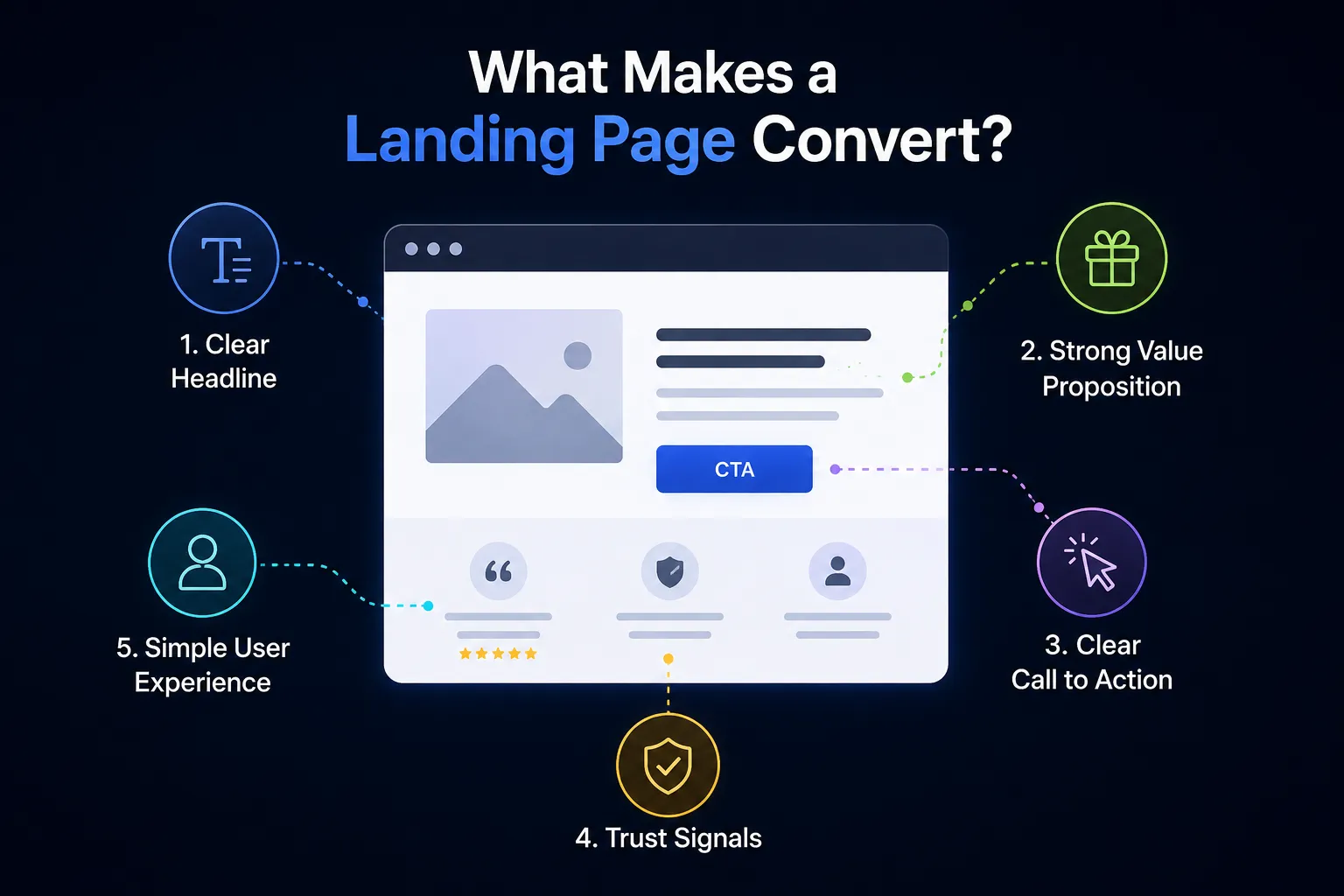
What Makes a Landing Page Convert?
A high-converting landing page usually succeeds because it makes the visitor’s next step clear and easy.
People should quickly understand three things:
- What you are offering
- Why it is valuable to them
- What they need to do next
If visitors cannot understand these points within a few seconds, they may leave without taking action.
Several elements contribute to a successful landing page.
1. A Clear and Relevant Headline
Your headline should immediately communicate the main value of your offer.
Avoid vague statements such as:
- The Future of Better Business
Instead, be specific:
- Manage Your Customer Support Requests From One Dashboard
The second headline tells visitors what the product actually does.
A strong headline should match the visitor’s expectations. If someone clicks an ad promising a free website audit, the landing page should clearly mention the free website audit.
This consistency is an important part of landing page best practices.
2. A Strong Value Proposition
Your landing page should answer one important question:
Why should the visitor care?
Features explain what something does. Benefits explain why it matters.
For example:
Feature: AI-powered analytics dashboard
Benefit: Identify high-performing marketing campaigns without manually analyzing spreadsheets.
The benefit gives visitors a practical reason to take action.
3. A Clear Call to Action
The call to action, or CTA, tells visitors what to do next.
Common CTA examples include:
- Start Your Free Trial
- Book a Free Demo
- Get Your Quote
- Download the Guide
- Create Your Account
Generic CTAs such as “Submit” or “Click Here” often provide very little context. A good CTA should clearly communicate the next action and, when possible, the value the visitor will receive.
4. Trust Signals
People are often hesitant to share their information or make a purchase from an unfamiliar business. Trust signals can reduce this hesitation.
Examples include:
- Customer reviews
- Testimonials
- Client logos
- Case studies
- Security badges
- Certifications
- Money-back guarantees
- Industry awards
- Real customer results
Trust is particularly important for landing pages that ask visitors to make a purchase or submit personal information.
5. A Simple User Experience
Good landing page UX best practices focus on reducing unnecessary friction. The choice of technology can also influence the user experience, and modern front-end frameworks can help developers create cleaner, faster, and more responsive interfaces. Visitors should not have to work hard to understand your offer. Keep the page focused.
Remove unnecessary distractions, excessive navigation options, and information that does not support the conversion goal.
A visitor should naturally move through the page from:
Problem → Solution → Benefits → Proof → Call to Action
The easier the experience, the more likely visitors are to complete the desired action.
Landing Page Optimization: How to Improve Conversion Performance
Landing page optimization is the process of improving different elements of a landing page to increase the number or percentage of visitors who convert. This is closely connected to conversion rate optimization (CRO).
However, effective optimization is not about randomly changing colors or rewriting buttons.
It should be based on data.
Start by understanding how people interact with your landing page.
You can analyze metrics such as:
- Conversion rate
- Bounce rate
- Engagement time
- Scroll depth
- Form abandonment
- CTA click-through rate
- Traffic source
- Desktop vs. mobile performance
These metrics can help identify where visitors are dropping off. For example, if many visitors start filling out a form but do not complete it, the form may be too long or ask for information they are not comfortable sharing.
If visitors leave the page before scrolling further, your headline or opening section may not be engaging enough. The goal of landing page conversion optimization is to identify these friction points and systematically improve them.
How to Optimize a Landing Page for Conversions
If you are wondering how to improve your landing page conversion rate, start with these steps.
Understand Your Audience
A landing page cannot convert effectively if it does not address the needs of the people visiting it.
Before making design changes, understand:
- What problem does your audience have?
- What are they trying to achieve?
- What concerns might stop them from converting?
- What information do they need before making a decision?
- Where did they come from?
Someone arriving from a Google search may have a different level of awareness than someone who clicked a retargeting advertisement.
Your messaging should reflect the visitor’s intent.
Improve Message Match
Your ad, email, social media post, or search result should match the landing page.
For example, if your advertisement says:
Get a Free SEO Audit
- The landing page should not lead with a generic description of your digital marketing agency.
- Instead, it should clearly focus on the free SEO audit.
- This creates a smoother journey and reassures visitors that they have arrived at the right place.
Simplify Your Forms
Long forms can create friction.
Only ask for information you genuinely need at that stage. For a newsletter signup, you may only need an email address. For a complex B2B service inquiry, you may need additional details, but every field should have a purpose.
Reducing unnecessary form fields is one of the simplest landing page design tips for improving conversions.
Make the Page Mobile-Friendly
A significant portion of website traffic comes from mobile devices. If your landing page is difficult to navigate on a smaller screen, you may lose potential customers. In some cases, businesses may also consider Progressive Web App (PWA) development to deliver a faster and more app-like mobile experience.
Check whether:
- Text is easy to read
- Buttons are easy to tap
- Forms are simple to complete
- Images load correctly
- The CTA is visible
- The page loads quickly
A good desktop experience does not automatically mean you have a good mobile experience.
Improve Page Speed
Slow-loading pages can create a poor first impression and cause visitors to leave before engaging with your content.
Optimize images, reduce unnecessary scripts, and regularly test your page performance.
Speed is not just a technical issue. It is also part of the overall user experience.
Use Social Proof
People often look for evidence before making a decision. Customer testimonials, reviews, success stories, and measurable results can make your offer more credible.
For example, compare these two statements:
We provide excellent web development services.
And:
See how businesses improved website performance after working with our development team.
The second approach is stronger when supported by real examples or case studies.
Why Is My Landing Page Not Converting?
If your landing page receives traffic but generates very few conversions, there may be several reasons.
Some of the most common problems include:
Your Offer Is Not Clear
Visitors may not understand what you are offering or why they should take action.
Simplify the message and focus on the main benefit.
You Are Attracting the Wrong Traffic
A landing page may have a low conversion rate because the visitors are not your target audience.
Review your keywords, advertisements, audience targeting, and traffic sources. This becomes especially important for businesses targeting specific professional audiences, where effective B2B web design should align the page with the needs and expectations of the intended audience.
More traffic does not always mean better results.
Your CTA Is Weak or Difficult to Find
Visitors need a clear next step.
Make sure your CTA stands out and clearly explains what will happen after they click.
The Page Has Too Many Distractions
A landing page with too many links, pop-ups, competing offers, or unrelated information can overwhelm visitors. Every major element on the page should support the primary conversion goal.
There Is Not Enough Trust
If you are asking for personal information, payment details, or a significant commitment, visitors may need more reassurance. Add relevant proof, testimonials, security information, or case studies.
Your Landing Page Does Not Match Search Intent
A visitor searching for information may not be ready to purchase immediately. Similarly, someone ready to buy may become frustrated if they land on a long educational page without a clear purchasing option.
Understanding search and user intent is essential when optimizing a landing page.
How to A/B Test a Landing Page
A/B testing, also known as split testing, allows you to compare two versions of a landing page.
For example:
- Version A uses the headline: Get a Free SEO Audit
- Version B uses: Discover What’s Holding Your Website Back
Visitors are divided between the two versions, and you compare which version produces more conversions.
The key is to test one meaningful variable at a time.
You can test:
- Headlines
- CTA text
- CTA placement
- Form length
- Images
- Pricing presentation
- Testimonials
- Page layout
- Value propositions
Avoid changing everything at once.
If you change the headline, design, CTA, and form simultaneously, it becomes difficult to understand which change actually influenced the results.
A good A/B testing process looks like this:
- Identify a problem.
- Create a hypothesis.
- Change one important element.
- Run the test with enough traffic.
- Compare the results.
- Implement the winning version if the improvement is meaningful.
- Continue testing.
For example:
- Hypothesis: Visitors may be hesitant to book a demo because they do not know how long the process takes.
- Test: Add the text “Book a 15-Minute Demo” to the CTA.
This is a more structured approach than simply changing elements based on personal preference.
Landing Page Best Practices for Higher Conversions
Here are some practical landing page best practices to keep in mind:
Focus on One Primary Goal
Avoid asking visitors to do multiple unrelated things.
If the goal is to generate demo requests, make that the primary action throughout the page.
Put Important Information First
Your headline, value proposition, and CTA should be easy to find.
Do not force visitors to scroll through several sections before understanding the offer.
Write for Clarity, Not Cleverness
Creative copy can be effective, but clarity should come first.
Visitors should immediately understand what you offer.
Use Visuals That Support the Message
Images, screenshots, videos, and graphics should help explain the product or service.
Avoid adding visuals simply to fill empty space.
Address Common Objections
Think about what might stop someone from converting.
Common objections include:
- Is this free?
- How much does it cost?
- How long will it take?
- Do I need technical knowledge?
- Can I cancel anytime?
- Is my information secure?
- Addressing these questions can reduce hesitation.
- Make the CTA Visible Throughout the Page
For longer landing pages, repeat the CTA at logical points. Visitors should not have to scroll back to the top when they are ready to take action.
The Role of Conversion Rate Optimization (CRO)
Conversion rate optimization (CRO) is the broader process of improving the percentage of users who complete a desired action. Landing pages are an important part of CRO because they are often designed around a specific business objective.
For online businesses, CRO can also support broader ecommerce growth strategies by improving the journey from initial visit to conversion.
A successful CRO strategy typically involves:
- Researching user behavior
- Understanding audience intent
- Analyzing website data
- Identifying friction points
- Testing improvements
- Measuring results
- Repeating the process
The most important principle is that CRO should be evidence-based.
Do not assume that a green button will always perform better than a blue one or that shorter pages always convert better. What works for one audience may not work for another. The best approach is to understand your users and test your assumptions.
Final Thoughts
A landing page conversion is more than just a completed form or sale. It represents a visitor deciding that your offer is valuable enough to take the next step. The most effective landing pages are not necessarily the ones with the most advanced designs or the most persuasive-sounding copy.
They are the ones that clearly understand the visitor. If you want to build a high-converting landing page, whether as part of a dedicated campaign or a larger eCommerce website development project, focus on the basics first: understand your audience, create a clear offer, communicate the value, reduce friction, build trust, and make the next action obvious.
Then use data, user behavior, and A/B testing to improve your results over time. That is the foundation of effective landing page optimization and sustainable conversion rate optimization.
Tags
Categories
Recent Posts
Popular Posts
- How to Choose a Reliable Offshore Development Partner?
- Transforming Web Development with HTMX’s Declarative Approach for Dynamic UIs
- Top 15 Ecommerce Growth Strategies to Maximize Sales in 2026
- What is B2B Web Design? Benefits, Best Practices, and Examples
- Why Your Conversion Funnel Needs a Composable Commerce Solution?