- Why Businesses Are Choosing Open Source eCommerce Platforms
- Open Source vs Hosted eCommerce Platforms
- How We Selected These Open Source eCommerce Platforms
- Top 10 Free and Open Source eCommerce Platforms
- eCommerce Platform Comparison (2026)
- How to Choose the Best Open Source eCommerce Platform
- Common Mistakes When Choosing an Open Source eCommerce Platform
- Conclusion
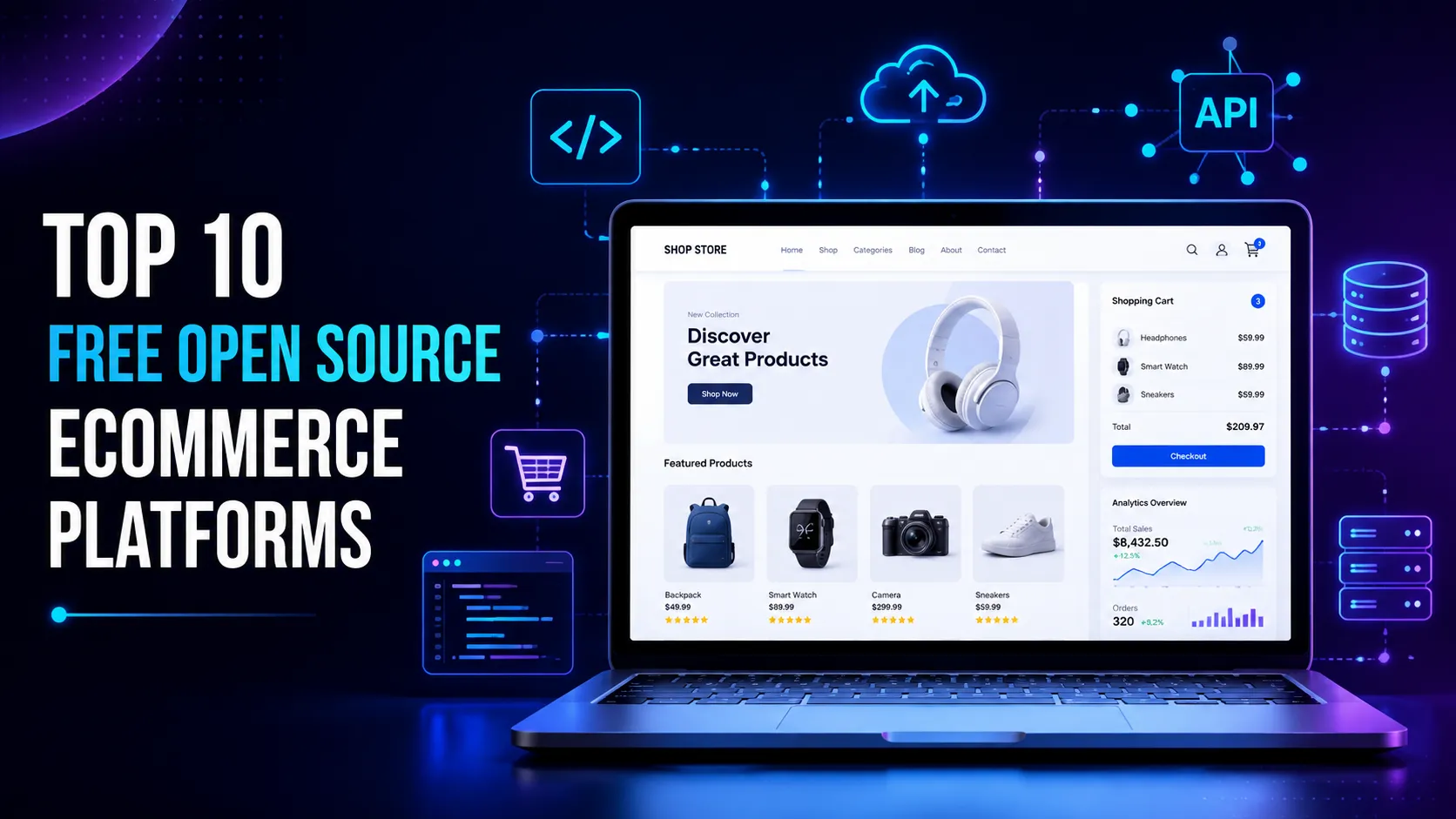
Launching an online store doesn’t always require paying expensive monthly subscription fees. If you’re looking for complete control over your website, customer data, and features, an open source ecommerce platform can be the ideal solution. The best option for most small and medium-sized businesses is WooCommerce, thanks to its ease of use and WordPress integration.
However, platforms like Magento Open Source, PrestaShop, OpenCart, and Shopware are also excellent choices depending on your business size, technical expertise, and long-term goals.
This guide compares the top open source ecommerce platforms available in 2026, highlighting their features, strengths, limitations, pricing, and the type of business each platform is best suited for. By the end, you’ll have a clear understanding of which free open source ecommerce platform aligns with your needs.
Why Businesses Are Choosing Open Source eCommerce Platforms
Choosing an ecommerce platform is one of the most important decisions you’ll make when starting or expanding an online business. While hosted platforms like Shopify make it easy to launch quickly, many businesses eventually outgrow their limitations. Subscription fees, restricted customization, and limited access to backend functionality often become challenges as the business scales.
That’s where an open source ecommerce platform stands out.
Open source software gives you access to the platform’s source code, allowing you to customize every aspect of your online store. Instead of relying on a single vendor for updates, features, or integrations, you have the freedom to modify the platform according to your business requirements.
Another major advantage is ownership. With a self-hosted ecommerce platform, you retain complete control over your customer data, website files, and hosting environment. This flexibility is particularly valuable for businesses with unique workflows, advanced product catalogs, or custom integrations.
While you’ll still need to pay for hosting, domain registration, and optional premium extensions, the core software is generally free to download and use. This makes many free open source ecommerce platforms a cost-effective option for businesses that want long-term flexibility.
Open Source vs Hosted eCommerce Platforms
Before comparing the platforms themselves, it’s helpful to understand how open source ecommerce differs from hosted ecommerce software.
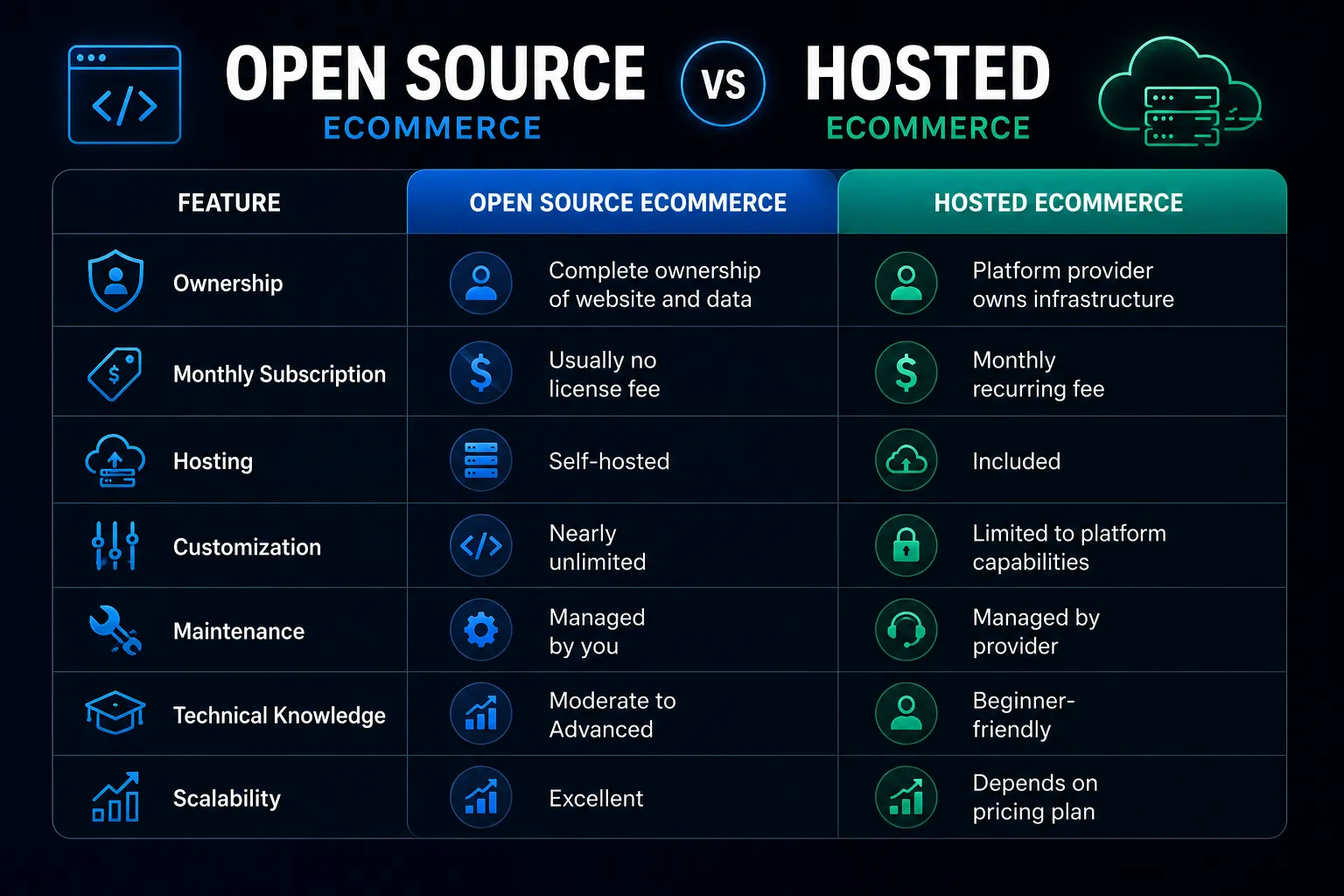
| Feature | Open Source eCommerce | Hosted eCommerce |
| Ownership | Complete ownership of website and data | Platform provider owns infrastructure |
| Monthly Subscription | Usually no license fee | Monthly recurring fee |
| Hosting | Self-hosted | Included |
| Customization | Nearly unlimited | Limited to platform capabilities |
| Maintenance | Managed by you | Managed by provider |
| Technical Knowledge | Moderate to Advanced | Beginner-friendly |
| Scalability | Excellent | Depends on pricing plan |
Hosted platforms are often ideal for beginners who want to launch quickly without worrying about maintenance. On the other hand, businesses planning for long-term growth, complex functionality, or extensive customization often benefit more from an open source approach.
How We Selected These Open Source eCommerce Platforms
Not every ecommerce software deserves a place on this list. To make this guide genuinely useful, we evaluated each platform based on practical factors that matter to business owners, not just developers.
Our evaluation considered:
- Ease of installation and setup
- Customization capabilities
- Extension and plugin ecosystem
- Performance and scalability
- Community support and documentation
- SEO features
- Security and update frequency
- Integration options
- Suitability for different business sizes
- Long-term maintenance requirements
Rather than focusing solely on popularity, we also considered how well each platform performs for startups, small businesses, growing brands, and enterprise organizations.
Top 10 Free and Open Source eCommerce Platforms
1. WooCommerce
If you’re searching for the best ecommerce platform for small business, WooCommerce will likely appear at the top of nearly every recommendation, and for good reason.
WooCommerce is an open source plugin built specifically for WordPress, transforming a standard website into a fully functional online store. Since WordPress already powers a significant portion of websites worldwide, WooCommerce has grown into one of the most widely adopted ecommerce solutions available.
One of WooCommerce’s biggest advantages is its flexibility. Whether you’re selling physical products, digital downloads, subscriptions, memberships, or services, the platform can be customized using thousands of plugins, themes, and integrations.
This flexibility has also fueled a large ecosystem of WooCommerce development services, making it easier for businesses to build custom features, optimize store performance, integrate third-party tools, and create unique shopping experiences tailored to their requirements.
Another reason businesses choose WooCommerce is its SEO potential. Because it’s built on WordPress, users can leverage powerful SEO plugins, create optimized blog content, and structure product pages to improve search visibility. Also
Is WooCommerce Free?
Yes. The WooCommerce plugin itself is completely free to download and install. However, running a professional online store usually involves additional costs, including:
- Web hosting
- Domain registration
- SSL certificate
- Premium themes
- Paid plugins
- Payment gateway transaction fees
The good news is that you only pay for the features you actually need, making WooCommerce one of the most affordable free ecommerce platforms available.
Key Features
- WordPress integration
- Unlimited products
- Product variations
- Inventory management
- Built-in coupon system
- Multiple payment gateways
- Shipping management
- Thousands of extensions
- Large developer community
Pros
- Beginner-friendly
- Excellent SEO capabilities
- Massive plugin ecosystem
- Highly customizable
- Large support community
- Cost-effective for growing businesses
Cons
- Performance depends heavily on hosting quality
- Plugin conflicts may occur
- Large stores require optimization and caching
Ideal For: Small businesses, content-driven brands, bloggers, agencies, and entrepreneurs looking for a scalable yet affordable ecommerce solution.
2. Magento Open Source
Magento Open Source is one of the most powerful and feature-rich ecommerce platforms available. Designed for businesses with complex product catalogs and advanced operational requirements, it provides almost unlimited flexibility for developers.
Unlike simpler platforms, Magento is built to handle extensive inventories, multiple storefronts, advanced pricing rules, customer segmentation, and custom workflows. This makes it a preferred choice for large retailers and B2B organizations.
The platform also offers a robust API framework, allowing seamless integration with ERP systems, CRM software, payment providers, inventory management tools, and marketing platforms. However, Magento’s power comes with a learning curve. Installation, customization, and ongoing maintenance generally require experienced developers, making it less suitable for beginners.
Key Features
- Multi-store management
- Advanced catalog management
- Powerful API support
- Customer segmentation
- Flexible pricing rules
- Enterprise-grade scalability
- Extensive customization
Pros
- Highly scalable
- Excellent for large product catalogs
- Strong developer ecosystem
- Advanced customization capabilities
- Suitable for complex business models
Cons
- Steeper learning curve
- Higher hosting requirements
- Professional development is often necessary
Ideal For: Large ecommerce businesses, manufacturers, wholesalers, B2B companies, and brands planning significant growth.
3. PrestaShop
PrestaShop has been a trusted name in the ecommerce industry for many years and continues to be one of the most popular free open source ecommerce platforms. It strikes a balance between ease of use and advanced functionality, making it suitable for businesses that have outgrown simpler website builders but don’t require the complexity of Magento.
One of PrestaShop’s standout strengths is its support for multilingual and multi-currency stores. Businesses targeting customers across different countries can easily localize product catalogs, pricing, and checkout experiences without relying on extensive custom development.
The platform also includes a well-organized admin dashboard that allows merchants to manage products, orders, customers, discounts, taxes, and shipping options from a single interface.
Is PrestaShop Free?
Yes. The core PrestaShop software is free to download and use. However, like many open source solutions, businesses often purchase premium themes, modules, and integrations to extend functionality or simplify specific workflows.
Key Features
- Multi-language support
- Multi-currency support
- SEO-friendly URLs
- Product management
- Marketing tools
- Analytics dashboard
- Extensive module marketplace
Pros
- User-friendly administration panel
- Strong international selling capabilities
- Good balance between simplicity and flexibility
- Active developer community
Cons
- Premium modules can increase overall costs
- Some advanced customizations require technical expertise
Ideal For: Growing retailers, international businesses, wholesalers, and merchants looking for a feature-rich platform without the complexity of enterprise software.
4. OpenCart
If simplicity is your top priority, OpenCart is one of the easiest open source ecommerce platforms to get started with. Despite its lightweight architecture, it includes many essential ecommerce features right out of the box, making it a practical option for entrepreneurs launching their first online store.
Unlike some platforms that rely heavily on extensions for basic functionality, OpenCart provides built-in support for product management, multiple payment gateways, shipping methods, and order processing. Its straightforward admin dashboard makes everyday store management relatively easy, even for users with limited technical experience.
OpenCart also offers a large marketplace of extensions and themes, allowing businesses to expand functionality as their needs evolve. While it may not offer the same level of enterprise scalability as Magento, it remains an excellent choice for small to medium-sized stores that value simplicity and speed.
Key Features
- Unlimited categories and products
- Multiple payment gateways
- Built-in order management
- Multi-store support
- Customer groups
- Product reviews and ratings
- Extension marketplace
- Multi-language and multi-currency support
Pros
- Easy to install and configure
- Lightweight and fast
- Beginner-friendly admin dashboard
- Low hosting requirements
- Large extension marketplace
Cons
- Limited built-in marketing features
- Advanced customizations often require developer support
- Smaller community compared to WooCommerce
Ideal For: Small businesses, startups, and entrepreneurs launching their first ecommerce website.
5. Shopware Community Edition
Shopware has gained significant popularity among merchants looking for a scalable and flexible ecommerce platform. Built with an API-first approach, it supports both traditional online stores and modern headless commerce experiences.
One of Shopware’s standout features is its “Shopping Experiences” builder, which enables merchants to create visually engaging landing pages and product presentations without extensive coding. This makes it easier to deliver a more personalized customer experience while maintaining flexibility for future growth.
Shopware also integrates well with various sales channels, making it suitable for businesses selling across marketplaces, social commerce platforms, and physical stores.
Key Features
- API-first architecture
- Headless commerce support
- Visual content builder
- Multi-channel selling
- Product stream management
- Rule-based automation
- Responsive storefront
Pros
- Modern technology stack
- Excellent user experience
- Flexible customization
- Strong scalability
Cons
- Smaller plugin ecosystem than WooCommerce
- Some advanced business features are available only in commercial editions
Ideal For: Mid-sized businesses, growing brands, and retailers planning omnichannel expansion.
6. Drupal Commerce
Drupal Commerce is built specifically for businesses that rely heavily on content marketing alongside ecommerce. Since it’s integrated with Drupal CMS, it allows organizations to manage blogs, documentation, communities, and online stores from a single platform.
Its modular architecture makes it highly flexible for developers, while advanced user permissions and multilingual capabilities support organizations with complex publishing workflows. Although Drupal Commerce requires more technical expertise than WooCommerce or OpenCart, it’s an excellent option for organizations that prioritize content and customer engagement.
Key Features
- Deep Drupal CMS integration
- Flexible product architecture
- Advanced content management
- Multilingual support
- Powerful user permissions
- Extensive API support
Pros
- Excellent for SEO and content marketing
- Highly customizable
- Strong security
- Suitable for complex websites
Cons
- Steeper learning curve
- Requires Drupal knowledge
- Smaller extension ecosystem
Ideal For: Publishers, educational institutions, nonprofits, and businesses with content-driven marketing strategies.
7. Bagisto
Bagisto is one of the newer entrants among free open source ecommerce software, but it has gained attention thanks to its modern Laravel foundation. Developers who already work within the Laravel ecosystem often find Bagisto easier to customize than older ecommerce platforms.
Its clean architecture supports multi-vendor marketplaces, inventory management, and API integrations while maintaining a user-friendly admin panel. As the platform continues to mature, its community and extension ecosystem are also expanding.
Key Features
- Laravel framework
- Multi-vendor support
- Multi-warehouse inventory
- Customer groups
- REST APIs
- Role-based access control
Pros
- Modern codebase
- Developer-friendly
- Clean interface
- Flexible architecture
Cons
- Smaller marketplace for extensions
- Community is still growing
Ideal For: Laravel developers, startups, and businesses building custom ecommerce solutions.
8. Sylius
Sylius is designed for businesses that need complete flexibility rather than an extensive collection of pre-built features. Built on the Symfony framework, it follows a modular approach that allows developers to create tailored ecommerce experiences.
Instead of forcing businesses into predefined workflows, Sylius makes it easier to build custom product types, checkout processes, promotions, and integrations. This flexibility has made it a preferred choice for organizations with unique operational requirements.
Key Features
- Symfony framework
- API-first design
- Modular architecture
- Flexible catalog management
- Custom checkout workflows
- Enterprise integrations
Pros
- Extremely customizable
- Scalable architecture
- Clean developer experience
- Strong API capabilities
Cons
- Requires experienced developers
- Not suitable for beginners
Ideal For: Enterprise businesses and organizations requiring highly customized ecommerce functionality.
9. nopCommerce
nopCommerce is an open source ecommerce platform built on Microsoft’s ASP.NET framework. It offers a wide range of enterprise features while remaining completely free to download. Businesses already using Microsoft technologies often choose nopCommerce because it integrates naturally with existing .NET applications and development workflows.
Key Features
- ASP.NET architecture
- Multi-store support
- Multi-vendor marketplace
- Inventory management
- SEO tools
- Responsive themes
- Extensive plugin support
Pros
- Strong performance
- Enterprise-ready features
- Active community
- Excellent Microsoft ecosystem support
Cons
- Best suited for Windows-based development
- Smaller community than WooCommerce
Ideal For: Microsoft-focused organizations, B2B companies, and enterprise retailers.
10. Solidus
Solidus is a mature ecommerce framework that evolved from Spree Commerce. Rather than targeting beginners, it focuses on developers building highly customized ecommerce applications. Its modular design allows businesses to create unique storefronts while integrating with modern APIs, subscription services, and custom checkout experiences.
Key Features
- Ruby on Rails framework
- Modular architecture
- Flexible checkout
- API support
- Subscription commerce
- Advanced order management
Pros
- Highly flexible
- Excellent developer experience
- Scalable architecture
- Strong customization capabilities
Cons
- Requires Rails expertise
- Limited beginner resources
Ideal For: Development agencies, SaaS businesses, and custom ecommerce projects.
eCommerce Platform Comparison (2026)
| Platform | Best For | Self Hosted | Free Core Version | Scalability |
| WooCommerce | Small businesses | Yes | Yes | High |
| Magento Open Source | Enterprise | Yes | Yes | Excellent |
| PrestaShop | SMBs | Yes | Yes | High |
| OpenCart | Beginners | Yes | Yes | Medium |
| Shopware | Growing brands | Yes | Yes | Excellent |
| Drupal Commerce | Content-heavy websites | Yes | Yes | High |
| Bagisto | Laravel projects | Yes | Yes | High |
| Sylius | Enterprise customization | Yes | Yes | Excellent |
| nopCommerce | .NET businesses | Yes | Yes | High |
| Solidus | Rails developers | Yes | Yes | High |
How to Choose the Best Open Source eCommerce Platform
With so many options available, choosing the right platform depends on your business goals, technical expertise, and future growth plans. Instead of selecting the platform with the most features, focus on the one that aligns with your current requirements while leaving room to scale.
Choose WooCommerce if:
- You already have a WordPress website.
- You want an affordable solution with excellent SEO capabilities.
- You plan to publish blogs alongside your online store.
- You prefer a large ecosystem of plugins and themes.
Choose Magento Open Source if:
- You manage a large inventory.
- You require advanced pricing, customer segmentation, or multiple storefronts.
- You have access to experienced developers.
Choose PrestaShop if:
- You sell internationally.
- You need multilingual and multi-currency support.
- You want a balance between ease of use and flexibility.
Choose OpenCart if:
- You’re launching your first ecommerce website.
- You need a lightweight platform that’s easy to maintain.
Choose Shopware, Sylius, Bagisto, nopCommerce, or Solidus if:
Your business requires modern development frameworks, advanced APIs, or highly customized workflows that go beyond the capabilities of traditional ecommerce platforms.
Common Mistakes When Choosing an Open Source eCommerce Platform
Many businesses focus only on whether the software is free, overlooking the total cost of ownership.
Some of the most common mistakes include:
- Underestimating hosting and maintenance costs.
- Ignoring future scalability requirements.
- Choosing a platform that’s too complex for your team’s technical skills.
- Overlooking extension or plugin costs.
- Failing to prioritize website speed and security.
- Not planning for regular software updates and backups.
Considering these factors early can help you avoid expensive migrations later.
Conclusion
An open source ecommerce platform gives businesses complete control over their online store, making it an excellent choice for merchants who value flexibility, customization, and ownership. While every platform on this list has its strengths, there isn’t a one-size-fits-all solution.
If you’re starting a new online business or already use WordPress, WooCommerce offers the best balance of affordability, usability, and scalability. Businesses managing large product catalogs or complex B2B operations should consider Magento Open Source, while PrestaShop and OpenCart provide reliable alternatives for small and medium-sized retailers.
Developer-focused platforms such as Shopware, Sylius, Bagisto, nopCommerce, and Solidus are ideal for organizations building tailored ecommerce experiences. Before making your final decision, define your business goals, estimate your long-term maintenance budget, and test a few platforms in a staging environment.
Choosing the right platform today can make future growth much easier while helping you avoid costly migrations down the road.
Tags
Categories
Recent Posts
Popular Posts
- How to Choose a Reliable Offshore Development Partner?
- Transforming Web Development with HTMX’s Declarative Approach for Dynamic UIs
- Top 15 Ecommerce Growth Strategies to Maximize Sales in 2026
- What is B2B Web Design? Benefits, Best Practices, and Examples
- Why Your Conversion Funnel Needs a Composable Commerce Solution?