As an ecommerce business grows, they tend to manage more than a single sales channel and have more complex scenarios to deal with. These generally include managing huge volumes of orders and the entire chart of inventory management, accounting, and much more. This does lead to the need for higher coordination among teams and smarter task management.
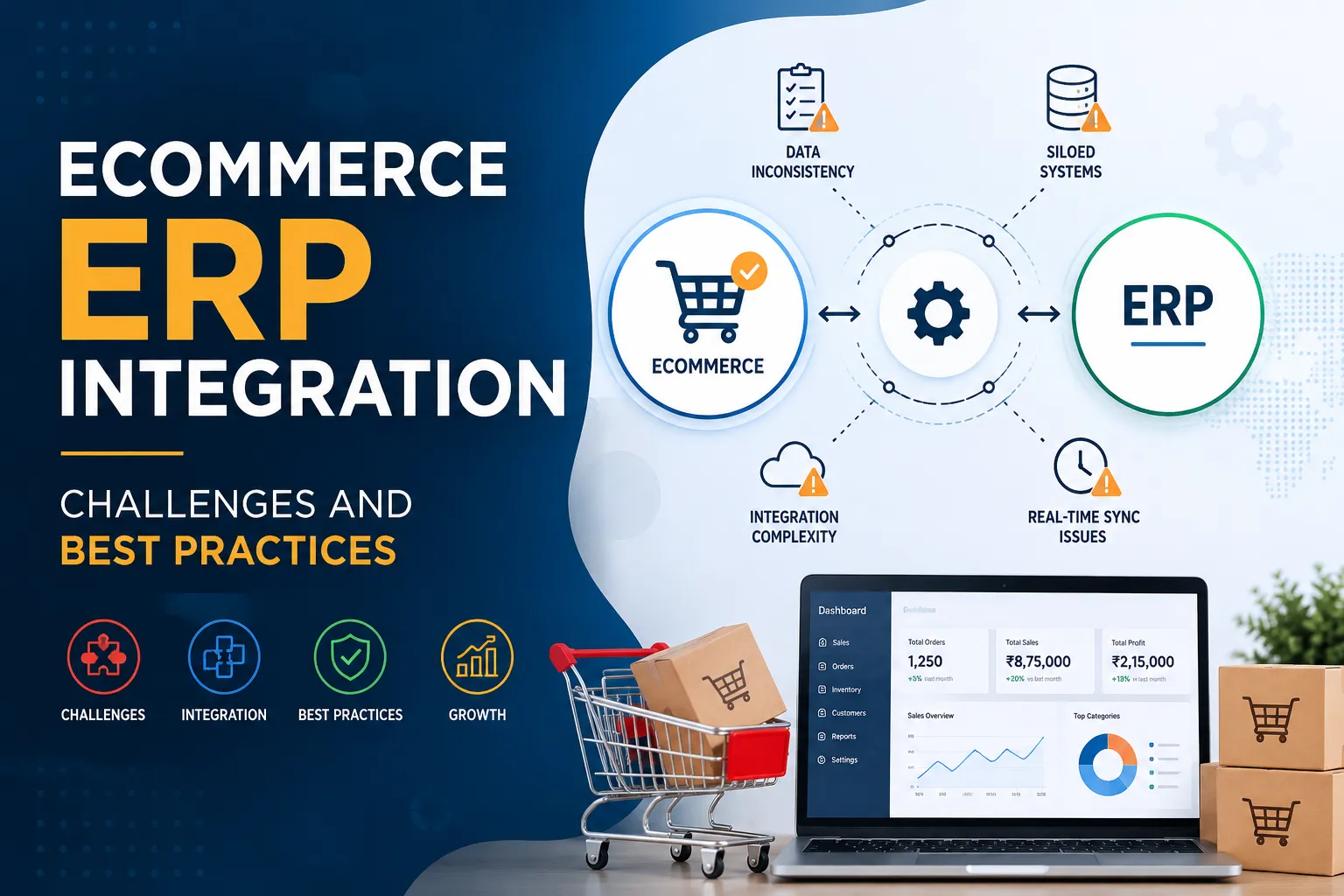
This is where ecommerce ERP integration offers a solution. Mainly, this integration allows more connected ecommerce workflows and a better-managed operational environment. What’s more, this helps ERP platforms provide real-time updates across systems, including pricing, logistics, and more. This also allows easier management of higher sales and customer expectations.
However, working on this process is rarely straightforward. It actually requires dealing with legacy structure challenges like unstructured data, dependencies, and workflows. So, to help leaders deal with this more cautiously, this guide shares the steps, challenges, and best practices for ecommerce ERP integration. Overall, this knowledge will help businesses build more scalable and connected ecommerce operations in 2026.
Why ERP for Ecommerce Matters?
Simply speaking, ERP integration is the transformation that powers the ecommerce platform with higher end-to-end connectivity and visibility. Herein, the digital platform is carefully integrated with an Enterprise Resource Planning (ERP) system to achieve seamless data flows and task accomplishment.
What’s more, ERP integration is trusted by teams as it helps them plan inventory management, order processing, accounting, logistics, and even customer operation roles. In practice, this dynamic integration allows the system to be updated as soon as the customer places an order online, and this is in terms of the following aspects:
- Updating present inventory levels and fulfillment needs
- Accordingly, future orders can be processed,
- An invoice can be generated,
- Logistics can be planned for the scheduled orders.
Apart from these aspects, shipping is also coordinated along with managing customer queries. Furthermore, this helps teams in reflecting the necessary financial data across the organization.
So, this integration is the best solution that can help enterprises and emerging ecommerce businesses in avoiding unnecessary delays in order fulfillment while seamlessly managing system inconsistencies. This also means easier and automated management of multiple sales channels and warehouses, all while reducing the challenge of data silos.
Well, this powerful integration depends on the following aspects for its implementation:
- APIs,
- Key middleware platforms,
- Some custom connectors, and
- Native integrations provided by ERP and ecommerce vendors.
So, trusting ERP ecommerce integrations and planning them well can help teams reduce the complexity of their ecommerce ecosystem while allowing more scalability for enterprises.
ERP Ecommerce Integration: Detailed Steps
The next main step in this research work is understanding how teams can effectively connect their ecommerce platform with the ERP system. Overall, understanding these steps can practically help teams in managing this transition in real time.
That being said, here are the steps for this process:
1. Evaluation of Existing Workflows
Before the integration begins, your business needs to assess aspects such as:
- What are some of your platform’s limitations and dependencies?
- What are its key existing workflow issues, and
- In terms of API compatibility, what is the current system’s status?
Overall, this analysis helps teams understand the key issues and fragmented workflows. And this forms the basis for the next step, which is planning where changes can be made.
2. Understanding Key, High-Impact Workflows
Proceeding further, the next stage involves leaders brainstorming and figuring out how the friction areas can be improved. These usually routine processes include:
- Inventory management,
- Order processing,
- Fulfillment coordination,
- Customer management, and
- Financial reporting.
Mainly, a key recommendation here is that they should start with a few key processes that need immediate change. Starting small can help them assess issues quickly, while promising better output and efficiency.
3. Standardizing Data Across Platforms
Planning the next stage of the phased ERP integration move, leaders should understand the different data structures in the workflows. Only then can they actually plan on standardizing them to allow a seamless flow of information in their framework.
Mainly, this involves standardizing elements like:
- SKUs,
- Inventory data,
- Pricing structures, and
- Customer data
Indeed, this allows companies to achieve outcomes like better data synchronization, thereby making their workflows more reliable.
4. Selecting the Right Integration Architecture
Moving forward, companies should plan and choose the right integration architecture that can help ensure higher scalability and performance. That being said, teams generally tend to choose among these choices:
- Native integrations,
- Middleware platforms,
- Custom APIs, and
- Hybrid architectures.
While making a choice, companies should also consider the impact on operational complexity and flexibility.
5. Implementing Automation Around Core Workflows
While we ensure that the data is structured and systems can be connected, teams should now make financial decisions around automating routine tasks like:
- Inventory updates,
- Invoice generation,
- Shipping and logistics, and
- Sharing order status on the app in real-time.
For teams, this reduces the chance of human errors that might happen and improves the overall consistency and efficiency of teams across departments.
6. Testing and Monitoring Integration Workflows Continuously
Finally, ERP ecommerce integrations need to be tested in terms of certain aspects before initial deployment. These mainly include the following:
- Checking overall data flows in the system, including their synchronization,
- Assessing the impact on workflows and their accuracy, and
- Ensuring that the overall API’s impact aligns with the company’s expectations.
That being said, all these aspects can change how your ecommerce platform performs. For teams, they can expect outcomes like: better real-time data sync across systems, improved customer experience, higher visibility, and improved efficiency, which is all measurable in real-time.
Common Challenges and Their Solutions in Ecommerce ERP Integration
As teams plan their ERP integration process, they may face certain challenges in the roadmap. In many cases, these may be linked to dependencies in their systems or their workflows. However, they can be more complicated as well, where the business may need to work with experts to sort them out.
That being said, here are some of the key challenges and their solutions that can help teams plan their process more seamlessly.
1. Disconnected Data Across Systems
The first challenge among them is having inconsistent data between the ecommerce platform and ERP system (that need to be linked together). In this case, an ecommerce company needs to check its inventory data, customer information, and pricing structure to sync their formats properly.
Solution:
A simple solution to this problem is that the business needs to standardize its operational data early in the process. This can be done by establishing centralized data governance before implementing and scaling the integrations that they are planning for.
2. Legacy ERP Limitations
Well, older ERP systems often face challenges while integrating with modern ERP systems. Both their architectures need to be aligned so that data can be synced in real time and APIs can be put into effect to improve the workflows.
Solution:
Technically, teams can use middleware platforms and even API-first integration layers to allow teams to overcome this legacy challenge. In the present day, it is actually necessary to plan this integration correctly.
3. Smartly Managing Workflow Disruptions During Integration
Simply put, this challenge comes in terms of implementation, where ERP changes can temporarily affect fulfillment operations, reporting, and even inventory updates. This usually happens when too much is put in place at once.
Solution:
Well, this challenge can be solved by managing the entire flow of integration in a phased manner. This can practically help teams stress out about fewer changes while maintaining higher visibility and validating the workflows across systems.
4. Scalability and Performance Bottlenecks
There is another key challenge that is faced by teams working on ERP integration, i.e., managing a higher volume of transactions. Herein, poorly managed workflows can be slow, thereby causing friction in processes.
Solution:
Practically, teams can build their workflows around integration using automation, while keeping scalability in their plans from day one. This is especially helpful later when your ecommerce operations expand, and better coordination is needed.
Overall, managing these challenges in a timely manner can help ensure the smooth flow of operations, while ensuring higher efficiency in the long run.
Best Practices for Managing ERP Implementation Challenges
There are certain practices that leaders need to follow to ensure successful ERP ecommerce integrations. Key practices among them are highlighted in the section below:
1. Prioritize Workflow Visibility Even Before the Change is Made
Before you plan to automate your functions in terms of ecommerce integration with ERP, there must be clear visibility into how systems, teams, and processes will change after their implementation.
2. Focusing on High-Impact Integrations is a Must
Before teams try to automate the workflows, there must be incredible planning that backs this change. This mainly includes highlighting key integrations and highly impactful workflows.
3. Planning the Changes Around Scalability and Future Goals
This practice makes all the difference in your output. Herein, it is necessary to understand that ecommerce environments evolve quickly over time, and planning for integrations must always cater to the company’s scalability and future goals.
4. Continuously Monitor Integration Health
Finally, it is necessary to make these changes and monitor them to ensure success. This helps businesses detect and rectify issues on time while managing workflow inconsistencies before they affect operations in real-time.
Future of ERP Integration in Ecommerce
As we compile our research into a guide, it is necessary to share the future scope of ERP integrations for the ecommerce companies. That being said, it can open doors of opportunity for enterprises to move towards agile, more connected workflows.
Moving beyond basic functions, it supports the following aspects:
- AI-driven operations,
- Better decision-making based on real-time data,
- Automated workflow management,
- Managing composable commerce architectures, and
- Cloud-native scalable ERP ecosystems.
Additionally, it also helps improve visibility in the enterprise ecommerce platforms by aligning sales channels, warehouses, and customer service. This is why ERP integration has a high potential to add to an ecommerce company’s growth graph in the long run.
Final Thoughts
Ultimately, ERP integration is a logical investment that can add to an enterprise’s e-commerce solution growth in the future. Here, this planning must be kept aligned with the company’s long-term goals and key workflows (to allow a phased approach). What’s more, real value comes from integrating ERP changes that seem stable, reliable, and less complex. Overall, this will help teams create a connected operational environment that supports their long-term ecommerce performance, visibility, and growth.
Tags
Categories
Recent Posts
Popular Posts
- How to Choose a Reliable Offshore Development Partner?
- Transforming Web Development with HTMX’s Declarative Approach for Dynamic UIs
- Top 15 Ecommerce Growth Strategies to Maximize Sales in 2026
- What is B2B Web Design? Benefits, Best Practices, and Examples
- Why Your Conversion Funnel Needs a Composable Commerce Solution?