- What Is Blazor?
- What Is React?
- Blazor vs React: Core Differences
- Blazor vs React Performance
- Blazor vs React Speed
- React Pros and Cons
- Blazor Pros and Cons
- Blazor Use Cases
- React Use Cases
- React vs Blazor for Enterprise
- Flask vs React: Understanding the Difference
- What Are the Advantages of Blazor?
- Why Use Blazor Over React?
- Blazor vs React: Which Is Better?
- Final Thoughts
Modern web development continues to evolve rapidly, and selecting the right frontend technology is more important than ever. Businesses want fast, scalable, and maintainable applications, while developers seek frameworks that improve productivity without sacrificing performance.
Among the many frontend technologies available today, Blazor and React remain two of the most discussed options. Although both can be used to build modern, interactive web applications, they differ significantly in architecture, programming language, ecosystem, and ideal use cases.
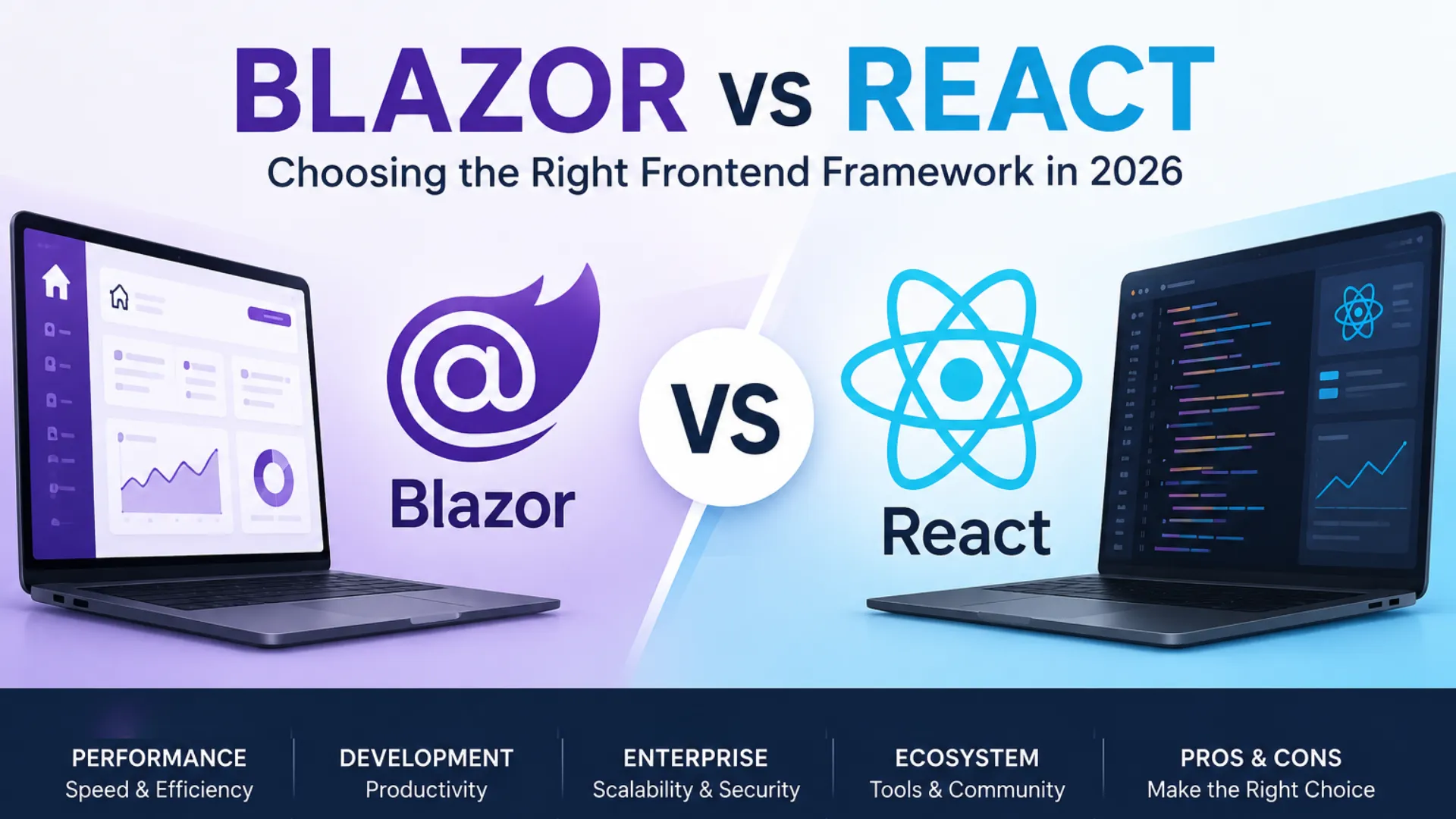
If you’re comparing Blazor vs React, this guide explains how each framework works, their strengths and limitations, and which one may be the better choice in 2026 depending on your project requirements.
What Is Blazor?
Before comparing the two technologies, it’s important to understand what is Blazor and why it has become increasingly popular among Microsoft developers. The Blazor framework is Microsoft’s modern web UI framework that enables developers to build interactive web applications using C# instead of JavaScript.
Built on ASP.NET Core, Blazor allows developers to share code between the frontend and backend, reducing duplication and improving maintainability.
Blazor offers two primary hosting models:
- Blazor Server
- Blazor WebAssembly (WASM)
Blazor Server processes application logic on the server while maintaining a real-time connection with the browser. Blazor WebAssembly runs directly inside the browser, allowing applications to execute C# code client-side without requiring JavaScript for most application logic.
As Microsoft’s ecosystem continues to expand with .NET 9 and cloud-native development, Blazor has become an attractive option for organizations already invested in the .NET stack.
What Is React?
To fairly compare Blazor vs React, it’s equally important to understand what is React.
React is an open-source JavaScript library developed by Meta for building user interfaces. Rather than being a complete framework, React focuses specifically on creating reusable UI components while allowing developers to choose additional libraries for routing, state management, authentication, and data fetching.
Today, the React frontend framework powers thousands of enterprise applications ranging from startups to global technology companies.
Its popularity stems from several advantages:
- Huge developer community
- Massive package ecosystem
- Flexible architecture
- Excellent tooling
- Strong support for mobile development through React Native
Because of its maturity, React often becomes the default choice for teams building modern web applications.
Blazor vs React: Core Differences
Although both technologies create dynamic web applications, they approach frontend development differently.
| Feature | Blazor | React |
| Language | C# | JavaScript/TypeScript |
| Developed by | Microsoft | Meta |
| Rendering | Server or WebAssembly | Client-side Virtual DOM |
| Ecosystem | .NET | JavaScript |
| Learning Curve | Easier for .NET developers | Easier for JavaScript developers |
| Community | Growing | Extremely large |
The biggest distinction is language choice. Blazor enables full-stack C# development, while React relies on JavaScript or TypeScript for frontend implementation. This difference alone often determines which technology fits an organization’s existing expertise.
Blazor vs React Performance
One of the most searched comparisons is Blazor vs React performance because application speed directly impacts user experience and business outcomes. React is known for its efficient rendering model using the Virtual DOM. Instead of updating the entire page, React only modifies components that actually change, helping applications remain responsive even as complexity grows.
Blazor performance varies depending on its hosting model.
Blazor Server benefits from smaller downloads but depends heavily on network latency because UI interactions travel between the browser and server. Blazor WebAssembly eliminates constant server communication but requires downloading the .NET runtime before the application starts, which may increase initial load times.
From a pure frontend rendering perspective:
- React generally offers faster initial page loads.
- Blazor performs well after startup, particularly for enterprise applications running within Microsoft’s ecosystem.
- Server-side Blazor can outperform client-side applications in certain controlled environments but requires reliable network connectivity.
Ultimately, React performance remains more predictable for public-facing websites with high traffic, whereas Blazor excels in internal business applications where integration with existing .NET systems matters more than initial page speed.
Blazor vs React Speed
Although closely related to performance, Blazor vs React speed often refers to developer productivity as much as application responsiveness. React allows rapid development thanks to its mature tooling, extensive documentation, and enormous ecosystem.
Blazor improves development speed for organizations already using C#. Developers can write both frontend and backend code in the same language, reducing context switching and enabling greater code reuse.
Development speed depends largely on your team’s expertise.
A JavaScript team will typically build faster with React, while a .NET team may achieve higher productivity using Blazor.
React Pros and Cons
Understanding the React pros and cons helps clarify why it remains one of the world’s most popular frontend technologies.
Pros
- Large developer community
- Extensive third-party ecosystem
- Excellent performance
- Cross-platform development with React Native
- Strong long-term support
Cons
- Requires additional libraries for complete applications
- Fast-changing ecosystem
- JavaScript complexity can increase in larger projects
- State management introduces additional learning requirements
Blazor Pros and Cons
Like any frontend technology, Blazor has strengths and limitations. Understanding these trade-offs will help you determine whether it aligns with your project’s technical and business requirements.
Pros
- Uses C# for both frontend and backend development
- Integrates seamlessly with the .NET ecosystem
- Enables code sharing between client and server
- Strong support from Microsoft with regular updates
- Excellent choice for enterprise applications already using ASP.NET Core
- Reduces the need for extensive JavaScript in many scenarios
Cons
- Smaller community compared to React
- Limited third-party component ecosystem
- Blazor WebAssembly applications can have larger initial downloads
- Fewer experienced Blazor developers are available in the job market
- Some JavaScript interoperability is still required for browser-specific features
Organizations already invested in Microsoft’s technology stack often find that the benefits outweigh these limitations, especially for line-of-business applications.
Blazor Use Cases
While Blazor is capable of building a wide variety of applications, it performs particularly well in environments where .NET technologies are already in use.
Some common Blazor use cases include:
- Enterprise business portals
- Customer relationship management (CRM) systems
- Internal dashboards
- Financial and healthcare applications
- Manufacturing and inventory management software
- Government and public sector applications
- Secure employee self-service portals
Because developers can reuse backend models, validation rules, and business logic, Blazor helps reduce development effort for organizations that primarily use Microsoft technologies.
React Use Cases
React remains one of the most versatile frontend technologies available today. Its flexibility and mature ecosystem make it suitable for projects ranging from small startups to global enterprise platforms.
Popular React use cases include:
- Single-page applications (SPAs)
- SaaS platforms
- E-commerce websites
- Customer-facing portals
- Social networking platforms
- Content management systems
- Progressive Web Apps (PWAs)
- Mobile applications through React Native
Its extensive ecosystem also makes React an excellent choice when projects require advanced UI libraries, animations, data visualization, or third-party integrations.
React vs Blazor for Enterprise
A common question among decision-makers is React vs Blazor for enterprise applications. The answer depends less on which framework is objectively superior and more on the organization’s existing technology ecosystem.
Blazor is often the stronger option for enterprises that:
- Already use ASP.NET Core
- Have experienced C# developers
- Want to share business logic between frontend and backend
- Prioritize long-term maintainability within the Microsoft ecosystem
- Require strong integration with Azure services
React, on the other hand, is typically preferred by organizations that:
- Have established JavaScript or TypeScript teams
- Need highly interactive customer-facing applications
- Require maximum flexibility
- Depend on a wide variety of third-party libraries
- Expect rapid UI iteration across multiple platforms
Large enterprises frequently use both technologies for different products depending on business goals rather than standardizing on a single frontend framework.
Flask vs React: Understanding the Difference
While researching frontend technologies, developers sometimes compare Flask vs React, although the two technologies serve different purposes. Flask is a lightweight Python web framework designed primarily for backend development. It handles server-side logic, APIs, authentication, and database interactions.
React, by contrast, focuses exclusively on building user interfaces in the browser. Rather than choosing one over the other, many modern applications use Flask as the backend and React as the frontend. This combination allows developers to leverage Python for server-side functionality while creating responsive, component-based user experiences with React.
What Are the Advantages of Blazor?
If you’re evaluating what are the advantages of Blazor, several features make it particularly attractive for .NET development teams.
Some of its key advantages include:
- A single programming language (C#) across the entire application stack
- Shared models, validation logic, and business rules
- Simplified maintenance with less duplicated code
- Tight integration with ASP.NET Core
- Strong security features inherited from the .NET platform
- Long-term support from Microsoft
- Improved developer productivity for existing .NET teams
These advantages become especially valuable when maintaining large enterprise applications over multiple years.
Why Use Blazor Over React?
Many organizations ask why use Blazor over React when React has such widespread adoption.
Blazor may be the better choice if your organization:
- Already has experienced .NET developers
- Wants to minimize JavaScript development
- Builds primarily internal business applications
- Uses Microsoft Azure extensively
- Requires seamless integration with existing ASP.NET Core services
- Values code reuse between frontend and backend
However, this doesn’t mean Blazor is universally better. Teams with deep JavaScript expertise or projects requiring a large ecosystem of frontend libraries often achieve better results with React. Organizations that already rely on JavaScript development services can also benefit from React’s mature ecosystem, extensive tooling, and large talent pool. Ultimately, the right framework depends on your team’s skills, project goals, existing technology stack, and long-term maintenance strategy.
Blazor vs React: Which Is Better?
One of the most frequently searched questions is Blazor vs React which is better. There isn’t a universal winner because each framework excels in different scenarios.
Choose Blazor if:
- Your organization primarily uses Microsoft technologies.
- Your developers are proficient in C#.
- You want to share code across frontend and backend.
- You’re building enterprise or internal business applications.
Choose React if:
- You need a mature and highly flexible frontend ecosystem.
- Your team already works with JavaScript or TypeScript.
- You’re building customer-facing applications with complex user interfaces.
- Fast initial load times and broad community support are priorities.
Ultimately, selecting the right framework involves balancing technical capabilities with your team’s expertise, project timeline, scalability requirements, and future maintenance needs.
Final Thoughts
The Blazor vs React debate isn’t about identifying a single winner, it’s about choosing the technology that best aligns with your business objectives and development workflow. Blazor continues to gain momentum within the Microsoft ecosystem by offering a productive C#-based development experience and strong integration with ASP.NET Core.
React, meanwhile, remains the industry standard for building highly interactive, scalable web applications, supported by a vast community and a mature ecosystem. Before making your decision, evaluate factors such as developer expertise, infrastructure, long-term maintenance, application complexity, and performance requirements.
A framework that fits your existing technology stack will often deliver better results than simply choosing the most popular option.
By understanding the strengths, limitations, and ideal use cases of each framework, you’ll be better equipped to choose a frontend solution that supports your application today and scales effectively into the future.
Tags
Categories
Recent Posts
Popular Posts
- How to Choose a Reliable Offshore Development Partner?
- Transforming Web Development with HTMX’s Declarative Approach for Dynamic UIs
- Top 15 Ecommerce Growth Strategies to Maximize Sales in 2026
- What is B2B Web Design? Benefits, Best Practices, and Examples
- Why Your Conversion Funnel Needs a Composable Commerce Solution?