- What Is Enterprise Content Management?
- The Enterprise Content Management Lifecycle
- Enterprise Content Management Benefits
- ECM Must-Haves: Key Features to Look For
- Enterprise CMS Platforms: A Comparative Look
- Choosing the Right Enterprise Content Management Framework
- ECM Migration: What to Plan For
- When Is the Right Time to Invest in ECM?
- Final Thoughts
Managing content at scale is one of the most persistent challenges facing modern organizations in the United States. From regulatory documents and contracts to marketing assets and employee records, businesses generate enormous volumes of content every day. Without a structured approach, that content becomes a liability instead of an asset.
Enterprise Content Management (ECM) exists to solve that problem. Whether you are a CIO evaluating platforms for the first time or an IT leader looking to replace a fragmented system, this guide covers what you need to know about ECM: what it is, why it matters, what features to look for, and which platforms are leading the market today.
What Is Enterprise Content Management?
Enterprise content management is a set of strategies, processes, and technologies that organizations use to capture, store, organize, manage, and deliver content throughout its lifecycle. The goal is to make the right information available to the right people at the right time, while maintaining security, compliance, and operational consistency.
An ECM system does not just store files. It governs how content is created, reviewed, approved, archived, and eventually disposed of. That governance is what separates a true ECM platform from a basic file-sharing tool or a simple document repository.
The term covers a broad range of use cases: invoice processing, contract management, HR onboarding documents, regulatory compliance archives, customer correspondence, and more. If your organization generates structured or unstructured content that needs to be managed across departments and over time, enterprise content management applies to you.
The Enterprise Content Management Lifecycle
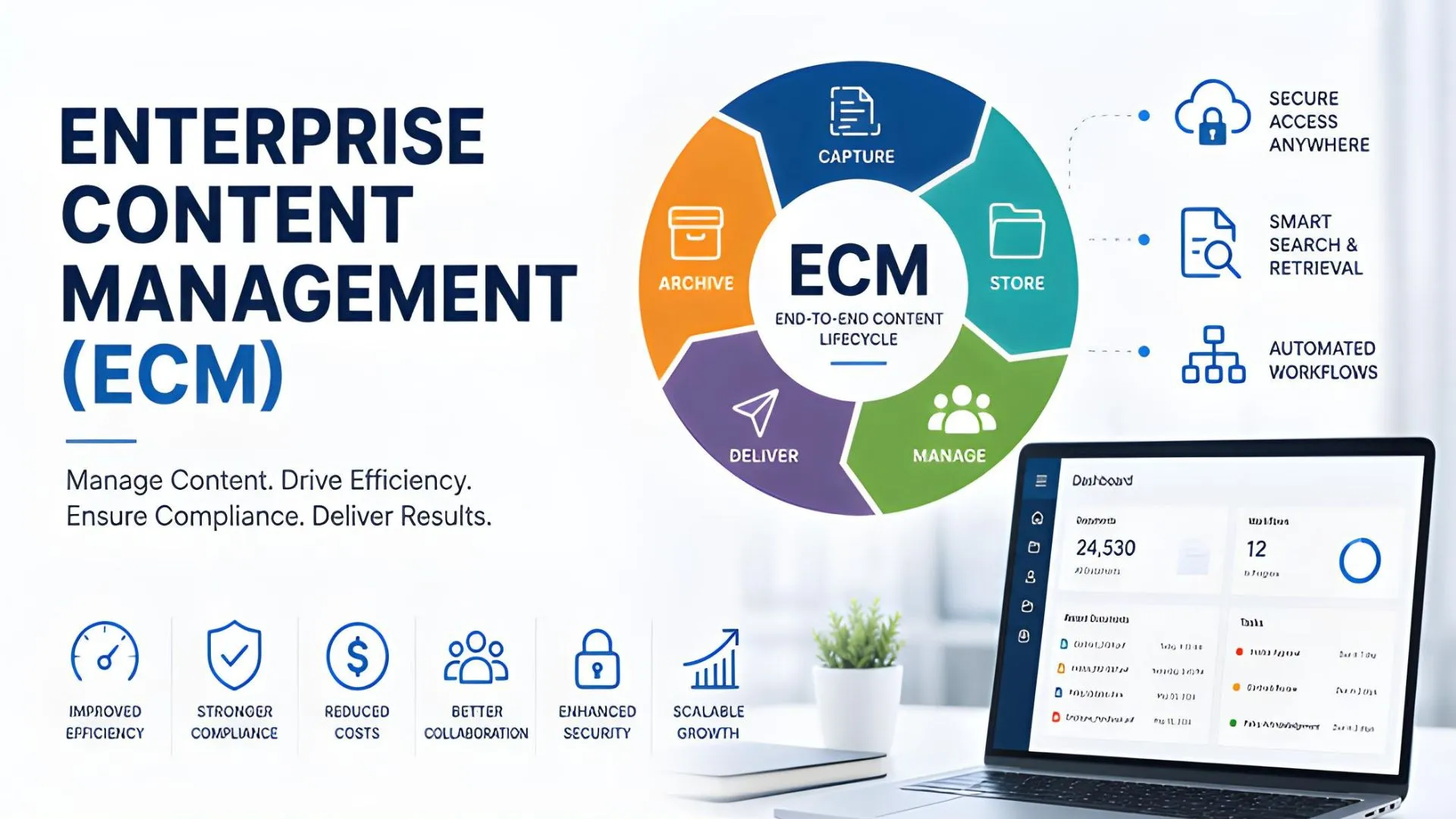
Understanding the enterprise content management lifecycle is fundamental to choosing and implementing the right solution. The lifecycle typically moves through five stages:
- Capture: Content enters the system through scanning, email ingestion, web forms, mobile uploads, or integrations with other business applications. OCR (optical character recognition) technology converts physical documents into searchable digital formats at this stage.
- Store and Organize: Once captured, content is stored in a central repository with metadata attached. Metadata tags such as document type, author, department, date, and status make retrieval fast and accurate. Folder structures and taxonomies are applied to keep the repository navigable as it scales.
- Manage: This is where workflows, version control, access permissions, and collaboration tools come into play. Teams can review, annotate, approve, or escalate documents within the platform. Audit trails are maintained automatically, which is critical for regulated industries like healthcare, finance, and legal services.
- Deliver: approved content to the right stakeholders: internally via employee portals or integrated business applications, or externally via customer-facing portals and APIs. Delivery mechanisms must be flexible enough to support both structured and on-demand access.
- Archive and Dispose: Content that has reached the end of its active use is either archived for compliance purposes or permanently deleted according to a records retention policy. Automated retention schedules reduce the risk of keeping sensitive data longer than necessary.
Organizations that treat ECM as a lifecycle process, rather than just a storage solution, tend to see better compliance outcomes, lower operational costs, and faster information retrieval across the board.
Enterprise Content Management Benefits
Investing in enterprise content management software delivers measurable returns across multiple business functions. Here are the core enterprise content management benefits that drive adoption in US enterprises:
Improved Operational Efficiency
Searching for documents manually across shared drives, email inboxes, and local folders wastes significant time. ECM centralizes content in one searchable repository, reducing the time employees spend locating information. Automated workflows further eliminate manual handoffs that slow down approvals, reviews, and processing cycles.
Stronger Compliance and Risk Management
Regulated industries face strict requirements around document retention, access controls, and audit trails. An ECM system enforces those requirements automatically. Retention schedules ensure documents are kept for exactly as long as required and disposed of safely afterward. Role-based access controls limit who can view, edit, or share sensitive content.
Reduced Operational Costs
Physical storage is expensive. Paper-heavy processes consume time, space, and resources. Digitizing and centralizing content with an ECM solution reduces costs tied to printing, physical filing, off-site storage, and manual data entry. Over time, those savings compound.
Better Collaboration Across Teams
Modern enterprise content management solutions include version control, co-editing capabilities, and task-based workflows. Teams working across different offices or time zones can access the same document, see the latest version, and track every change without the confusion of emailed attachments and conflicting file names.
Enhanced Security
ECM platforms apply granular permissions at the document, folder, and user level. Sensitive contracts, financial records, and personnel files are protected by access policies that follow the content wherever it goes. Many platforms also support encryption, digital rights management, and integration with identity providers like Active Directory.
Scalability for Growing Organizations
Content volumes grow with the business. An enterprise CMS platform is built to scale, whether that means storing millions of additional documents or onboarding hundreds of new users. Cloud-based ECM solutions in particular offer elastic scaling without the overhead of managing on-premises infrastructure.
ECM Must-Haves: Key Features to Look For
Not every platform delivers on all of these capabilities equally. When evaluating enterprise content management software, here are the ECM must-haves that should appear on every checklist:
1. Document Capture and Ingestion
The system should support multiple input channels: scanning, email, mobile, web forms, and API-based ingestion from third-party systems. Automated classification and metadata extraction at the point of capture reduce manual tagging workloads significantly.
2. Search and Retrieval
Full-text search, metadata-based filtering, and advanced query capabilities are non-negotiable in a modern ECM system. Users should be able to find any document in seconds, regardless of where it originated or how long ago it was stored.
3. Workflow Automation
Look for a platform that supports configurable, rule-based workflows for common processes like invoice approval, contract review, onboarding, and compliance sign-offs. No-code or low-code workflow builders make it easier for business users to create and modify workflows without IT involvement.
4. Version Control and Audit Trails
Every change to a document should be logged with a timestamp and user attribution. Previous versions should be accessible and restorable. This feature is especially important in legal, financial, and healthcare environments where document integrity is legally significant.
5. Records Management and Retention
The platform should support automated retention schedules aligned with legal and regulatory requirements. Disposition workflows should be auditable, with records of what was deleted, when, and under whose authority.
6. Security and Access Controls
Role-based access, multi-factor authentication, encryption at rest and in transit, and integration with enterprise identity systems are baseline requirements. Look for platforms that offer fine-grained permissions at the document level, not just folder-level controls.
7. Integration Capabilities
An ECM system that cannot connect to your existing ERP, CRM, HR platform, or email system will create silos rather than eliminate them. REST APIs, pre-built connectors, and support for standards like CMIS (Content Management Interoperability Services) are important markers of a well-designed platform.
Mobile Access Field workers, remote employees, and executives on the go need access to content from any device. A responsive web interface or dedicated mobile app is a practical necessity for most US enterprises today.
Enterprise CMS Platforms: A Comparative Look
The enterprise CMS comparison landscape is broad, with options ranging from large commercial suites to flexible open-source frameworks. Here is a category-level overview to help frame your evaluation.
1. Commercial ECM Platforms
Commercial platforms typically offer the most complete feature sets out of the box, backed by vendor support, compliance certifications, and enterprise-grade SLAs.
Microsoft SharePoint
It is among the most widely deployed enterprise content management solutions in the United States, largely because of its deep integration with the Microsoft 365 ecosystem. It handles document management, intranets, and collaboration well, though it requires significant configuration to function as a true ECM system.
OpenText
It is a purpose-built ECM vendor with deep roots in records management, compliance, and large-scale document processing. It is widely used in industries like government, finance, and life sciences, where regulatory requirements are strict.
IBM FileNet (now part of IBM Cloud Pak for Business Automation)
It is a heavyweight platform suited to large enterprises with complex, high-volume document processing needs. It excels in workflow automation and integration with IBM’s broader ecosystem.
Laserfiche is a strong option for mid-to-large US organizations looking for an intuitive interface combined with robust records management and workflow automation. It is particularly popular in government agencies and educational institutions.
M-Files
It takes a metadata-driven approach that differentiates it from folder-based systems. Its intelligent information management model makes retrieval more intuitive and reduces dependence on rigid folder structures.
2. Enterprise CMS Open Source Options
For organizations that want flexibility, lower licensing costs, and the ability to customize deeply, enterprise CMS open source platforms are worth serious consideration.
Alfresco
It is one of the most capable open-source ECM platforms available. It supports document management, records management, and business process automation, and it is widely used in both public and private sector organizations globally.
NuxeoIt
It is a cloud-native, open-source content services platform built for developers who need to create content-rich applications. Its API-first design makes it well-suited to organizations building custom ECM workflows or integrating content management deeply into their applications.
LogicalDOC
It is a lighter-weight open-source option appropriate for smaller organizations or those beginning their ECM journey. It covers core document management, versioning, and search without the complexity of larger platforms.
Open-source platforms require more internal technical capability to deploy and maintain, but for organizations with strong development teams, they offer significant flexibility in building a custom enterprise content management framework.
Choosing the Right Enterprise Content Management Framework
Selecting a platform is only one part of building a successful ECM strategy. You also need a governance framework that defines how content will be classified, who owns it, how long it will be retained, and how it will be secured.
An effective enterprise content management framework addresses four areas:
- Governance Policies: Document ownership, classification schemes, naming conventions, and retention schedules should be formally defined before any platform goes live.
- Process Design: Map out the key workflows the ECM system will support. Invoice processing, contract management, and HR document handling each have distinct requirements that should be designed before configuration begins.
- Change Management: ECM implementations fail most often because of adoption, not technology. Invest in training, communication, and change management to bring employees along through the transition.
- Integration Architecture: Identify every system the ECM platform needs to connect with and design those integrations as part of the implementation, not as an afterthought.
ECM Migration: What to Plan For
If your organization is moving from an older system to a modern ECM platform, enterprise cms migration planning is critical. Moving large volumes of legacy content introduces risks: corrupted metadata, broken links, incomplete records, and compliance gaps.
A well-executed migration plan covers:
- A content audit to identify what needs to be migrated, what can be archived, and what should be deleted
- Metadata mapping between the old and new system’s schemas
- A pilot migration with a representative sample before full cutover
- Validation testing to confirm that documents, metadata, versions, and permissions were transferred correctly
- A rollback plan in case critical issues surface post-migration
Partnering with an experienced implementation team significantly reduces migration risk.
When Is the Right Time to Invest in ECM?
Many US organizations delay ECM investment until a crisis forces the issue: a failed audit, a compliance fine, a critical document lost, or a merger that exposes how fragmented their content infrastructure really is. Waiting for that moment is expensive.
If your organization is experiencing any of the following, the case for ECM investment is already strong:
- Employees regularly struggle to find current versions of important documents
- Your compliance team cannot produce the requested records quickly during audits
- Content is scattered across shared drives, email, and personal folders with no central governance
- You are growing through acquisition and need to consolidate content from multiple systems
- Your existing content management system comparison shows your current platform cannot meet current regulatory or scalability needs
For organizations evaluating web development and digital infrastructure alongside their ECM investment, it offers a complementary resource for teams managing both internal and external content at scale.
Final Thoughts
Enterprise content management is not a technology purchase. It is a strategic commitment to governing information as a business asset. The right ECM platform, deployed within a clear governance framework and supported by well-designed workflows, can transform how an organization operates: reducing costs, strengthening compliance, and making employees measurably more productive.
Whether you are evaluating the best enterprise content management software options, exploring enterprise cms open source alternatives, or planning a complex migration from a legacy platform, the foundational principles remain the same. Start with a clear understanding of your content lifecycle, define your governance requirements, and select a platform built to grow with your organization.
The investment pays off. The organizations that treat content management as a core operational discipline consistently outperform those that treat it as an afterthought.
Tags
Categories
Recent Posts
Popular Posts
- How to Choose a Reliable Offshore Development Partner?
- Transforming Web Development with HTMX’s Declarative Approach for Dynamic UIs
- Top 15 Ecommerce Growth Strategies to Maximize Sales in 2026
- What is B2B Web Design? Benefits, Best Practices, and Examples
- Why Your Conversion Funnel Needs a Composable Commerce Solution?