- What Is Ecommerce Conversion Rate Optimization?
- Why Ecommerce Conversion Rate Optimization Matters
- Average Ecommerce Conversion Rate: What Should You Aim For?
- 10 Ecommerce Conversion Rate Optimization Strategies That Work
- 1. Optimize Product Pages for Higher Conversions
- 2. Simplify the Checkout Process
- 3. Improve Website Speed and Performance
- 4. Use Social Proof to Build Trust
- 5. Conduct Regular Ecommerce A/B Testing
- 6. Personalize the Shopping Experience
- 7. Focus on Conversion Funnel Optimization
- 8. Optimize for Mobile Commerce
- 9. Perform an Ecommerce CRO Audit
- 10. Create and Follow an Ecommerce CRO Checklist
- How Ecommerce Conversion Optimization Supports Growth
- Benefits of an eCommerce Website
- The Role of an Ecommerce Development Company
- Conversion Optimization for B2B eCommerce Platforms
- Profitable Ecommerce Business Ideas That Benefit from CRO
- How to Increase Conversion Rate Ecommerce Stores Generate
- Conclusion
Attracting visitors to your online store is only the first step toward generating revenue. Whether you’re investing in SEO, paid advertising, social media campaigns, or email marketing, your success ultimately depends on how many visitors convert into customers.
This is where ecommerce conversion rate optimization becomes critical. Many ecommerce businesses focus heavily on driving traffic but overlook the importance of optimizing the customer journey. As a result, they miss out on significant revenue opportunities despite attracting thousands of visitors every month.
Effective ecommerce conversion optimization helps businesses maximize the value of existing traffic by improving user experience, reducing friction, and encouraging more visitors to complete purchases. In this guide, we’ll explore 10 proven conversion rate optimization strategies that can help you increase sales, improve customer satisfaction, and build a more profitable ecommerce business.
What Is Ecommerce Conversion Rate Optimization?
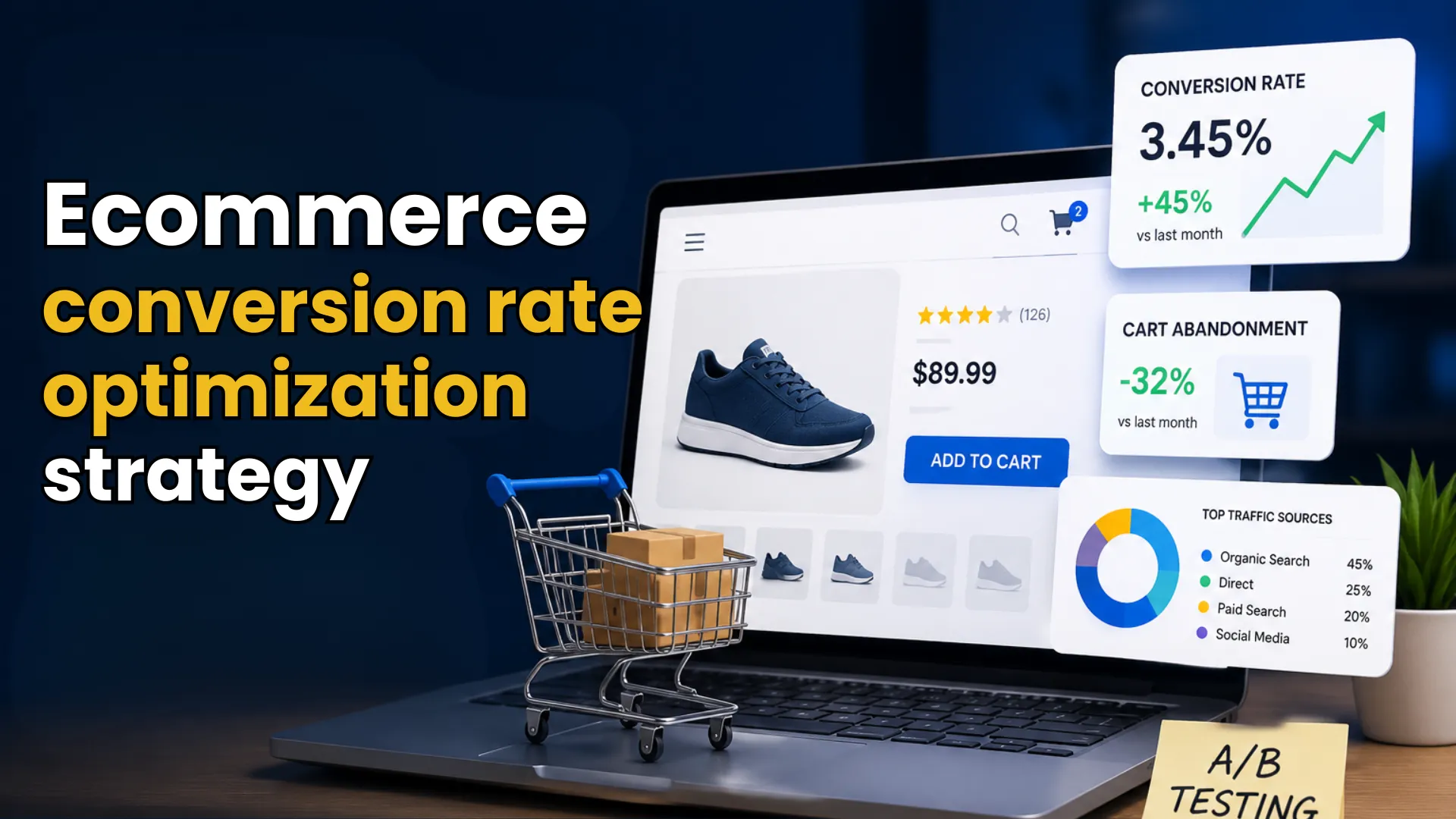
Ecommerce conversion rate optimization (CRO) is the process of improving your online store to increase the percentage of visitors who complete a desired action.
These actions may include:
- Making a purchase
- Adding products to a cart
- Signing up for a newsletter
- Downloading a resource
- Creating an account
Simply put, ecommerce CRO focuses on turning more visitors into customers without increasing advertising spend.
The conversion rate formula is: Conversion Rate = (Conversions ÷ Total Visitors) × 100
For example, if your store receives 10,000 visitors per month and generates 300 sales, your conversion rate is 3%. Businesses that invest in cro ecommerce initiatives often see significant improvements in revenue, customer retention, and marketing ROI.
Why Ecommerce Conversion Rate Optimization Matters
Acquiring traffic is becoming more expensive every year. Rising advertising costs and increased competition mean businesses can no longer rely solely on traffic growth. A strong ecommerce conversion optimization strategy allows you to:
- Increase revenue without increasing traffic
- Lower customer acquisition costs
- Improve user experience
- Increase average order value
- Reduce cart abandonment
- Generate better returns from marketing campaigns
Even a small increase in conversion rate can have a substantial impact on overall revenue. For example, improving a conversion rate from 2% to 3% represents a 50% increase in sales from the same amount of traffic.
Average Ecommerce Conversion Rate: What Should You Aim For?
One of the most common questions ecommerce businesses ask is:
What Is a Good Conversion Rate for Ecommerce?
The answer depends on your industry, audience, product pricing, and traffic sources. Generally, the average ecommerce conversion rate falls between 2% and 4%. However, high-performing stores often achieve conversion rates between 5% and 10%. Understanding your industry’s ecommerce conversion rate benchmark can help you set realistic goals and measure performance effectively.
Rather than comparing yourself to every online store, compare your metrics against competitors within your niche.
10 Ecommerce Conversion Rate Optimization Strategies That Work
1. Optimize Product Pages for Higher Conversions
Your product pages play a critical role in purchasing decisions. Effective ecommerce product page optimization can significantly increase trust and reduce buyer hesitation.
Best Practices
- Use high-quality images
- Include multiple product angles
- Add zoom functionality
- Write benefit-focused descriptions
- Display pricing clearly
- Include customer reviews
- Highlight key features
Many businesses underestimate how much product page improvements can help improve ecommerce conversion rate performance. Visitors should be able to answer every purchasing question without leaving the page.
2. Simplify the Checkout Process
Checkout friction is one of the biggest conversion killers. Customers often abandon purchases when checkout feels lengthy, confusing, or intrusive. If you’re wondering how to reduce checkout abandonment, start by simplifying every step.
Checkout Optimization Tips
- Enable guest checkout
- Reduce form fields
- Offer autofill functionality
- Display shipping costs early
- Provide multiple payment methods
- Allow digital wallet payments
- Remove unnecessary distractions
A streamlined checkout process remains one of the most effective ecommerce conversion best practices.
3. Improve Website Speed and Performance
Modern shoppers expect instant experiences. Research consistently shows that slow websites negatively impact engagement and conversions. When pages take too long to load, users leave before they even see your products.
Speed Optimization Techniques
- Compress images
- Minify CSS and JavaScript
- Use browser caching
- Implement a CDN
- Optimize server response times
- Remove unnecessary plugins
Page speed is one of the most overlooked yet impactful conversion rate optimization best practices. Even a one-second improvement can lead to measurable conversion gains.
4. Use Social Proof to Build Trust
Trust is a major factor in ecommerce purchasing decisions. Most shoppers seek validation before spending money online. Adding social proof reduces uncertainty and increases buyer confidence.
Examples of Effective Social Proof
- Product reviews
- Customer ratings
- Testimonials
- User-generated content
- Case studies
- Verified purchase badges
Social proof can influence visitors at every stage of the buying journey and help improve ecommerce conversion rate metrics.
5. Conduct Regular Ecommerce A/B Testing
Successful optimization depends on evidence, not assumptions. Ecommerce A/B testing allows businesses to compare different page versions and identify what drives more conversions.
- Elements Worth Testing
- Headlines
- CTA buttons
- Product images
- Checkout layouts
- Pricing displays
- Navigation menus
- Promotional banners
Many businesses make changes based on opinions rather than data. A/B testing removes guesswork and provides clear insights into customer behavior. This is one of the most valuable conversion rate optimization tips for long-term growth.
6. Personalize the Shopping Experience
Consumers increasingly expect personalized online experiences. Generic messaging often fails to engage visitors effectively. Personalization helps create more relevant interactions and encourages purchases.
- Personalization Ideas
- Product recommendations
- Dynamic homepage content
- Personalized emails
- Cart recovery campaigns
- Location-based promotions
- Recently viewed products
Personalized experiences help businesses better understand customer intent and increase conversion rates.
7. Focus on Conversion Funnel Optimization
Many stores lose potential customers before they reach checkout. This is why conversion funnel optimization is essential.
The ecommerce funnel typically includes:
- Awareness
- Product discovery
- Product evaluation
- Add to cart
- Checkout
- Purchase
Analyzing each stage helps identify bottlenecks that prevent conversions.
Questions to Ask
- Where are users dropping off?
- Which pages have high exit rates?
- Are visitors abandoning carts?
- Are mobile users converting?
Understanding these patterns enables better optimization decisions.
8. Optimize for Mobile Commerce
Mobile traffic now accounts for the majority of ecommerce visits. However, mobile conversion rates often lag behind desktop performance.
- Mobile Optimization Strategies
- Use responsive design
- Improve mobile page speed
- Simplify navigation
- Create thumb-friendly layouts
- Enable one-click payments
- Reduce form complexity
Mobile optimization should be a core component of every ecommerce conversion optimization strategy.
9. Perform an Ecommerce CRO Audit
A comprehensive ecommerce CRO audit helps uncover issues that may be hurting performance. Many conversion problems remain hidden until a detailed analysis is performed.
Areas to Evaluate
User Experience
Review navigation, search functionality, and customer flow.
Product Pages
Analyze content quality, images, pricing, and CTAs.
Mobile Experience
Test usability across multiple devices.
Analytics Data
Identify drop-off points and underperforming pages.
Checkout Process
Evaluate friction and abandonment triggers. Regular audits help businesses prioritize improvements and maximize ROI.
10. Create and Follow an Ecommerce CRO Checklist
Optimization efforts become more effective when guided by a structured process. An ecommerce CRO checklist helps teams consistently identify and address conversion issues.
Essential Ecommerce CRO Checklist
Homepage
- Clear value proposition
- Fast loading speed
- Easy navigation
- Product Pages
- High-quality images
- Detailed descriptions
- Customer reviews
Cart
- Transparent pricing
- Shipping information
- Trust signals
Checkout
- Guest checkout
- Multiple payment methods
- Minimal form fields
Analytics
- Goal tracking
- Funnel analysis
- Conversion monitoring
Using a checklist ensures optimization efforts remain organized and data-driven.
How Ecommerce Conversion Optimization Supports Growth
Effective ecommerce conversion rate optimization is one of the most powerful Ecommerce Growth Strategies available to online businesses. Rather than spending more money on acquiring traffic, companies can increase revenue by improving conversion performance. Even small increases in conversion rates can significantly impact overall profitability.
Businesses that continuously improve user experiences, optimize checkout flows, and personalize customer journeys often generate stronger long-term growth.
Benefits of an eCommerce Website
Understanding the Benefits of an eCommerce website is important when evaluating digital growth opportunities.
Key benefits include:
- Global reach
- Lower operating costs
- 24/7 availability
- Better customer insights
- Easier scalability
- Enhanced customer convenience
When combined with strong ecommerce conversion optimization efforts, these benefits help businesses maximize online revenue.
The Role of an Ecommerce Development Company
Many organizations work with an ecommerce Development Company to improve website performance and support conversion optimization initiatives.
A professional development partner can help with:
- Website speed optimization
- Mobile responsiveness
- Secure payment integrations
- Analytics implementation
- Conversion tracking
- UX improvements
A technically sound website provides the foundation needed for successful ecommerce CRO campaigns.
Conversion Optimization for B2B eCommerce Platforms
While CRO is often associated with retail brands, B2B eCommerce Platforms also benefit significantly from conversion optimization.
B2B buyers typically have longer purchasing journeys and require more information before making decisions. Businesses can improve conversions by:
- Simplifying product discovery
- Providing detailed specifications
- Offering quote requests
- Displaying trust signals
- Improving lead generation forms
Applying ecommerce conversion best practices to B2B environments can increase qualified leads and revenue.
Profitable Ecommerce Business Ideas That Benefit from CRO
Conversion optimization is valuable across a wide range of Profitable Ecommerce Business Ideas.
Examples include:
- Subscription box businesses
- Print-on-demand stores
- Direct-to-consumer brands
- Fashion ecommerce stores
- Health and wellness products
- Home décor businesses
- Digital product marketplaces
Stores that optimize conversions often outperform competitors, even when operating with similar traffic levels.
How to Increase Conversion Rate Ecommerce Stores Generate
If you’re wondering how to increase conversion rate ecommerce businesses achieve, focus on:
- Faster page loading
- Better product content
- Simplified checkout
- Strong trust signals
- Personalization
- Continuous testing
These improvements collectively help improve ecommerce conversion rate metrics and increase overall sales.
Conclusion
Successful ecommerce conversion rate optimization requires ongoing testing, analysis, and improvement. From ecommerce product page optimization and ecommerce A/B testing to conversion funnel optimization and comprehensive ecommerce CRO audits, every improvement contributes to better customer experiences and higher revenue.
By following proven conversion rate optimization strategies, applying conversion rate optimization best practices, and continuously measuring performance, ecommerce businesses can increase sales, reduce abandonment, and maximize growth.
A strong optimization strategy is even more effective when supported by high-quality ecommerce development. Fast-loading pages, mobile-friendly experiences, secure checkout systems, and scalable architecture create the foundation needed for successful CRO initiatives. Many businesses partner with an experienced ecommerce Development Company to ensure their online store is built for both performance and conversions.
The ultimate goal is not simply attracting more visitors but converting more of the visitors you already have into loyal customers. Businesses that combine strategic optimization with robust ecommerce development are better positioned to achieve sustainable growth and long-term success.
Tags
Categories
Recent Posts
Popular Posts
- How to Choose a Reliable Offshore Development Partner?
- Transforming Web Development with HTMX’s Declarative Approach for Dynamic UIs
- Top 15 Ecommerce Growth Strategies to Maximize Sales in 2026
- What is B2B Web Design? Benefits, Best Practices, and Examples
- Why Your Conversion Funnel Needs a Composable Commerce Solution?