- What is Staff Augmentation?
- Staff Augmentation VS Managed Services
- When should Leaders Invest in Staff Augmentation Services?
- Staff Augmentation Roadmap for Enterprises
- Benefits of Staff Augmentation for Decision-Makers
- Practical Use Cases of Staff Augmentation
- Cost Overview for Staff Augmentation Services
- Why do Companies Need Staff Augmentation Services?
- How to Choose A Staff Augmentation Company?
As businesses today scale and evolve, leaders are increasingly adopting the approach of moving beyond traditional recruiting strategies. That being said, they are welcoming some new tech-driven changes in staffing. Staff augmentation is one such innovative talent planning solution adopted by enterprises today.
Simply speaking, it is an outsourcing model that helps businesses easily meet their talent needs for various projects. In this way, they not only cut down the long hiring cycles, but also reduce the stress of entirely managing an in-house team, which needs to be updated (in terms of knowledge) from time to time. This is why this modern solution is technologically adaptive, practical, and cost-effective.
So, gone are the days when teams depended on full-time employees. In today’s day and age, enterprises are temporarily extending their workflow capabilities, whether by hiring a staff augmentation developer or a digital transformation professional. This helps leaders stay agile while managing their outcomes better.
With this perspective, this guide explores the essence, process, types, benefits, and use cases of staff augmentation, along with its practical examples for organizations in 2026.
What is Staff Augmentation?
In the present day, staying agile is a business necessity. Meeting this need gets easier with a key workforce strategy, i.e., staff augmentation. Simply, this allows your team to hire external talent temporarily based on your specific project requirements and workload demands.
Here, another key aspect is reducing hiring cycles and speeding up the onboarding of trained professionals. So, this supports the company’s goal of digital transformation and scalability.
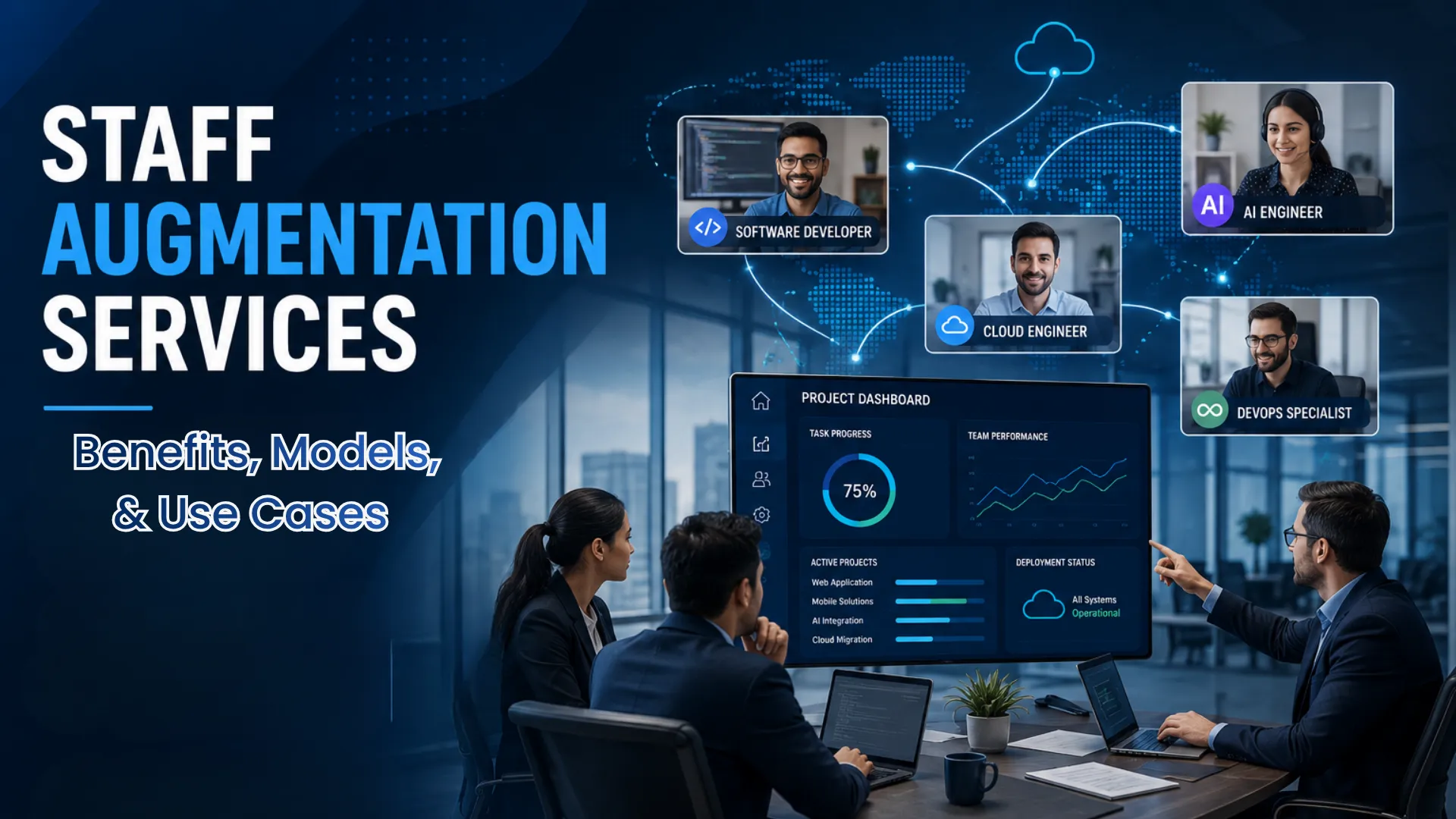
That being said, this model is commonly used by software development companies. What’s more, enterprises also hire IT experts, cloud engineers, AI professionals, cybersecurity-field ethical hackers, and more through this service model.
The intent here clearly is to hire a team of experts faster, focusing on your goals, workflows, and results. Hence, this model can help companies accelerate their project delivery timelines without even having the need to expand the in-house workforce.
Types of Staff Augmentation Models
For a business that wants to adopt this approach, there are various models that leaders can consider, based on how their project functions. These are shared in detail below:
1. Commodity-Based Staff Augmentation
As the name suggests, in this model, the experts are hired for specific routine technical expertise, like customer support, data processing, administrative operations, or back-office functions.
2. Skill-Based Staff Augmentation
In this approach, teams work on hiring specialized experts like developers, AI experts, QA testers, and more to fill in certain capability gaps in their teams.
3. Project-Based Staff Augmentation
This model clearly helps fulfill a certain project’s talent needs, which may involve niche skills or even senior-level professionals.
4. Offshore Staff Augmentation
In this model, teams hire offshore development partners and other professionals from distant geographic zones. Mainly, this is done to reduce the operational hiring cost and to gain access to a larger talent pool.
5. Near-Shore Augmentation
In this augmentation model, teams hire experts from nearby countries. Overall, this allows teams to gain expert skills while looking forward to better project coordination, as the culture and time zones don’t vary much in these countries.
6. Managed Services
Another common term when we understand staff augmentation is managed services. Here, a third-party provider takes the responsibility of managing this service for your company. So, this further reduces the stress of hiring experts for the organization.
Staff Augmentation VS Managed Services
Generally, many enterprises compare staff augmentation with managed services while planning this expert talent planning move.
While both models help companies hire experts externally, there are a few differences between them that leaders need to understand to make informed decisions. These are mentioned in the table below:
| Factors | Staff Augmentation | Managed Services |
| Control | Augmentation allows leaders to manage the external staff directly. | Control of managing experts lies with the service provider. |
| Ownership | Its ownership entirely remains with the business. | Here, responsibility is partly or fully handled by the provider. |
| Flexibility | This approach is highly scalable and flexible. | In this case, the scope for flexibility depends on the company’s contract with the third-party provider. |
| Implementation | This is best for teams that want to fill their skill gaps. | This is best in case the company needs project-based hirings. |
| Responsibility | The responsibility of managing this task falls on the internal managers. | Here, the responsibility falls upon the vendor. |
| Cost Structure | This factor depends on the resources that need to be onboarded. | In this case, the cost structure is mostly pre-decided. |
| Collaboration | This approach may require collaboration between the external staff and in-house teams. | Here, teams are generally separately managed. |
| Best For | It is best for agile and faster talent management. | This plan is better for project-based plans that may require variations. |
Thus, we can say that these two approaches are highly effective, but what is necessary is understanding which one works best for a business, considering their project complexity and scalability perspective for the future.
When should Leaders Invest in Staff Augmentation Services?
To gain the best results, businesses should typically invest in staff augmentation services in the following ideal situations:
- When the company is investing in modern technologies, managing them requires specialized staff.
- When the company wants to get access to faster hiring processes.
- To handle a rise in the temporary workload.
- In case a company needs to support its digital transformation strategies through niche skills.
Finally, this is also fruitful when a company is seeking more flexibility in their recruiting strategies, and they do not want to multiply their commitment in-house at the same time.
Staff Augmentation Roadmap for Enterprises
Well, to get long-term success in staff augmentation, a leader must know the structured roadmap. With this perspective, this section helps define the process for this planning, while also sharing its related risks and how they can be overcome.
First things first, here is a step-by-step process for this plan:
- The most important step is to analyze your business and skills requirements, keeping in mind the ongoing and future speculation of projects and digital transformation goals.
- The next key part of this plan is to evaluate the vendors that offer staff augmentation services. That being said, their selection criteria generally revolve around aspects like technical expertise, industry experience, talent quality, scalability capabilities, communication practices, and security standards.
- Putting the prior step in action, leaders can then finalize the services partner, post which, teams can start planning the hiring of the resources.
- In this approach, businesses must onboard the partner into existing workflows, tools, communication systems, and project management environments so that coordination with them can be well-aligned.
- Finally, set the KPIs in advance, and monitor their performance to achieve the planned staffing goals in 2026.
That being said, there are some risks that teams need to address in this process, which are:
-
Communication Gaps
In this process, communication routes need to be made transparent and clear to avoid this key challenge.
-
Skill Mismatch
This can occur generally only when technical assessments are not done by the company to ensure that the right talent is hired.
-
Security Risks
Overall, this risk cannot be avoided, so the partnership with the staff augmentation services must be compliance-proof to avoid unnecessary issues.
Thus, when staff augmentation is properly managed with these risks in check, the process can help improve your talent acquisition workflows significantly.
Benefits of Staff Augmentation for Decision-Makers
For business leaders, staff augmentation is not just a modern hiring model. Rather, it is a strategic approach that helps teams hire faster and better (based on evolving market demands).
That being said, staff augmentation can help enterprises in the following key ways:
-
Faster Access to Specialized Talent
By trusting staff augmentation services, businesses can quickly onboard experienced professionals with niche expertise in areas like AI, cloud computing, DevOps, cybersecurity, and software engineering.
-
Better Scalability
Thanks to staff augmentation, organizations can easily scale their human resources based on project requirements and other evolving business priorities.
-
Accelerated Project Deliveries
There is no doubt that investing in this talent planning approach also helps companies deliver projects and digital solutions at a much accelerated pace.
-
Reduced Operational Costs
Additionally, staff augmentation helps teams downsize their expenses that account for full-time hiring roles, training, employee benefits, and other workforce maintenance aspects.
-
Greater Flexibility
Apart from these benefits, decision-makers also gain higher flexibility to manage their resources based on market demand, evolving technology trends, and more.
Hence, we can say that this model is becoming a practical tool for enterprises that want to hire specialized talent faster and more efficiently.
Practical Use Cases of Staff Augmentation
Well, leaders can achieve wonders by investing in professional staff augmentation services. That being said, it is widely adopted across various business settings, including:
-
Managing software development projects
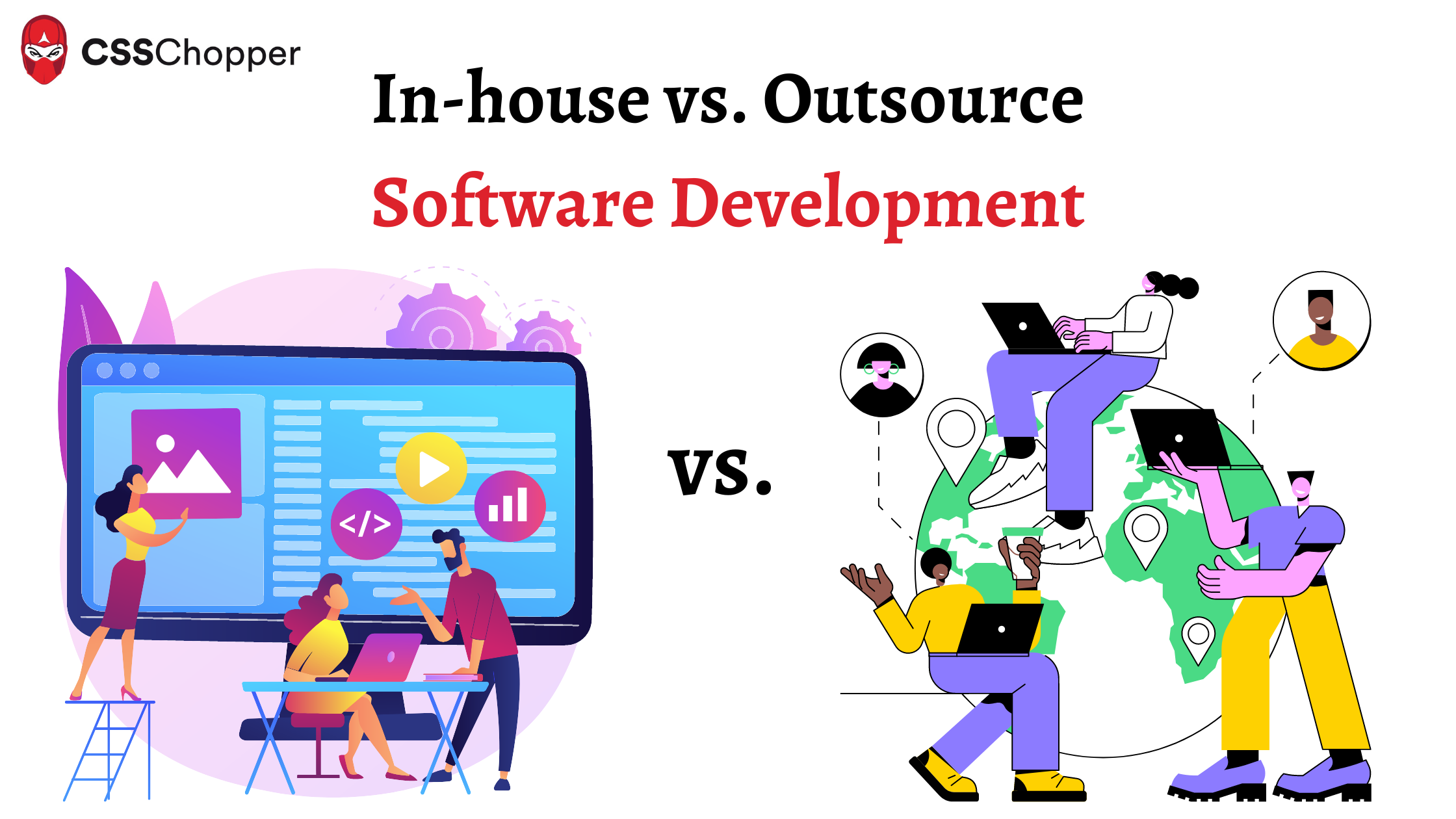
Undoubtedly, companies hire expert frontend developers, backend engineers, QA testers, and DevOps professionals. They understand the trade-off between in-house vs outhouse software development, and know that this approach can more efficiently help them based on their project requirements to improve their project outputs.
-
Streamlining cloud and infrastructure modernization
Furthermore, teams commonly hire cloud professionals and specialized infrastructure engineers through this model. This helps them support cloud migration and modernization across the system.
-
Supporting AI and data engineering initiatives
Many enterprises also focus on AI adoption, automation, data analytics, and machine learning models. Here, staff augmentation services can be of great help, as they support the recruitment process of a company.
-
Ensuring much-needed cybersecurity and compliance support
Organizations also work on strengthening their security practices by hiring augmented cybersecurity analysts, ethical hackers, compliance consultants, and SOC specialists through these services.
-
Providing product development support
Many startups and emerging brands hire staff augmentation experts to add more resources to their product development teams. This allows them to have greater control in managing MVP launches while also ensuring faster execution in these projects.
-
Allowing seamless enterprise digital transformation
Furthermore, large-scale organizations hire these experts to manage their complex ERP modernization process. What’s more, they are reliable even for automation, analytics, and other enterprise-wide transformation projects.
Hence, staff augmentation can truly benefit companies to achieve their project goals faster, as it directly supports the talent planning function in an enterprise.
Cost Overview for Staff Augmentation Services
Generally, the cost in the case of staff augmentation technology partners depends on many variables, like resource expertise, location, project complexity, and engagement duration.
That being said, here are some of the cost estimates based on these mentioned aspects:
| Cost Factor | Pricing Impact | Average Cost |
| Expertise Level | Senior specialists cost more than junior or mid-level resources. | $15–$150/hour |
| Team Location | Offshore teams are more affordable than nearshore or onshore teams. | Varies by region |
| Engagement Duration | Long-term engagements usually offer better pricing efficiency. | $5K–$200K+/project |
| Tech Stack | Advanced technologies require specialized and higher-cost talent. | $15–$180+/hour |
| Team Size | Larger teams increase overall operational costs. | $10K–$500K/month |
| Project Complexity | Complex enterprise projects demand higher investment. | $5K–$1M+/project |
So, with this table sharing average costs and their context, businesses can set a reasonable budget while investing in staff augmentation services based on the factors shared above.
Why do Companies Need Staff Augmentation Services?
As we comprehensively explore the essence of staff augmentation services, let us now understand why businesses need to invest in them in real industry settings.
Mainly, it helps enterprises deal with hiring in an organized manner, which makes the process more streamlined. Other than that, the practical pressure for managing skill shortages is really high and overbearing for teams, which is resolved with this solution.
Overall, focus on your goals, whether it is to hire dedicated developers to improve your process or to undergo digital transformation. Based on that, analyze what the provider’s input is and whether it is with your company. This will help you to make the right choice.
How to Choose A Staff Augmentation Company?
Undoubtedly, choosing the right staff augmentation partner counts a lot. It affects not only your project quality and team collaboration but also the business outcomes.
That being said, here are some of the key aspects teams should keep in mind while choosing an expert staff augmentation company.
- Evaluating the company’s proven experience in terms of technologies, frameworks, and project requirements.
- Understanding the company’s screening process is a must before signing a contract with them and hiring & onboarding professionals through them.
- Having industry experience also counts as valuable. This is because companies with relevant industry experience understand compliance and operational challenges better.
- Priotize scalability, and assess the client testimonials, project portfolios, and case studies to help validate the company’s actual capabilities and reliability for your enterprise.
Overall, focus on your goals and in detail analyze if the provider’s input aligns with your company to make the right choice.
Tags
Categories
Recent Posts
Popular Posts
- How to Choose a Reliable Offshore Development Partner?
- Transforming Web Development with HTMX’s Declarative Approach for Dynamic UIs
- Top 15 Ecommerce Growth Strategies to Maximize Sales in 2026
- What is B2B Web Design? Benefits, Best Practices, and Examples
- Why Your Conversion Funnel Needs a Composable Commerce Solution?