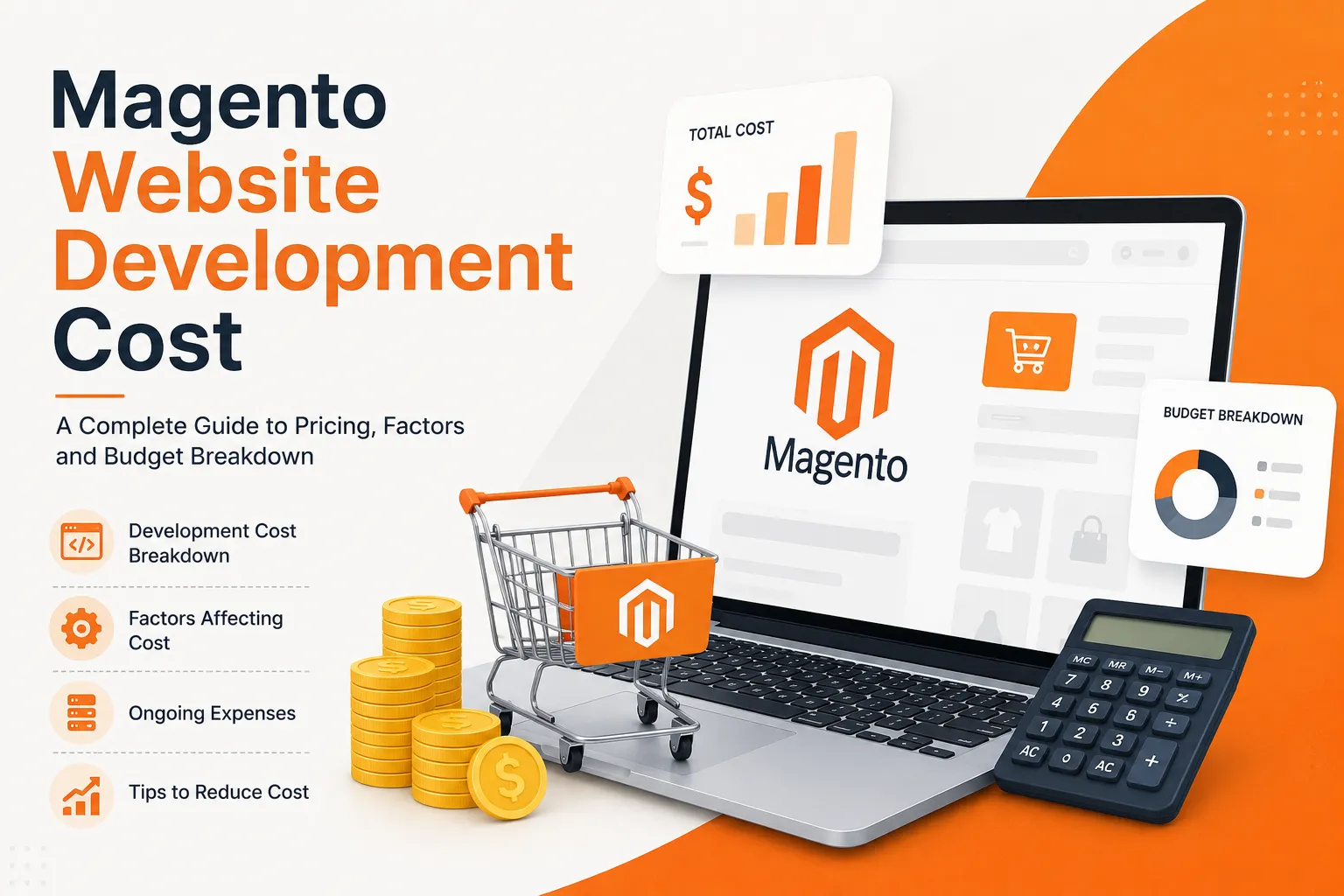
- How Much Does Magento Website Development Cost in 2026?
- Why Magento Development Costs Vary So Much
- Magento Open Source vs Adobe Commerce Pricing
- Which Magento Version Should You Choose?
- Factors That Affect Magento Website Development Cost
- Magento Website Development Cost Breakdown
- Magento Website Development Cost by Business Size
- Hidden Magento Development Costs
- How to Reduce Magento Website Development Cost
- Is Magento Worth the Investment?
Launching an eCommerce store is a significant investment, and one of the first questions business owners ask is, “How much does a Magento website cost?” The answer isn’t straightforward because every Magento project is different. A simple online store with basic features will cost much less than an enterprise-level marketplace with custom integrations, advanced security, and thousands of products.
Magento, now known as Adobe Commerce in its commercial edition, continues to be one of the most powerful eCommerce platforms available. It offers unmatched flexibility, supports complex business operations, and can scale as your business grows. This is why many medium-sized businesses and global brands choose Magento over simpler platforms.
However, that flexibility also means development costs can vary widely. Your total investment depends on several factors, including the version of Magento you choose, the complexity of your store, design requirements, third-party integrations, and ongoing maintenance.
In this guide, you’ll learn:
- How much Magento website development costs in 2026
- The difference between Magento Open Source and Adobe Commerce pricing
- The key factors that influence development costs
- What to expect based on your business size
- Tips to manage your budget without compromising quality
Whether you’re planning a new online store or migrating from another platform, this guide will help you understand what goes into the cost of building a Magento website.
How Much Does Magento Website Development Cost in 2026?
The average Magento website development cost can range anywhere from $5,000 to over $250,000, depending on the scope of the project. While small businesses can launch a basic store with a modest budget, larger organizations often invest significantly more to build customized, high-performance eCommerce platforms.
Here’s a general pricing estimate for different business types.
| Business Type | Estimated Development Cost | Estimated Timeline |
| Small Business | $5,000–$20,000 | 1–3 Months |
| Mid-sized Business | $20,000–$60,000 | 3–6 Months |
| Enterprise Business | $60,000–$200,000+ | 6–12 Months |
| Custom B2B Store | $75,000–$250,000+ | 6–12 Months |
These figures include development work only. Additional costs such as hosting, Adobe Commerce licensing, premium extensions, maintenance, and marketing should also be considered when planning your budget.
Let’s look at each category in more detail.
Small Business Magento Website Cost
For startups and small businesses, Magento Open Source is often the preferred choice because there is no software licensing fee. Businesses can invest their budget in custom development instead of paying for the platform itself.
A typical small business Magento website may include:
- A custom or pre-built theme
- Product catalog
- Shopping cart and checkout
- Payment gateway integration
- Shipping configuration
- Basic SEO setup
- Mobile-responsive design
The total investment usually falls between $5,000 and $20,000, depending on the number of customizations required.
If your store has fewer products and straightforward business requirements, development costs remain relatively affordable.
Mid-sized Business Magento Development Cost
As businesses grow, their eCommerce requirements become more complex.
Mid-sized companies often need features such as:
- Custom product pages
- Advanced search and filtering
- Customer accounts
- Loyalty programs
- CRM integration
- Marketing automation
- Multiple payment gateways
- Inventory synchronization
These additional features increase development time, bringing the average project cost to around $20,000–$60,000.
At this stage, businesses also begin investing more in performance optimization, security, and user experience to support increasing traffic and sales.
Enterprise Magento Website Development Cost
Large enterprises require highly customized eCommerce solutions designed to handle thousands of products, high traffic volumes, and complex business operations.
Enterprise Magento projects commonly include:
- Multi-store management
- Multi-language support
- Multi-currency functionality
- ERP integration
- CRM integration
- AI-powered product recommendations
- Advanced customer segmentation
- Business intelligence dashboards
- High-availability hosting
- Enterprise-grade security
These projects typically start around $60,000 and can easily exceed $200,000, depending on the level of customization.
Many enterprise organizations also choose Adobe Commerce because it includes advanced business features and dedicated support.
Custom B2B Magento Store Development Cost
Magento is widely used for B2B commerce because it supports features that many other platforms lack.
A custom B2B store may include:
- Company accounts
- Multiple buyers per organization
- Custom catalogs
- Personalized pricing
- Purchase approval workflows
- Bulk ordering
- Quote management
- ERP integration
- Automated invoicing
Because of these advanced requirements, a custom B2B Magento project generally costs between $75,000 and $250,000 or more.
The final cost depends on how deeply the platform needs to integrate with your existing business systems.
Why Magento Development Costs Vary So Much
It’s common for two businesses to receive very different quotes for what appears to be a similar project. That’s because Magento development is highly customizable, and every business has unique requirements.
Some of the biggest factors that influence pricing include:
- Number of products
- Design complexity
- Custom features
- Third-party integrations
- Marketplace functionality
- Multi-store setup
- Performance requirements
- Security requirements
- Development team’s expertise
- Project timeline
A business launching a simple online store may only need a few weeks of development, while an enterprise with multiple warehouses and custom workflows may require several months of planning, development, and testing.
Instead of focusing only on the initial development cost, it’s important to consider the long-term value your Magento store can deliver.
Magento Open Source vs Adobe Commerce Pricing
One of the biggest decisions you’ll make before starting your project is choosing between Magento Open Source and Adobe Commerce. Although both platforms share the same core technology, they are designed for different business needs and come with different pricing models.
Here’s a quick comparison.
| Feature | Magento Open Source | Adobe Commerce |
| License Cost | Free | Paid Annual License |
| Hosting | Self-hosted | Cloud or Self-hosted |
| Source Code Access | Yes | Yes |
| B2B Features | Limited | Built-in |
| AI & Personalization | No | Available |
| Customer Segmentation | Basic | Advanced |
| Adobe Support | Community Only | Dedicated Support |
| Best For | Small & Mid-sized Businesses | Medium to Large Enterprises |
Magento Open Source Pricing
Magento Open Source is free to download and use, making it an attractive option for businesses looking to reduce software licensing costs. However, “free” doesn’t mean there are no expenses.
You’ll still need to budget for:
- Website development
- Web hosting
- Domain registration
- SSL certificate
- Premium extensions
- Security updates
- Ongoing maintenance
Many businesses choose Magento Open Source because it provides complete control over customization without recurring platform licensing fees.
Adobe Commerce Pricing
Adobe Commerce is the premium version of Magento designed for businesses that need advanced eCommerce capabilities and enterprise-level support. Unlike Magento Open Source, Adobe Commerce requires an annual license fee.
The pricing isn’t publicly fixed because it depends on factors such as:
- Annual revenue
- Gross Merchandise Value (GMV)
- Business size
- Deployment model
- Required features
In return, businesses gain access to capabilities like:
- Advanced B2B functionality
- AI-driven merchandising
- Personalized shopping experiences
- Business intelligence tools
- Enterprise security features
- Dedicated Adobe support
For companies managing large product catalogs and high transaction volumes, these built-in features can reduce the need for custom development.
Which Magento Version Should You Choose?
The right choice depends on your business goals.
Magento Open Source is generally suitable if you:
- Are a startup or growing business
- Need a highly customizable store
- Have a limited development budget
- Don’t require enterprise-level features
Adobe Commerce is a better fit if you:
- Operate at an enterprise scale
- Manage multiple brands or storefronts
- Need advanced B2B capabilities
- Expect high traffic and rapid growth
- Want dedicated technical support from Adobe
While Adobe Commerce involves a higher upfront investment, many large organizations find that its built-in capabilities help reduce long-term development and operational costs.
Factors That Affect Magento Website Development Cost
No two Magento projects are exactly alike. While one business may only need a standard online store, another may require custom workflows, ERP integrations, multiple storefronts, or B2B functionality. These differences have a direct impact on the overall development budget.
Understanding the factors below will help you estimate costs more accurately and identify where your investment is going.
1. Website Complexity
The overall complexity of your website is one of the biggest cost drivers.
A basic Magento store with a few product categories and standard checkout features takes far less time to develop than a marketplace or enterprise platform with custom functionality.
For example:
- A fashion store with 200 products and standard checkout is relatively straightforward.
- A B2B website with custom pricing, quote requests, and multiple user roles requires significantly more development.
- As the number of features increases, so does the time spent on development, testing, and deployment.
2. UI/UX Design
Design is more than just making a website look attractive. It directly influences user experience, conversions, and customer trust.
Businesses can choose between:
- A ready-made Magento theme
- A customized premium theme
- A completely custom UI/UX design
Using a pre-built theme is generally the most budget-friendly option. However, businesses that want a unique brand identity often invest in custom designs tailored to their audience. Custom UI/UX projects usually require additional research, wireframing, prototyping, and revisions, which naturally increase development costs.
3. Custom Development
Most growing businesses eventually need features that aren’t available out of the box.
These may include:
- Custom product configurators
- Subscription models
- Membership portals
- Booking systems
- Vendor dashboards
- Advanced search functionality
- Personalized customer experiences
Every custom feature requires planning, coding, testing, and future maintenance. The more custom functionality your store needs, the higher your Magento development cost will be.
4. Theme Customization
Even if you purchase a premium Magento theme, it’s unlikely to match your business requirements perfectly.
Common customizations include:
- Homepage redesign
- Custom product pages
- Checkout improvements
- Mobile optimization
- Navigation updates
- Landing page creation
Small visual changes are relatively inexpensive, while extensive modifications may require frontend development similar to building a custom theme from scratch.
5. Magento Extensions
Magento offers thousands of extensions that add extra functionality without building everything from scratch.
Popular extensions include:
- SEO tools
- Marketing automation
- Live chat
- Customer reviews
- Payment gateways
- Shipping solutions
- Inventory management
- Email marketing
While extensions can save development time, premium extensions often come with licensing fees and ongoing update costs. Businesses should also avoid installing unnecessary extensions, as too many can affect website performance.
6. Payment Gateway Integration
A secure and reliable payment process is essential for every online store. Magento supports many payment providers, but some businesses require custom integrations with regional payment gateways or financial systems.
Common payment options include:
- Stripe
- PayPal
- Authorize.Net
- Razorpay
- Square
If your preferred payment provider isn’t supported out of the box, custom integration work can increase project costs.
7. ERP and CRM Integration
Many medium-sized and enterprise businesses connect Magento with internal business systems.
Popular integrations include:
- ERP software
- CRM platforms
- Inventory management systems
- Accounting software
- Warehouse management systems
These integrations help automate operations by syncing products, inventory, orders, invoices, and customer information.
Because every business uses different software, integration costs can vary significantly depending on complexity.
8. Third-party APIs
Modern eCommerce websites rarely operate in isolation.
Many rely on third-party services for:
- Shipping
- Tax calculation
- Fraud prevention
- Email automation
- SMS notifications
- Analytics
- Customer support
Connecting Magento with these services often requires API intergration, development and testing.
Some providers also charge usage-based fees, which should be considered when estimating long-term costs.
9. Data Migration
Businesses moving from platforms like Shopify, WooCommerce, BigCommerce, or PrestaShop often need to migrate existing data.
Migration may include:
- Products
- Categories
- Customers
- Orders
- Reviews
- Blog content
- SEO URLs
A clean migration ensures valuable business data isn’t lost and helps preserve search engine rankings.
Larger product catalogs naturally require more migration effort.
10. Performance Optimization
Website speed has a direct impact on customer experience and search rankings.
Performance optimization typically includes:
- Image optimization
- Caching
- Database optimization
- CDN implementation
- Code optimization
- Server tuning
Although this work adds to development costs, it can improve page load times, increase conversions, and reduce bounce rates.
11. Security
Security should never be treated as an optional expense. Magento websites often process sensitive customer information, making them a target for cyberattacks.
Security measures may include:
- SSL configuration
- Firewall implementation
- Malware scanning
- Two-factor authentication
- Security patches
- Backup systems
Investing in security helps protect customer data and reduces the risk of costly downtime or data breaches.
12. Testing
Before launch, every Magento website should undergo thorough testing.
Quality assurance usually covers:
- Functional testing
- Mobile responsiveness
- Browser compatibility
- Checkout testing
- Payment testing
- Performance testing
- Security testing
Skipping this stage can lead to bugs that affect user experience and sales after launch.
13. Deployment
Deployment is the final step before your website goes live.
This process often includes:
- Server configuration
- Domain setup
- SSL installation
- Final testing
- Performance verification
- Monitoring
A smooth deployment minimizes downtime and ensures customers have a seamless experience from day one.
Magento Website Development Cost Breakdown
The table below provides a general estimate of how your budget may be distributed across different stages of a Magento development project.
| Development Stage | Estimated Cost |
| Discovery & Planning | $1,000–$5,000 |
| UI/UX Design | $2,000–$10,000 |
| Frontend Development | $3,000–$15,000 |
| Backend Development | $5,000–$30,000+ |
| Theme Customization | $1,000–$8,000 |
| Extension Development & Configuration | $2,000–$15,000 |
| Third-party Integrations | $2,000–$20,000 |
| Data Migration | $1,000–$10,000 |
| QA & Testing | $1,500–$8,000 |
| Deployment | $500–$3,000 |
| Project Management | 10–20% of Project Cost |
These figures are indicative and can vary based on project complexity, location of the development team, and business requirements.
Discovery and Planning
Every successful Magento project starts with proper planning.
This phase involves understanding business goals, identifying technical requirements, preparing documentation, and creating a development roadmap. Investing time in planning helps reduce costly revisions later in the project.
UI/UX Design
Designers create wireframes, user journeys, and high-fidelity layouts that align with your brand and improve the shopping experience.
A well-designed interface can lead to higher engagement and better conversion rates.
Frontend Development
Frontend developers convert approved designs into responsive Magento themes using HTML, CSS, JavaScript, and Magento’s frontend framework. Their work ensures the website looks and functions consistently across different devices and browsers.
Backend Development
Backend development focuses on the core functionality of the store.
This includes product management, customer accounts, order processing, checkout workflows, custom modules, and business logic. Projects with extensive backend customization often account for the largest share of the development budget.
Extension Development and Configuration
Some features can be added using existing Magento extensions, while others require custom module development.
The choice depends on your business requirements, compatibility, and long-term maintenance considerations.
Third-party Integrations
Integrating Magento with payment gateways, ERP systems, CRM platforms, shipping providers, and marketing tools requires careful development and testing to ensure reliable data synchronization.
Data Migration
Migrating data involves transferring products, customer accounts, historical orders, images, and SEO information from your existing platform to Magento.
Proper migration helps maintain business continuity and minimizes disruptions.
Quality Assurance
Before launch, testers verify that every feature works as expected.
This includes testing user flows, checkout, payment processing, mobile responsiveness, and overall website stability.
Deployment
Once testing is complete, the development team deploys the website to the production environment, configures servers, and performs final checks before making the store available to customers.
Project Management
Magento projects involve designers, developers, testers, and stakeholders working together.
Project managers coordinate communication, timelines, resource allocation, and issue resolution to keep the project on track.
Magento Website Development Cost by Business Size
Magento can support businesses at every stage of growth, but the required investment varies depending on operational complexity.
Startups
Startups typically focus on launching quickly with essential eCommerce features.
Their priorities usually include:
- Responsive design
- Secure checkout
- Product management
- Basic SEO
- Payment integration
A budget between $5,000 and $20,000 is often sufficient for businesses with straightforward requirements.
Small and Medium-sized Enterprises (SMEs)
As businesses grow, they often require more advanced functionality.
This may include:
- Customer loyalty programs
- CRM integration
- Marketing automation
- Advanced search
- Inventory management
- Better analytics
Most SMEs invest between $20,000 and $60,000, depending on the level of customization.
Enterprise Businesses
Enterprise organizations need highly scalable platforms capable of handling large product catalogs, high traffic, and complex operations.
Their projects commonly involve:
- Multiple storefronts
- Multi-language support
- ERP integration
- Advanced reporting
- Custom workflows
- Enterprise-grade security
Budgets generally start around $60,000 and can exceed $200,000 for highly customized implementations.
Marketplace Businesses
Building a marketplace requires significantly more functionality than a standard online store.
Common marketplace features include:
- Vendor registration
- Seller dashboards
- Commission management
- Product approvals
- Order splitting
- Multi-vendor payments
Because of these additional requirements, marketplace development typically involves a higher investment.
B2B Commerce
Magento is widely recognized for its strong B2B capabilities.
Businesses selling to wholesalers, distributors, or corporate buyers often require:
- Company accounts
- Custom pricing
- Purchase orders
- Approval workflows
- Bulk ordering
- ERP synchronization
- Account-specific catalogs
These features require extensive customization, making B2B projects some of the most complex and expensive Magento implementations.
Hidden Magento Development Costs
Some expenses don’t appear in the initial project estimate but can affect your total investment over time.
Understanding these hidden costs helps you avoid budget surprises.
Scope Changes
Adding new features after development has started often increases both cost and timeline.
Clearly defining your project requirements before development begins is one of the best ways to control expenses.
Premium Extensions
Some extensions require annual licensing fees, while others may charge based on usage or additional support services.
It’s important to include these recurring costs in your long-term budget.
Performance Optimization
As your store grows, additional optimization may be required to maintain fast loading speeds.
This could involve:
- Database tuning
- Server upgrades
- Image optimization
- Code improvements
- Caching enhancements
These investments help deliver a better shopping experience and support higher traffic volumes.
Third-party Service Fees
Many businesses rely on external platforms for payments, shipping, analytics, email marketing, or fraud prevention. While integrating these services is one cost, some providers also charge monthly subscriptions or transaction-based fees.
Compliance Requirements
Depending on your location and industry, your website may need to comply with regulations related to customer privacy, accessibility, or payment processing. Meeting these requirements may require additional development, documentation, or legal consultation.
Security Audits
Large organizations often conduct periodic security assessments to identify vulnerabilities before they become serious problems.
Although this adds to operating costs, it can help prevent expensive security incidents later.
Staff Training
If your team is new to Magento, training may be necessary to manage products, process orders, and maintain the website efficiently. Proper training reduces mistakes and helps your team make better use of the platform.
Future Feature Development
Business needs rarely stay the same.
As your company grows, you may decide to introduce:
- Loyalty programs
- Mobile apps
- New payment methods
- International storefronts
- AI-powered search
- Customer personalization
Planning for future improvements ensures your Magento store continues to support your business goals.
How to Reduce Magento Website Development Cost
Building a Magento store doesn’t always mean spending more. With careful planning, you can control costs while still creating a reliable and scalable eCommerce website.
Define Your Project Scope Early
Before approaching a Magento development company, create a clear list of your requirements.
Identify:
- Essential features
- Nice-to-have features
- Future enhancements
A well-defined scope minimizes unexpected changes and keeps the project on schedule.
Prioritize an MVP
If you’re launching a new business, focus on a Minimum Viable Product (MVP). Start with the core functionality needed to begin selling, then introduce additional features as your business grows.
This approach reduces initial investment while allowing you to gather real customer feedback.
Use Trusted Magento Extensions
There’s no need to build every feature from scratch.
Reliable Magento extensions can add functionality such as payments, shipping, customer reviews, and marketing tools while reducing development time. Choose extensions from reputable developers that receive regular updates and have positive user reviews.
Choose the Right Hosting
Selecting hosting based on your current business size can help control costs.
Paying for enterprise-level infrastructure before you actually need it may increase expenses without delivering meaningful benefits. As your traffic grows, you can upgrade your hosting environment when necessary.
Work with an Experienced Magento Development Company
Hiring an experienced development partner may seem more expensive initially, but it often saves money over the long term.
Experienced developers can:
- Build scalable solutions
- Avoid common technical mistakes
- Recommend proven technologies
- Deliver projects more efficiently
Review portfolios, client testimonials, and Magento certifications before making a decision.
Plan for Long-term Maintenance
Budgeting for maintenance from the beginning helps avoid larger repair costs later.
Regular updates, security monitoring, and performance improvements keep your website stable and reduce the likelihood of major issues.
Is Magento Worth the Investment?
For many businesses, the answer is yes, but it depends on your goals.
Magento isn’t designed to be the cheapest eCommerce platform. Instead, it’s built for businesses that need flexibility, scalability, and the ability to customize nearly every aspect of their online store.
Here are some of the biggest advantages.
Excellent Scalability
Magento can grow with your business. Whether you’re selling hundreds or hundreds of thousands of products, the platform can support increasing traffic and expanding product catalogs when properly optimized.
Extensive Customization
Unlike many hosted platforms, Magento gives businesses complete control over functionality and design. This flexibility allows companies to create shopping experiences that match their unique business requirements.
Strong Performance
With the right hosting environment and optimization strategy, Magento can deliver excellent performance even during peak shopping periods. Fast websites improve customer satisfaction and can contribute to higher conversion rates.
Enterprise-ready Features
Adobe Commerce includes advanced capabilities such as:
- B2B commerce
- Customer segmentation
- AI-powered merchandising
- Personalized experiences
- Advanced reporting
These features are particularly valuable for larger organizations with complex operational needs.
Long-term Value
Although the upfront investment may be higher than some alternatives, Magento can provide long-term value by supporting business growth without requiring a complete platform change as your requirements evolve.
If your business expects to scale over the coming years, Magento is often a worthwhile investment.
Conclusion
Magento remains one of the most capable eCommerce platforms for businesses that need flexibility, scalability, and complete control over their online store. While the initial Magento website development cost may be higher than some alternatives, the platform offers the tools and customization needed to support long-term growth.
The final cost of building a Magento website depends on several factors, including the edition you choose, the complexity of your store, custom features, third-party integrations, and ongoing maintenance. By understanding these cost drivers early, you can create a realistic budget and avoid unexpected expenses during development.
If you’re planning a new Magento project, take the time to define your business goals, prioritize the features that matter most, and work with an experienced Magento development company that can recommend the right solution for your needs. A well-planned investment today can result in a secure, scalable, and high-performing eCommerce store that continues to deliver value for years to come.
Tags
Categories
Recent Posts
Popular Posts
- How to Choose a Reliable Offshore Development Partner?
- Transforming Web Development with HTMX’s Declarative Approach for Dynamic UIs
- Top 15 Ecommerce Growth Strategies to Maximize Sales in 2026
- What is B2B Web Design? Benefits, Best Practices, and Examples
- Why Your Conversion Funnel Needs a Composable Commerce Solution?