- Why Shopify Apps Matter in 2026
- What to Look for in Shopify Apps in 2026
- How We Chose the Top 15 Shopify Apps
- Best 15 Shopify Apps to Increase Sales and Conversions
- 1. Klaviyo (Email & SMS Marketing Automation)
- 2. Omnisend (Multichannel Marketing Automation)
- 3. OptinMonster (CRO & Lead Capture)
- 4. PushOwl (Web Push Notifications)
- 5. ReConvert (Upsell & Cross-Sell Funnels)
- 6. Shopify Bundles (Native Product Bundling)
- 7. FOMO (Social Proof & Urgency Popups)
- 8. Yotpo (Reviews, UGC & Ratings)
- 9. Plug In SEO (Sitewide SEO Optimization)
- 10. Judge.me (Review Collection & Display)
- 11. Tidio (AI Chat & Customer Support Automation)
- 12. Attentive (Personalized SMS Marketing)
- 13. Bold Subscriptions (Recurring Revenue & Memberships)
- 14. Wishlist Plus (Save for Later & Retention Growth)
- 15. Rivo (Loyalty, Rewards & Personalized Recommendations)
- Best Shopify Apps for Specific Store Types
- ROI Comparison of Shopify App Categories
- Conversion Uplift by Shopify App Category
- Marketing Channel Revenue Share of Shopify Apps
- Best Free Shopify Tools for 2026
- Best Print-on-Demand (POD) Apps for 2026
- Best Dropshipping Apps for 2026
- Best Checkout Optimization Apps for 2026
- Conclusion
The Shopify ecosystem in 2026 continues to expand rapidly, with customers now spending more than $5.7 trillion online. As customer acquisition costs rise and shopping behaviors evolve, merchants are relying heavily on high-performance shopify apps to optimize conversions, streamline operations, and deliver personalized experiences.
A recent Shopify Commerce Report revealed that stores using advanced automation tools grew revenue up to 25% faster than those relying solely on native features. This shift highlights a crucial reality that merchants are opting Shopify for eComerce. It is no longer determined solely by great products, but by the technology stack powering the store.
With thousands of apps available, identifying the ones that truly drive sales and measurable business impact is essential. This guide explores the top Shopify apps for 2026 that help modern merchants increase sales, boost conversions, and compete effectively in the crowded ecommerce topography.
Why Shopify Apps Matter in 2026
With more businesses migrating ecommerce Store to Shopify to benefit from its robust ecosystem, choosing the right apps becomes essential to stay competitive in 2026. This is where the best shopify apps for ecommerce play a transformative role.
Growth of Ecommerce
Consumer journeys have become increasingly complex, spanning multiple channels, devices, and touchpoints. Apps that enhance site performance, optimize SEO, increase conversions, and streamline purchase flows now directly influence revenue outcomes.
Role of Automation
From personalized product recommendations to AI-powered email flows and real-time customer support, these ecommerce trends for shopify significantly reduce manual work while improving customer engagement. Shopify reports that merchants adopting workflow automation save up to 40% more time on daily operations.
What to Look for in Shopify Apps in 2026
Choosing the right apps for shopify has become a strategic priority for merchants aiming to scale efficiently in 2026. With thousands of options available, it’s essential to focus on tools that genuinely improve performance and profitability. Most high-growth brands now rely on intelligent automation, data-driven insights, and user experience enhancements. These are the areas where modern shopify marketing apps and optimization tools excel.
A. AI-Driven Personalization
Artificial intelligence plays a central role in shaping customer journeys. Apps that use AI to deliver tailored product recommendations, personalized content, and predictive offers help merchants increase conversions and AOV with minimal manual effort.
B. SEO Performance
Organic visibility remains a top priority. Apps that enhance structured data, improve indexing, identify keyword gaps, and automatically fix on-page issues contribute significantly to long-term traffic growth.
C. Speed & Optimization
Website performance directly affects revenue. When pages load in 1 second, the average conversion rate is almost 40%. Lightweight apps that don’t impact Core Web Vitals are essential for maintaining a fast, fluid shopping experience.
D. Revenue Contribution
Every installed tool should contribute to measurable business outcomes, such as higher conversions, improved retention, or increased AOV. In 2026, app selection is no longer about features alone but about confirmed revenue impact.
How We Chose the Top 15 Shopify Apps
Selecting the top 15 apps for 2026 required a careful, data-driven evaluation process focused on performance, reliability, and measurable business outcomes. For stores with complex workflows or custom requirements, hiring a shopify developer can help ensure apps are configured correctly and optimized for maximum performance.
A. Criteria
Our evaluation criteria covered several key areas:
- Ease of integration: Apps must seamlessly connect with Shopify and other essential tools.
- Performance impact: Only apps that do not slow down the storefront or negatively affect Core Web Vitals were considered.
- Feature relevance: Tools must solve real merchant pain points such as retention, AOV, automation, and user experience.
- Support & stability: Strong customer support, frequent updates, and app store ratings above 4.5 were prioritized.
B. Revenue Impact
We focused heavily on tools proven to influence direct revenue metrics, such as AOV, repeat purchase rate, cart recovery, and customer lifetime value. Apps connected to measurable financial performance ranked higher in our selection.
C. Conversion Benchmarks
We compared each app’s typical impact against industry benchmarks. For example, upsell tools often increase AOV by 20–30%, while review and UGC tools boost conversions by 8–18%. Only apps that consistently outperform these metrics made the final list.
Best 15 Shopify Apps to Increase Sales and Conversions
1. Klaviyo (Email & SMS Marketing Automation)
Klaviyo is the go-to platform for advanced email and SMS automation. Its predictive analytics, segmentation, and AI-driven recommendations help merchants deliver personalized journeys at scale. This makes it the best email marketing app for shopify, especially for brands focused on retention and revenue-driven automation.
Pricing: Free plan + Paid (usage-based)
Best For: Retention, lifecycle automation, D2C brands
Key Features: Predictive insights, purchase likelihood modeling, email/SMS flows, audience syncing
2. Omnisend (Multichannel Marketing Automation)
Omnisend combines email, SMS, and push notifications into one streamlined platform. With prebuilt workflows, drag-and-drop editors, and strong automation templates, it helps merchants boost engagement effortlessly. As one of the leading shopify email marketing apps, it’s ideal for teams wanting fast, multichannel execution without complexity.
Pricing: Free plan + Standard & Pro tiers
Best For: Growing ecommerce brands, automation-first merchants
Key Features: Prebuilt flows, omnichannel campaigns, segmentation, A/B testing
3. OptinMonster (CRO & Lead Capture)
OptinMonster is a powerful conversion optimization tool built to reduce abandonment and grow email lists. With behavior-driven triggers and high-converting popups, it captures leads at exactly the right moment. Its advanced targeting makes it one of the strongest best abandoned cart app shopify choices for boosting conversions.
Pricing: Starts at $9/month
Best For: Lead generation, onsite CRO, abandonment recovery
Key Features: Exit-intent popups, countdown timers, targeting rules, A/B testing
4. PushOwl (Web Push Notifications)
PushOwl helps merchants re-engage customers through instant browser notifications. It’s especially effective for recovering abandoned carts, promoting offers, and boosting traffic without relying on email or SMS. Stores can automate campaigns, segment subscribers, and send time-sensitive alerts that drive faster conversions.
Pricing: Free plan + Business & Enterprise tiers
Best For: Cart recovery, flash sales, re-engagement
Key Features: Automated push campaigns, cart reminders, back-in-stock alerts, subscriber segmentation
5. ReConvert (Upsell & Cross-Sell Funnels)
ReConvert boosts average order value with customizable post-purchase funnels. It enhances the Thank You page with tailored offers, timers, and product recommendations. Its simple drag-and-drop builder lets merchants create highly effective upsell flows without technical expertise.
Pricing: Free up to 50 orders/month + paid plans
Best For: AOV growth, post-purchase upsells
Key Features: Thank You page widgets, one-click upsells, order tracking widgets, personalized offers
6. Shopify Bundles (Native Product Bundling)
Shopify Bundles lets merchants create custom product bundles directly inside Shopify. It’s ideal for increasing AOV without complicating inventory or introducing third-party performance risks. Bundles sync automatically with stock levels, ensuring a smooth and consistent buying experience.
Pricing: Free (Shopify native)
Best For: Product kits, curated bundles, AOV optimization
Key Features: Native integration, dynamic inventory sync, simple bundle creation, variant grouping
7. FOMO (Social Proof & Urgency Popups)
FOMO displays real-time customer actions like purchases, reviews, and sign-ups to build trust and encourage faster decisions. These dynamic notifications reduce hesitation, boost credibility, and increase conversion rates instantly. It’s widely used by stores looking for quick, plug-and-play CRO improvements, making it one of the most effective shopify apps to boost sales in competitive niches.
Pricing: Starts at $25/month
Best For: Urgency building, trust signals, CRO
Key Features: Live notifications, geo-targeting, analytics, layout templates
8. Yotpo (Reviews, UGC & Ratings)
Yotpo helps brands collect and showcase customer reviews, ratings, and user-generated content to increase trust and influence buying decisions. Its integrations with Google and social platforms make review distribution seamless. Yotpo excels at boosting organic visibility, making it a leading choice for merchants searching for reliable shopify seo apps that strengthen credibility and rankings.
Pricing: Free plan + Growth tiers
Best For: Review collection, UGC, social proof
Key Features: Photo/video reviews, Google Seller Ratings, SMS review requests, and moderation tools
9. Plug In SEO (Sitewide SEO Optimization)
Plug In SEO automates SEO checks and fixes for merchants who want better organic traffic without technical complexity. It scans pages for metadata issues, broken links, schema errors, and speed problems. Its suggestions are beginner-friendly yet impactful, making it one of the best shopify apps for ensuring long-term search performance.
Pricing: Free plan + Premium option
Best For: Technical SEO, on-page fixes, indexing
Key Features: SEO audits, structured data support, keyword suggestions, automated fixes
10. Judge.me (Review Collection & Display)
Judge.me is a fast, lightweight review platform that allows merchants to collect unlimited photo and video reviews. Its widgets load quickly, improve trust, and integrate seamlessly across product pages and collections. With automated review requests and customizable displays, it’s one of the most reliable tools for brands wanting solid social proof without high costs.
Pricing: Free + $15/month Awesome Plan
Best For: Review automation, social proof, budget-friendly stores
Key Features: Unlimited reviews, widgets, Q&A, SEO snippets
11. Tidio (AI Chat & Customer Support Automation)
Tidio combines AI-powered chatbots with real-time live chat to enhance customer support and reduce bounce rates. Its automated responses handle common queries instantly, improving user experience and freeing support teams to focus on high-value conversations. Tidio is an excellent all-in-one communication tool and remains one of the most flexible apps for shopify focused on customer interaction.
Pricing: Free plan + Communicator & Chatbot tiers
Best For: Support automation, pre-purchase guidance
Key Features: AI chatbot, live chat, automation templates, visitor insights
12. Attentive (Personalized SMS Marketing)
Attentive helps merchants maximize engagement through personalized SMS campaigns that drive quick conversions. Its intelligent segmentation, compliance tools, and automated flows make SMS marketing scalable and effective. With high open rates and fast response times, Attentive stands out as the best sms marketing app for shopify for brands wanting direct and high-intent communication.
Pricing: Usage-based pricing
Best For: SMS automation, time-sensitive promotions
Key Features: Segmentation, behavioral triggers, personalization, compliance tools
13. Bold Subscriptions (Recurring Revenue & Memberships)
Bold Subscriptions enables merchants to build predictable recurring revenue through subscription boxes, replenishment products, and membership models. Its flexible rules, churn-reduction tools, and intuitive customer portal make it ideal for brands selling consumables or repeat-purchase items. Automated billing and retention workflows help businesses grow long-term customer value seamlessly.
Pricing: Starts at $49.99/month
Best For: Subscription products, memberships, recurring billing
Key Features: Smart dunning, customizable portals, flexible subscription rules
14. Wishlist Plus (Save for Later & Retention Growth)
Wishlist Plus helps shoppers save products without logging in, improving return visits and purchase intent. It works across devices, making browsing and saving effortless for customers. By identifying most-wishlisted items, merchants can optimize inventory and promotions. Its retention impact and ease of use make it ideal for loyalty-focused stores and one of the best loyalty program apps for Shopify.
Pricing: Free plan + Tiered upgrades
Best For: Wishlists, retention, repeat visits
Key Features: Multi-device sync, analytics, customizable wishlist UI
15. Rivo (Loyalty, Rewards & Personalized Recommendations)
Rivo offers a complete rewards ecosystem with loyalty points, referral incentives, and personalized product suggestions. Its branding customization and modern UI make it popular among D2C brands seeking higher engagement and repeat purchases. With AI-backed recommendations built in, Rivo stands out as the best product recommendation app for Shopify merchants wanting both loyalty and personalization in one platform.
Pricing: Free plan + Paid tiers
Best For: Reward programs, customer loyalty, referrals
Key Features: Points system, referral rewards, branded UI, AI recommendations
Best Shopify Apps for Specific Store Types
Fashion and apparel brands operate in one of the most competitive ecommerce segments, where checkout speed, product discovery, and personalization directly influence sales. For this category, the best shopify apps for clothing store optimization include tools that enhance visual merchandising, improve size and fit clarity, strengthen social proof, and boost repeat purchases.
Top Picks:
- Boost AI Search & Filter: Better product discovery
- Judge.me or Yotpo: Reviews + UGC
- ReConvert: AOV optimization
- Tidio: Pre-purchase guidance
- Wishlist Plus: Save-for-later engagement
ROI Comparison of Shopify App Categories
Understanding the ROI potential of different app categories helps merchants decide where to invest for the biggest revenue impact. The table below highlights average ROI ranges based on industry benchmarks, merchant reports, and performance studies across thousands of Shopify stores.
Average ROI by App Category
| App Category | Average ROI (%) | What It Means |
| Email Marketing Apps | 380% | Highest long-term ROI due to automation and retention |
| Upsell & Cross-Sell Apps | 450% | Major AOV boost with minimal effort. |
| SEO Optimization Apps | 220% | Strong for sustained organic traffic growth. |
| Loyalty & Rewards Apps | 300% | Encourages repeat purchases and referrals |
| Chat & Support Apps | 160% | Reduces drop-offs and improves pre-purchase decisioning |
Conversion Uplift by Shopify App Category
Understanding which app categories generate the highest conversion uplift helps merchants invest in tools that produce meaningful returns. The chart below highlights how upsell, email marketing, SEO optimization, loyalty programs, and chatbot apps contribute to store performance in 2026.
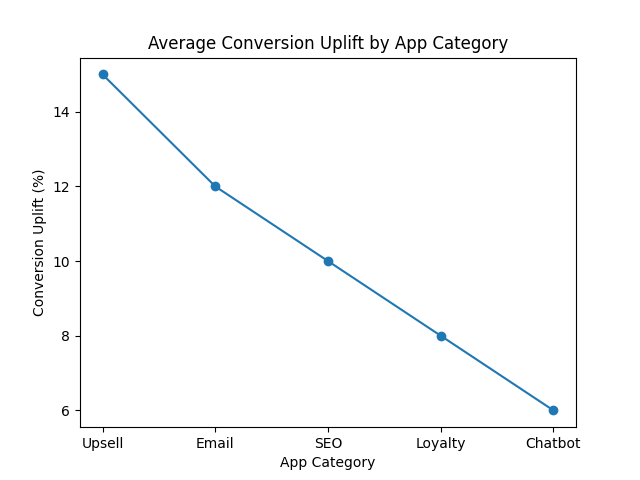
Key Insights from the Conversion Uplift Chart:
- Upsell & Cross-Sell Apps: Deliver the highest conversion gains due to targeted post-purchase and in-cart offers.
- Email Marketing Apps: Strong uplift driven by automated flows, retention sequences, and personalized messaging.
- SEO Optimization Tools: Improve discovery and organic conversions through better metadata and structured content.
- Loyalty & Rewards Apps: Encourage repeat purchases and strengthen customer lifetime value.
- Chatbots & Support Apps: Reduce drop-offs by providing shoppers with real-time, instant answers.
Marketing Channel Revenue Share of Shopify Apps
Different marketing channels contribute uniquely to Shopify store revenue, and understanding their impact helps merchants prioritize strategies that deliver the strongest returns. The pie chart below highlights how email, SMS, push notifications, social media, and loyalty programs influence sales distribution in 2026.
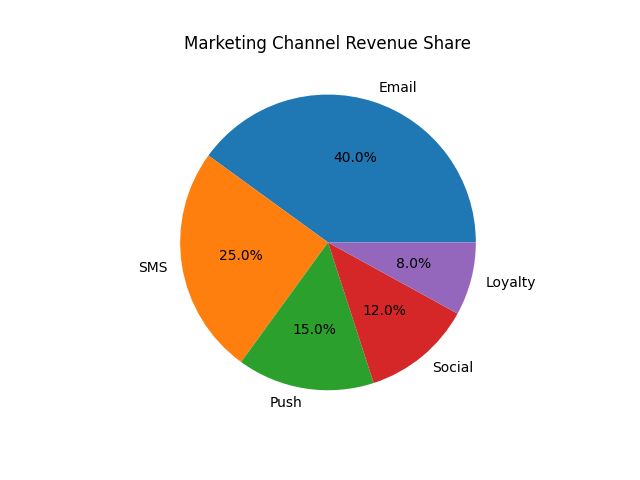
Key Takeaways from the Revenue Share Chart:
- Email Marketing: Generates the largest share of revenue due to automation, high open rates, and lifecycle flows.
- SMS Campaigns: Deliver strong performance for flash sales and time-sensitive promotions.
- Push Notifications: Re-engage shoppers instantly without relying on email or phone numbers.
- Social Media: Supports discovery and awareness but contributes less directly to conversions.
- Loyalty Programs: Drive repeat purchases by rewarding consistent customer engagement.
Best Free Shopify Tools for 2026
Merchants selling high-volume or fast-moving SKUs should also integrate reliable inventory management software to keep stock levels accurate and prevent overselling. These apps help merchants enhance marketing, product visibility, and overall store performance without recurring costs.
From improving search functionality to enabling essential email communication, free tools play a crucial role in scaling new and mid-sized brands. Shopify’s native search and discovery app shopify is especially useful for improving product findability and personalized recommendations.
Top Free Tools to Consider:
- Shopify Email: Essential for basic email campaigns
- Shopify Product Reviews: Collect ratings and social proof
- Google & YouTube Channel: Boost traffic and visibility
- Promo.com Video Maker: Create promotional videos
- Shopify Search & Discovery: Better filters and merchandising
Best Print-on-Demand (POD) Apps for 2026
Print-on-demand remains a popular business model in 2026, enabling merchants to launch customizable products without inventory risk. POD apps streamline product creation, fulfillment, and shipping, making it easy for creators and brands to scale unique merchandise.
Tools that offer fast production, global delivery, and high-quality mockups stand out as the best print on demand shopify apps for both new entrepreneurs and established businesses.
Top POD Apps to Use:
- Printful: Premium quality + automated fulfillment
- Printify: Wide supplier network with flexible pricing
- Gelato: Localized printing for faster delivery
- TeeLaunch: Apparel-focused POD options
- AOP+: UK-based, customizable product catalog
Best Dropshipping Apps for 2026
Dropshipping remains one of the most accessible business models for new Shopify merchants, and having the right tools is crucial for sourcing products, fulfilling orders, and managing suppliers.
In 2026, the most reliable shopify dropshipping apps offer fast shipping options, automated syncing, and large supplier networks to help merchants scale efficiently.
These apps streamline inventory updates, reduce errors, and ensure smooth order processing across global markets.
Top Dropshipping Apps to Use:
- DSers: Official AliExpress partner with bulk ordering
- Zendrop: Faster US shipping + private labeling
- Spocket: High-quality US/EU suppliers
- AutoDS: All-in-one automation suite
- CJ Dropshipping: Global warehouses and fast fulfillment
Best Checkout Optimization Apps for 2026
Checkout experience directly impacts revenue, and even minor friction can cause customers to abandon their carts. In 2026, merchants rely on streamlined checkout tools to reduce clicks, simplify payment options, and improve trust signals.
The best checkout apps for Shopify help optimize form fields, enable accelerated checkouts, and offer alternative payment methods that boost completion rates.
Top Checkout Optimization Apps:
- Shop Pay: Fast, trusted, accelerated checkout
- Sticky Add to Cart: Keeps the buy button always visible
- Checkout Blocks: Customizes checkout elements
- Rebuy Checkout: AI-driven upsells at checkout
- PayPal & GPay Integrations: Increases payment flexibility
Conclusion
Selecting the right tools can transform how efficiently a Shopify store grows in 2026. While every category serves a unique purpose, upsell tools, email automation platforms, and personalization engines consistently deliver the strongest ROI across industries.
To get the most out of these apps and optimize your store performance, many brands also invest in expert shopify development services to ensure seamless integration and long-term scalability.
Reviewing performance data, customer behavior, and long-term revenue impact helps merchants refine their tech stack. The best shopify apps to increase sales are those that enhance customer experience, reduce friction, and drive predictable revenue growth.
Key Takeaways:
- Prioritize apps with proven revenue impact
- Focus on automation and personalization
- Test and compare performance regularly
- Keep your tech stack lightweight and intentional.
Categories
Recent Posts
Popular Posts
- How to Choose a Reliable Offshore Development Partner?
- Transforming Web Development with HTMX’s Declarative Approach for Dynamic UIs
- Why Your Conversion Funnel Needs a Composable Commerce Solution?
- What is B2B Web Design? Benefits, Best Practices, and Examples
- Top 15 Ecommerce Growth Strategies to Maximize Sales in 2026