- What Is Shopify?
- What Is BigCommerce?
- BigCommerce vs Shopify Overview
- BigCommerce vs Shopify Pricing: What Will You Actually Pay?
- Ease of Use: Which Platform Is Simpler to Manage?
- Features Comparison: Built-In vs App-Dependent
- Design and Themes: How Does Your Store Look?
- SEO Capabilities: Which Platform Ranks Better?
- BigCommerce Enterprise vs Shopify Plus
- Payment Processing: Fees, Gateways, and Flexibility
- Apps and Integrations: Extending Your Store
- Customer Support: Who Has Your Back?
- Who Should Choose Shopify?
- Who Should Choose BigCommerce?
- Final Verdict: BigCommerce vs Shopify in 2026
If you are planning to launch an online store, chances are you have already come across two major eCommerce platforms: BigCommerce and Shopify. Both platforms are trusted by thousands of businesses worldwide, but choosing between them is not always easy.
Each platform offers powerful eCommerce features, customizable storefronts, payment integrations, and scalability. However, they are designed for different business needs. Picking the right platform can directly impact your store’s performance, growth, operational costs, and long-term flexibility.
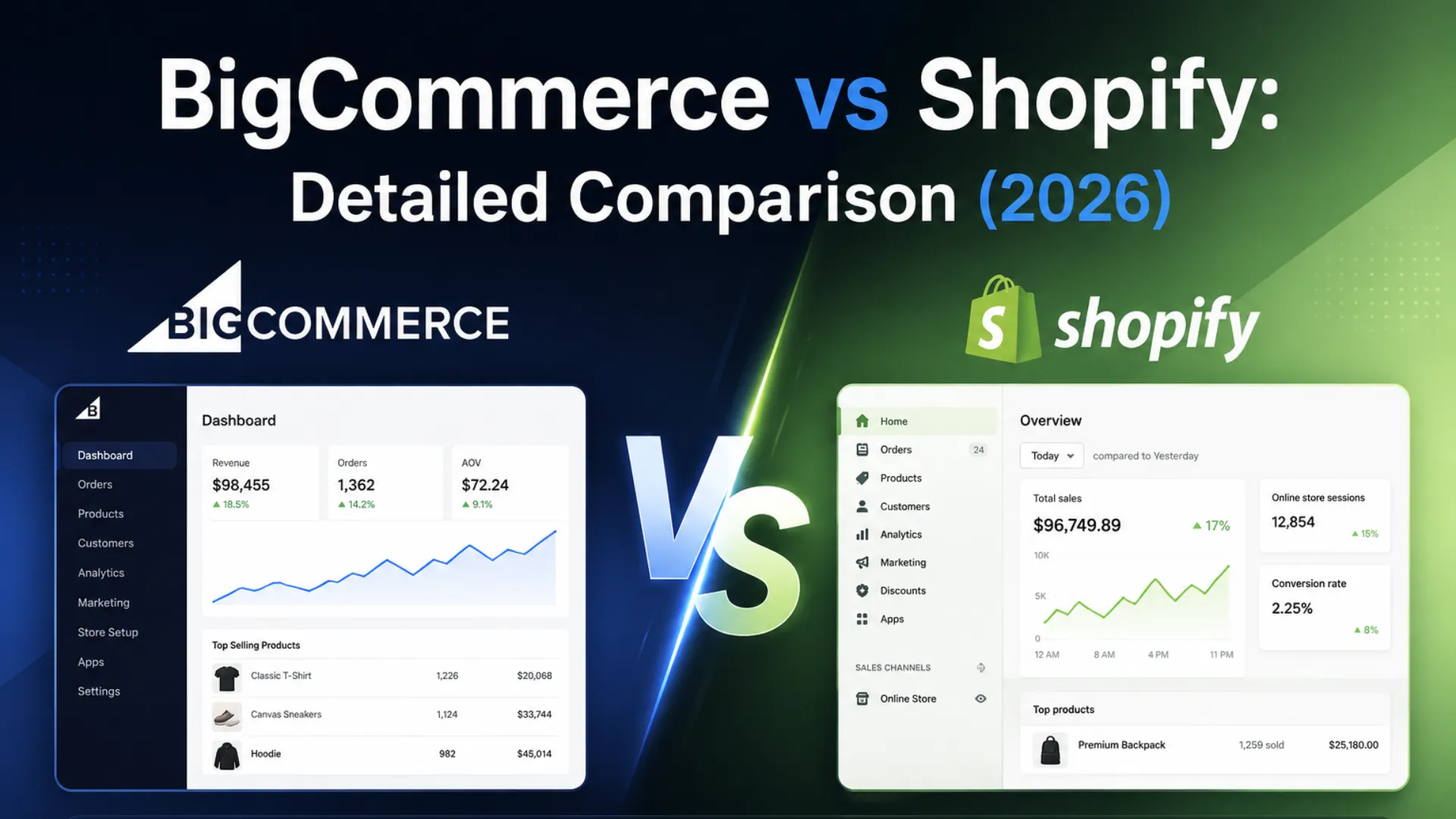
In this detailed BigCommerce vs Shopify comparison, we will break down everything you need to know, including pricing, ease of use, features, scalability, design flexibility, SEO capabilities, apps, and overall performance. By the end of this guide, you will have a clear understanding of which platform is the best fit for your online business. Quick Verdict Before We Dive In
- Choose Shopify if you want the easiest setup, the largest app ecosystem, and a platform that grows with you from day one.
- Choose BigCommerce if you have complex product catalogs, need advanced built-in features without relying on apps, or are running a B2B operation.
Now, let us dive deeper into the complete BigCommerce vs Shopify comparison and see which platform truly matches your business goals.
What Is Shopify?
Shopify is the most popular ecommerce platform in the world. It was built with one goal, to make selling online as simple as possible. Whether you are a solo entrepreneur selling handmade candles or a brand doing millions in revenue, Shopify scales with you. The platform handles everything from storefront design to payments to shipping, all under one roof.
If you have been exploring the benefits of Shopify or wondering whether to choose Shopify or Shopify Plus for your growing business, Shopify’s ecosystem makes both paths clear and accessible.
What Is BigCommerce?
BigCommerce is a robust ecommerce platform built for businesses that need more out of the box. Where Shopify keeps things simple, BigCommerce gives you more native features without needing third-party apps. It is particularly strong for mid-market and enterprise brands, especially those with complex catalogs or B2B needs.
If you are evaluating b2b ecommerce platforms, BigCommerce deserves serious consideration.
BigCommerce vs Shopify Overview
| Feature | Shopify | BigCommerce |
| Ease of Use | Excellent | Good |
| Built-in Features | Moderate | Extensive |
| App Ecosystem | 8,000+ apps | Smaller marketplace |
| Transaction Fees | Yes (unless using Shopify Payments) | None |
| Multi-currency Support | Yes | Yes |
| B2B Features | Limited (Shopify Plus and above) | Strong native B2B tools |
| SEO Tools | Good | Excellent |
| Starting Pricing | $39/month | $39/month |
| Annual Revenue Caps | None | Yes (plan-dependent) |
| Headless Commerce Support | Yes | Yes |
At a glance, Shopify stands out for its ease of use, massive app marketplace, and beginner-friendly ecosystem, making it ideal for startups, small businesses, and fast-growing DTC brands.
On the other hand, BigCommerce offers more built-in functionality, stronger native B2B capabilities, and advanced SEO controls, making it a solid choice for enterprise businesses, wholesalers, and stores with complex product catalogs.
Both platforms support Headless Commerce, multi-currency selling, and enterprise scalability, but the right choice ultimately depends on your business model, technical requirements, and long-term growth strategy.
BigCommerce vs Shopify Pricing: What Will You Actually Pay?
Pricing is never just the monthly subscription. Let us look at the real cost.
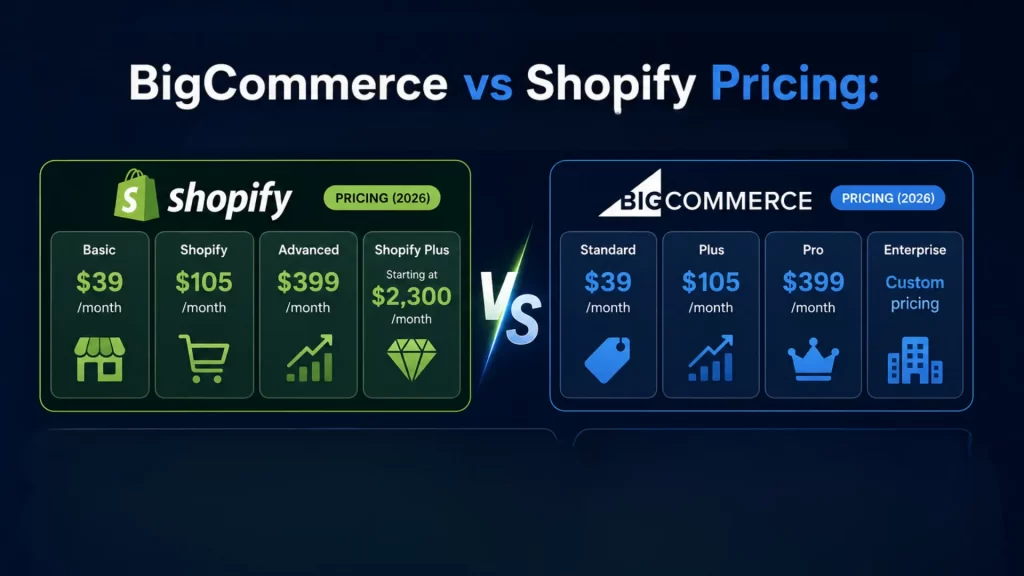
Shopify Pricing (2026)
- Basic: $39/month
- Shopify: $105/month
- Advanced: $399/month
- Shopify Plus: Starting at $2,300/month
Shopify charges transaction fees of 2%, 1%, and 0.5% on Basic, Shopify, and Advanced plans respectively. These fees disappear if you use Shopify Payments. If you use a third-party gateway, you pay every time a sale goes through. That matters. On $50,000 in monthly revenue, a 1% transaction fee is $500 gone every month.
If you are evaluating Shopify Plus development cost for enterprise needs, factor in both the platform fee and your development investment.
BigCommerce Pricing (2026)
- Standard: $39/month
- Plus: $105/mont
- Pro: $399/month
- Enterprise: Custom pricing
BigCommerce charges zero transaction fees. None. That is a meaningful advantage if your payment volume is high. The catch? BigCommerce ties plan limits to your annual revenue. On the Standard plan, you are capped at $50,000 per year. Hit that ceiling and you are automatically bumped to the next tier.
Which Is Cheaper?
For low-volume stores: roughly equal. For high-volume stores using third-party payment gateways: BigCommerce wins on fees. For enterprise: both go custom, so it depends on your negotiation and specific needs.
Ease of Use: Which Platform Is Simpler to Manage?
Shopify wins this round, and it is not particularly close. The Shopify dashboard is clean, intuitive, and forgiving. You can launch a functional store in a few hours without touching a single line of code. Product management, discount creation, shipping setup, it all follows a logical flow.
BigCommerce is not difficult, but it has a steeper learning curve. The additional built-in features come with additional menu items, settings, and decisions. If you are not tech-savvy, that can feel overwhelming at the start.
Think of it this way. Shopify is like an iPhone. BigCommerce is like Android with a custom launcher. Both are capable. One takes less time to figure out.
Features Comparison: Built-In vs App-Dependent
This is where BigCommerce genuinely shines.
What BigCommerce Includes Natively
- Multi-currency selling
- Advanced product filtering
- Customer groups and segmentation
- Faceted search
- B2B pricing tiers
- Abandoned cart recovery (all plans)
- Product reviews
What Shopify Requires Apps For
Many of the above features on Shopify require third-party apps. Abandoned cart recovery, for example, is only available on higher plans. Advanced product filtering often needs an app. B2B-specific pricing tools typically require Shopify Plus or a paid app.
Here is the trade-off: Shopify’s app ecosystem is massive. With over 8,000 Shopify apps to increase sales, you can add almost any functionality. But apps add monthly costs. A typical Shopify store running five to ten paid apps can add $100 to $500 per month to its expenses.
BigCommerce gives you more features in the box. That can simplify both your tech stack and your monthly bill.
Design and Themes: How Does Your Store Look?
First impressions drive sales. Your store’s design matters more than most people admit.
Shopify Themes
Shopify offers over 100 themes in its theme store. About a dozen are free. Paid themes range from $180 to $380. Every theme is mobile-responsive and professionally designed. The Shopify theme editor is drag-and-drop, making it easy to customize without a developer.
For deeper customization, Shopify uses its own templating language called Liquid. If you need a fully bespoke storefront, partnering with Shopify development services gives you the flexibility to build anything you envision.
BigCommerce Themes
BigCommerce has a smaller theme library, around 200 themes total, with a handful of free options. Paid themes run $150 to $400. The Stencil framework that powers BigCommerce themes is developer-friendly and supports advanced customization.
For complex design work, bigcommerce development services can help you build a custom experience that aligns with your brand.
Winner on Design
Roughly equal for standard stores. Shopify has a slight edge for non-developers due to its more intuitive editor. BigCommerce has an edge for developer-driven customizations.
SEO Capabilities: Which Platform Ranks Better?
Both platforms support solid SEO practices. But there are meaningful differences worth knowing.
BigCommerce SEO Strengths
- Automatically generates SEO-friendly URLs
- AMP (Accelerated Mobile Pages) support out of the box
- Better control over URL structures
- Strong canonical tag handling
- No need for SEO apps to manage basics
Shopify SEO Strengths
- Fast page load speeds (important for Core Web Vitals)
- Large selection of SEO apps for advanced needs
- Clean site architecture
- Built-in blog for content marketing
BigCommerce has a slight technical SEO edge due to its URL control and AMP support. Shopify makes up ground through its performance and content marketing tools.
If SEO is a top priority, staying informed about Shopify trends for ecommerce will also help you leverage new features as the platform evolves.
BigCommerce Enterprise vs Shopify Plus
When businesses hit scale, they graduate to enterprise-level solutions.
Shopify Plus
Shopify Plus starts at $2,300/month. It offers dedicated support, advanced automation through Shopify Flow, custom checkout experiences, and multi-store management. It is the choice for high-growth DTC brands.
Shopify Plus also unlocks headless commerce capabilities, allowing you to use Shopify as a backend while building your frontend with any technology you choose.
BigCommerce Enterprise
BigCommerce Enterprise is custom-priced and built for complex operations. It offers deeper B2B functionality, native multi-storefront management, advanced analytics, and strong integrations with ERPs and PIMs.
If your business involves wholesale pricing, complex catalogs, or multi-regional selling, BigCommerce Enterprise offers those capabilities natively where Shopify Plus may require additional development.
Which Enterprise Platform Wins?
For B2B and catalog-heavy businesses: BigCommerce. For DTC brands with strong marketing operations: Shopify Plus.
Payment Processing: Fees, Gateways, and Flexibility
Shopify Payments
Shopify’s built-in payment processor is available in most major markets. Rates start at 2.9% + 30 cents and decrease on higher plans. Use Shopify Payments and your transaction fees disappear entirely.
The limitation is that Shopify Payments is not available in every country, and if you use a third-party gateway, those transaction fees kick in.
BigCommerce Payments
BigCommerce integrates with over 65 payment gateways and charges zero transaction fees regardless of which one you use. That is a genuine differentiator. For businesses operating internationally or those already locked into a preferred gateway, BigCommerce offers more flexibility without a financial penalty.
Apps and Integrations: Extending Your Store
Shopify App Store
With over 8,000 apps, the Shopify App Store is unmatched. Need email marketing? Loyalty programs? Subscription billing? AI product recommendations? There is an app for it. The depth of Shopify’s ecosystem means you can build almost any kind of store, and find proven solutions for almost any problem.
BigCommerce App Marketplace
BigCommerce’s marketplace is smaller but still covers all the essential categories. The key difference is that BigCommerce needs fewer apps because more functionality is built in. If you are building a store that needs deep custom integrations, exploring custom web development services alongside either platform gives you the flexibility to connect any system you need.
Customer Support: Who Has Your Back?
Both platforms offer 24/7 support via live chat, email, and phone.
- Shopify’s support is widely regarded as responsive and helpful. The Shopify community forums are also active, meaning most questions have been answered somewhere already.
- BigCommerce support is equally responsive and offers dedicated account managers on higher plans. Their documentation is thorough and well-organized.
Neither platform leaves you stranded. On this front, it is a tie.
Who Should Choose Shopify?
Shopify is the right choice if:
- You are launching your first store and want a smooth setup experience
- You want access to the largest app marketplace for any functionality you might need
- You are a DTC brand focused on marketing, conversions, and customer experience
- You plan to scale to Shopify Plus and want a unified ecosystem from day one
- You want strong mobile commerce capabilities
Who Should Choose BigCommerce?
BigCommerce is the right choice if:
- You have a large or complex product catalog
- You are selling B2B and need features like customer groups, price lists, and bulk ordering
- You want to avoid transaction fees without being locked into a specific payment processor
- You need strong multi-currency and multi-language support out of the box
- You are a mid-market or enterprise brand evaluating platforms for long-term growth
Final Verdict: BigCommerce vs Shopify in 2026
There is no universally correct answer here. Both platforms are genuinely excellent at what they do. Shopify is the best ecommerce platform for most businesses, especially those starting out, scaling DTC brands, and any company that values simplicity and ecosystem depth. Its ease of use, massive app store, and clear upgrade path to Shopify Plus make it a safe, powerful choice for the majority of merchants.
BigCommerce earns its place for businesses with more complex needs, particularly B2B sellers, catalog-heavy operations, and brands that want more built-in functionality without a growing stack of apps and fees.
Before committing to either platform, consider where your business is today and where it will be in three years. The best platform is the one you will not have to migrate away from.
Tags
Categories
Recent Posts
Popular Posts
- How to Choose a Reliable Offshore Development Partner?
- Transforming Web Development with HTMX’s Declarative Approach for Dynamic UIs
- Top 15 Ecommerce Growth Strategies to Maximize Sales in 2026
- What is B2B Web Design? Benefits, Best Practices, and Examples
- Why Your Conversion Funnel Needs a Composable Commerce Solution?