- What is Headless Commerce?
- What is Composable Commerce?
- Difference Between Composable Commerce and Headless Commerce
- Benefits of Headless Commerce
- Headless Commerce Use Cases
- Key Benefits of Composable Commerce
- Composable Commerce Use Cases
- Headless Commerce Platform Options
- Composable Commerce Platform Options
- Composable Commerce vs Headless Commerce Platforms Comparison
- Headless vs Composable for B2B and Enterprise
- Why Does Composable Commerce Matter in Modern eCommerce
- Choosing Between Headless Commerce vs Composable Commerce
- Conclusion
Modern eCommerce is no longer just about selling online. It is about delivering fast, personalized, and seamless experiences across every digital touchpoint. According to Grand View Research, the global eCommerce market size was $25.9 trillion in 2023 and is expected to reach $83.3 trillion by 2030, indicating strong growth over the next few years.
As brands rethink their technology stacks, one debate keeps coming up around composable commerce vs headless commerce. Both approaches promise flexibility, scalability, and better customer experiences, but they are built on different architectural ideas and serve other business needs.
So, which approach is right for your business? In this blog, we’ll break down the key differences between headless and composable commerce, explore their benefits, and use cases. We will also compare leading platforms and help you decide which model fits your eCommerce growth strategy, technical maturity, and long-term digital goals.
What is Headless Commerce?
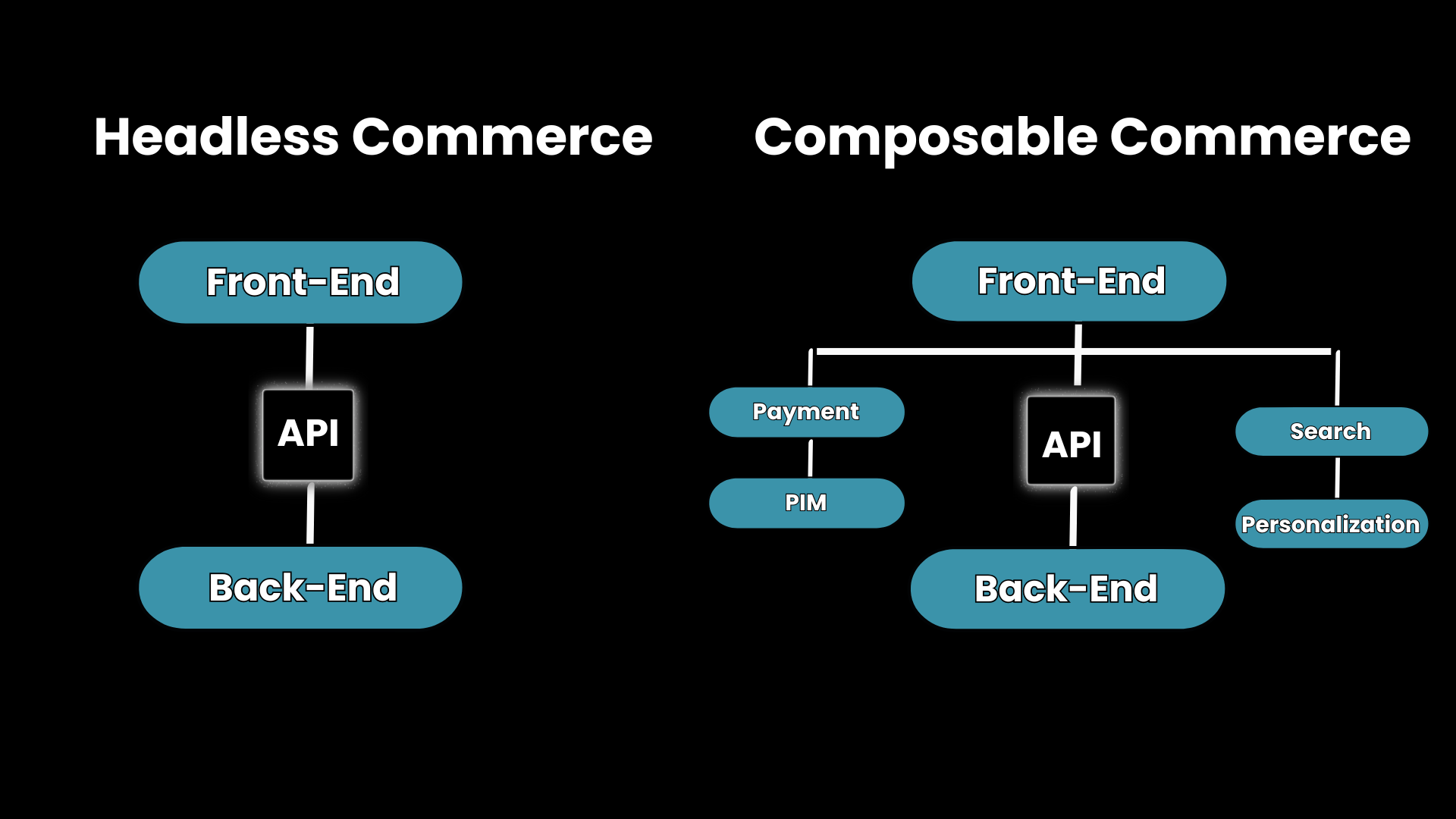
Headless commerce is an eCommerce architecture where the frontend presentation layer is separated from the backend. In simple terms, the “head” or user interface is decoupled from the system that manages products, carts, orders, and payments. This separation allows brands to design and deliver any kind of customer experience through custom ecommerce website development without being restricted by backend limitations.
In a traditional setup, the frontend and backend are tightly connected. That makes changes slow and customization harder. With headless commerce architecture, developers use APIs to connect the backend to any frontend, such as a web storefront, mobile app, kiosk, or even voice and IoT devices.
This API-driven approach gives teams much more freedom to innovate. If you’re planning to build or migrate, our headless commerce development guide can help you choose the right stack and best practices.
Businesses can use modern frameworks such as React, Vue, or Next.js to build fast, engaging interfaces while relying on a robust backend to handle core commerce functions. Popular headless commerce examples include Shopify, Magento, BigCommerce, and Salesforce Commerce Cloud.
What is Composable Commerce?
Composable commerce is an eCommerce approach in which businesses build their digital commerce stack from independent, best-of-breed components rather than relying on a single, all-in-one platform. Each part of the system, such as product management, search, payments, promotions, or content, works as a separate service and connects through APIs.
This modular setup allows teams to pick only what they need and change or upgrade components without disrupting the whole system. It is especially useful for fast-growing and enterprise businesses that want agility, scalability, and freedom from vendor lock-in.
What truly sets composable commerce architecture apart is its flexibility to adapt, scale, and innovate without constraints. Brands can design a commerce ecosystem that aligns with their specific business goals and evolve it as needs change. Some popular composable commerce examples include commercetools, Spryker, Elastic Path, and VTEX.
Difference Between Composable Commerce and Headless Commerce
This section breaks down the core differences between composable commerce vs. headless commerce. We will compare architecture, flexibility, complexity, and use cases so you clearly understand how each model supports modern eCommerce needs.
| Aspect | Composable Commerce | Headless Commerce |
| Core Concept | Builds the entire commerce stack from independent, modular services. | Separates the frontend from a single backend commerce system. |
| Architecture | Microservices-based architecture with multiple best-of-breed components connected via APIs. | Decoupled frontend with one core backend connected via APIs. |
| Scope | Covers frontend, backend, and all commerce capabilities | Focuses mainly on presentation layer flexibility. |
| Flexibility | Extremely high flexibility across the whole commerce system. | High flexibility in UI and customer experience design. |
| Customization | Customize every part of the stack, from search to checkout to content | Customize the frontend without touching backend logic. |
| Complexity | Higher complexity. Requires strong technical planning and integration. | Lower to moderate complexity. Easier to implement. |
| Scalability | Scales across services, features, and business growth. | Scales well for channels and experiences |
| Best For | Enterprises need complete control and best-of-breed technology choices. | Brands wanting better UX with an existing commerce engine |
| Time to Implement | Longer setup due to multi-vendor integration | Faster setup and quicker wins. |
| Cost | Higher upfront cost, but better long-term ROI for large systems. | Generally, lower initial cost. |
Benefits of Headless Commerce
Headless commerce is quickly gaining traction as the future of digital commerce, driving substantial business investment. The global market is expected to be worth $1.74 billion in 2025 and grow to about $7.16 billion by 2032. Now, let’s explore the key advantages of headless commerce below:
-
Freedom to Design Better User Experiences
Headless commerce lets you build custom storefronts with modern frameworks, enabling you to deliver unique, engaging, and brand-focused experiences without being constrained by backend limitations.
-
Faster Website Performance
By using lightweight frontends and optimized APIs, headless setups improve page speed, which boosts user experience, SEO rankings, and conversion rates.
-
True Omnichannel Delivery
A single backend can power multiple channels, such as web, mobile apps, kiosks, and IoT devices, ensuring a consistent experience across every customer touchpoint.
-
Faster Innovation and Updates
Teams can update or experiment with frontend features without touching backend systems, making it easier to roll out changes and respond to market needs quickly.
-
Future-Ready Flexibility
The decoupled structure makes it simpler to adopt new technologies and channels over time, helping your commerce stack stay adaptable and future-proof.
Headless Commerce Use Cases
Let’s look at practical use cases of headless commerce that help businesses deliver better performance and flexibility.
-
Custom Brand Storefronts
Brands that want full control over design use headless commerce to build unique, high-performance storefronts that stand out without being limited by traditional templates.
-
Omnichannel Retail Experiences
Headless commerce powers multiple touchpoints like websites, mobile apps, in-store kiosks, and smart devices from one backend. It ensures consistent customer journeys across the board, especially when integrated with ecommerce inventory management software for real-time stock visibility.
-
Content-Driven Commerce
Businesses that use rich content, blogs, or storytelling integrate a headless CMS with commerce backends to blend content and shopping into a seamless experience.
-
Mobile-First and App Experiences
For brands focusing on mobile apps, headless commerce provides APIs that deliver fast, app-native shopping experiences optimized for smartphones and tablets.
-
Rapid Experimentation and A/B Testing
Marketing teams use headless setups to test layouts, features, and journeys quickly, without disrupting backend systems or checkout workflows.
Key Benefits of Composable Commerce
In this part, we’ll highlight the key composable commerce benefits, including business agility, best-of-breed technology choices, faster time-to-market, and the ability to scale and adapt as your needs evolve.
-
Build with Best-of-Breed Technologies
Composable commerce lets you choose the best tool for each function, such as search, payments, PIM, or CMS, instead of settling for one all-in-one platform.
-
Unmatched Business Agility
You can add, replace, or upgrade individual components without affecting the whole system, helping your business adapt quickly to market changes across the funnels of Composable Commerce.
-
Scales as Your Business Grows
Each service can scale independently, making composable commerce ideal for high-traffic stores and enterprises with complex and evolving needs.
-
Reduced Vendor Lock-In
Since components are independent, you are not tied to a single vendor. This gives you more control over costs, roadmap decisions, and long-term strategy.
-
Future-Ready Architecture
Built on APIs, microservices, and cloud-native tools, composable commerce makes it easier to adopt new technologies and stay competitive as digital commerce evolves.
Composable Commerce Use Cases
Explore real-world use cases of composable commerce that help businesses handle complexity and scale with ease.
-
Enterprise eCommerce Ecosystems
Large businesses use composable commerce to manage complex catalogs, multiple brands, and high traffic by assembling a flexible stack tailored to their specific operational needs.
-
B2B Commerce with Complex Workflows
Composable commerce requirements work well for B2B scenarios that involve custom pricing, bulk ordering, contract management, and deep ERP or CRM integrations.
-
Rapid Innovation and Experimentation
Teams can quickly introduce new services, such as advanced search or AI-driven personalization, without reworking the entire commerce system.
-
Global and Multi-Region Expansion
Brands expanding into new markets use composable stacks to localize payments, taxes, languages, and content by swapping or adding regional services.
-
Modernization of Legacy Systems
Organizations modernize step by step by replacing legacy components with modern microservices, reducing risk as they move toward a future-ready commerce architecture.
Headless Commerce Platform Options
This section introduces headless commerce platforms, explains what to look for when choosing one, and shows how these solutions help you build flexible storefronts powered by robust backend commerce capabilities.
-
All-in-One Platforms with Headless Capabilities
Platforms like Shopify, Magento, BigCommerce, and Salesforce Commerce Cloud offer headless support, letting you keep their backend while building a custom frontend using APIs.
-
API-First Commerce Backends
These solutions focus on strong APIs to handle core commerce features such as catalog, cart, and checkout, making them ideal for fully custom frontend experiences.
-
Headless Commerce with CMS Integration
Many brands pair a headless commerce backend with a headless CMS to blend rich content and shopping into a single, seamless digital experience.
-
Cloud-Native and Scalable Solutions
Modern headless platforms are cloud-based, which helps businesses scale automatically during traffic spikes and ensure high availability.
Best Headless Commerce Platforms
- Shopify Headless Commerce – Shopify Headless Commerce is an easy-to-use backend with powerful APIs and the Hydrogen framework for building fast, custom storefronts.
- Magento (Adobe Commerce) Headless – Flexible, enterprise-ready platform with GraphQL APIs for complex and highly customized experiences.
- BigCommerce Headless – API-first approach with strong native integrations and support for multiple frontend frameworks.
- Salesforce Commerce Cloud Headless – Scalable cloud platform for large brands needing deep personalization and omnichannel capabilities.
- Commerce.js – Lightweight API-based commerce backend ideal for startups and custom headless builds.
Composable Commerce Platform Options
Here, we’ll look at composable commerce platforms, the tools they offer, and how they enable you to assemble a tailored commerce stack using microservices, APIs, and cloud-native technologies.
Best Composable Commerce Platforms
- Commercetools: API-first platform with modular services for building flexible, scalable commerce stacks.
- Spryker: Enterprise-grade composable solution with rich microservices and marketplace capabilities.
- Elastic Path: A Headless and composable commerce platform focused on customizable workflows and enterprise needs.
- VTEX: Composable platform with built-in marketplace, OMS, and omnichannel capabilities.
- Fabric: Composable commerce backend with flexible APIs for cart, checkout, and other core commerce functions.
Composable Commerce vs Headless Commerce Platforms Comparison
In this section, we’ll present a side-by-side comparison of headless vs composable commerce platforms, helping you evaluate features, flexibility, costs, and use cases to identify the best fit for your business.
| Aspect | Headless Commerce Platforms | Composable Commerce Platforms |
| Platform Type | One core commerce platform with headless APIs. | A set of best-of-breed platforms combined into a stack. |
| Examples | Shopify, Magento, BigCommerce, Salesforce CC. | commercetools, Spryker, Elastic Path, VTEX |
| Backend Setup | Single backend system. | Multiple independent services. |
| Customization Level | Frontend-heavy customization. | Customization across all services. |
| Integration Style | Integrate around one central platform. | Integrate many platforms via APIs |
| Scalability | Scales the main platform | Scales each service independently. |
| Vendor Dependency | Moderate, tied to one vendor | Low, services can be swapped. |
| Implementation Effort | Lower and faster. | Higher needs orchestration |
Headless vs Composable for B2B and Enterprise
In this section, we’ll compare headless vs composable commerce for B2B and enterprise businesses, focusing on scalability, integration needs, complex workflows, and which approach fits large, fast-growing organizations best.
Business Complexity
- Headless: Best for moderate complexity, where UX flexibility is the main goal.
- Composable: Ideal for highly complex B2B workflows and enterprise operations.
Pricing & Catalog Management
- Headless: Handles standard pricing and catalogs well with a single backend.
- Composable: Excels at custom pricing, contract catalogs, and multi-brand setups.
Integrations with ERP & CRM
- Headless: Integrates, but often via a single core platform.
- Composable: Designed for deep, flexible integrations with ERP, CRM, and legacy systems.
Scalability
- Headless: Scales channels and experiences effectively.
- Composable: Scales each service independently for enterprise-level growth.
Time to Value
- Headless: Faster to implement and easier to manage initially.
- Composable: Takes longer to set up, but pays off in the long term for greater agility.
Overall Fit
- Headless: Good for businesses upgrading UX without a significant backend change.
- Composable: Better choice for most B2B and enterprise organizations needing full control, flexibility, and future-ready architecture.
Why Does Composable Commerce Matter in Modern eCommerce
Today, businesses need more than just a functional online store. They require the ability to adapt quickly, experiment with new technologies, and deliver personalized experiences across channels. This is where composable commerce solutions truly matter.
Instead of being locked into a rigid, all-in-one platform, brands can build a commerce stack that fits their exact needs and evolve it over time. As customer expectations, markets, and technologies change, composable commerce provides organizations with the agility and resilience needed to stay competitive and future-ready.
Key Reasons why composable commerce matters:
- Business agility: Add, replace, or upgrade components without disrupting the entire system.
- Best-of-breed approach: Choose the strongest tools for search, payments, CMS, or PIM rather than settling for a single vendor.
- Faster innovation: Test and launch new features quickly using modular services and APIs.
- Scalability: Scale individual services as demand grows, not the whole platform.
- Reduced vendor lock-in: Maintain control over your stack and roadmap.
- Future readiness: Easily adopt emerging technologies and new channels as they appear.
Choosing Between Headless Commerce vs Composable Commerce
Here, we’ll guide you through choosing between headless and composable commerce based on your business goals, technical maturity, budget, and long-term growth strategy, so you can make a confident decision.
-
Start with Your Business Goals
If your main goal is to improve user experience and frontend flexibility, headless commerce is often enough. If you want full control across the entire commerce stack, composable commerce is the better fit.
-
Assess Your Technical Maturity
Headless works well for teams with moderate development skills, while composable commerce requires strong technical expertise to manage microservices, APIs, and integrations.
-
Consider Your Complexity and Scale
For simple to mid-level operations, headless keeps things manageable. For complex catalogs, workflows, and multi-brand setups, composable commerce offers more long-term value.
-
Evaluate Integration Needs
If you rely on deep ERP, CRM, or legacy integrations, composable commerce provides more flexibility to connect and evolve systems independently.
-
Think About Speed vs Long-Term Agility
Headless is faster to implement and delivers quick wins. Composable takes longer upfront but supports continuous innovation and future growth.
-
Plan for the Future
Choose headless if you want to modernize UX today. Choose composable if you are building a future-ready digital commerce foundation that can evolve for years to come.
Conclusion
The debate around composable commerce vs headless commerce is not about which model is universally better, but about which one fits your business today and tomorrow. Headless commerce development is a wise choice if your priority is creating faster, more engaging customer experiences without changing your core backend. It delivers quick wins and helps brands modernize their storefronts with flexibility.
Composable commerce, on the other hand, is built for long-term agility. It empowers businesses, especially B2B companies and large enterprises, to assemble a best-of-breed commerce stack, scale each component independently, and adapt continuously as markets and technologies evolve. While it requires more planning and technical maturity, the payoff is a future-ready architecture that supports innovation without limits.
Looking to modernize your eCommerce platform? Partner with CSSChopper to assess your needs, design the right architecture, and help you implement a headless or composable commerce solution tailored to your business goals.
Tags
Categories
Recent Posts
Popular Posts
- How to Choose a Reliable Offshore Development Partner?
- Transforming Web Development with HTMX’s Declarative Approach for Dynamic UIs
- Top 15 Ecommerce Growth Strategies to Maximize Sales in 2026
- What is B2B Web Design? Benefits, Best Practices, and Examples
- Why Your Conversion Funnel Needs a Composable Commerce Solution?