In most business meetings, one emerging topic of discussion has been web application development lately. That being considered, teams jump to approach, methodology, tech stack, and framework decisions all too soon. Instead, research should be built around what they are actually trying to build and what goals this platform has to meet.
With this pretext, we can understand that in the case of choosing among popular web development technologies, there is no single decision, but a bunch of them that help leaders make the right choice ultimately. It can be related to the application that you want to build, how its structure is planned, its complexity, integrations, and much more. Moreover, these aspects are based on various industry-related factors, such as whether a website is being built for a SaaS business, a simple website, or an eCommerce startup.
Thus, choosing the right type of web development is tricky, and it directly impacts your user experience. What’s more, it also influences how the system can manage higher operational load, scalability, performance, and the related long-term costs.
With this perspective, this comprehensive guide helps decision-makers understand and closely understand the main types of web development, thereby assisting them in making the right choices for their business. Overall, this will help them figure out the best working web development plan for the enterprise.
What is Web Development?
For teams that have experience working on many web development projects, they know that this term might sound pretty simple on the surface. But it has many key decisions that affect business performance in real-time.
Simply put, you might think that this term plainly means building websites or web applications. However, in practice, it includes planning the system, designing it, and maintaining it as well while handling real customers and managing their expectations 24*7. Here, it is necessary that the website can perform when the number of users increases.
So, there are three aspects that every web project team focuses on:
- What the user interacts with (frontend)
- What processes the logic (backend)
- How data is stored and moved around (databases and APIs)
Furthermore, aspects like choosing the right features and managing client expectations are another key part of these projects. Mostly, many clients expect a higher time-to-market, SEO, system performance, and promising user engagement.
So, all the teams’ decisions, like choosing the strategies for web development, framework, tech stack, and much more, help build a scalable, fast website or application that can meet these expectations.
What are the Key Types of Web Development for Businesses?
Moving forward, this web development guide helps leaders understand the different types of web development. For teams working on a project, this knowledge is very valuable as it will help you compare and choose which type of web development suits your project the best.
Mainly, this decision can be made based on three key aspects, which are:
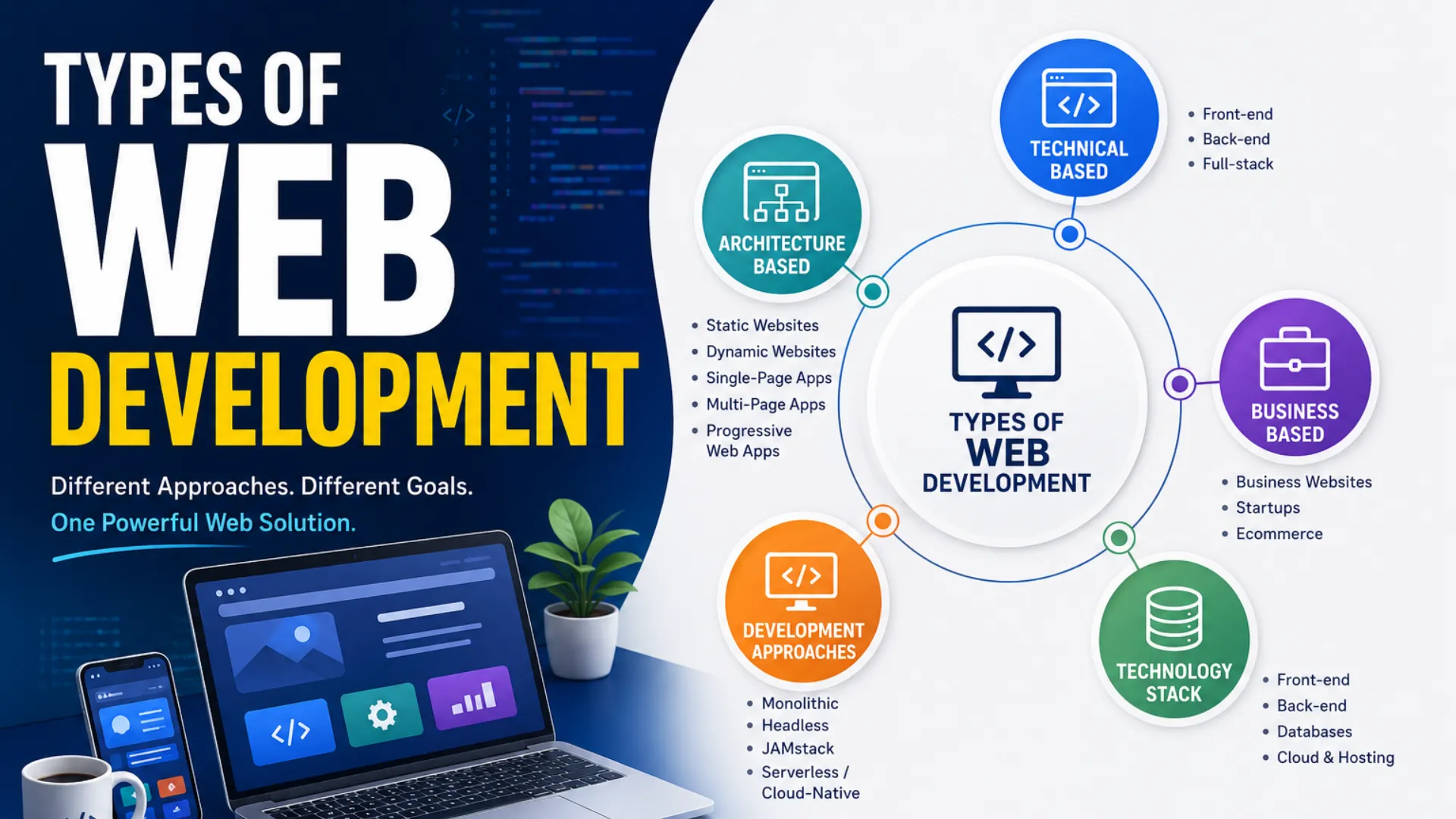
- Type of Technical Architecture (Front-end, Back-end, and Full-stack)
- Type of Web Application (Static, Dynamic, Single-page, Multi-page, Progressive web apps), and lastly
- The business industry that this app or website will serve (is it a simple business website, startup product, SaaS, or ecommerce web development)
Let us understand all these types of website development in more detail below, so that your project can fast-forward towards the right direction.
1. Web Development Based on Technical Web Development
As we know, most teams start by building the app’s structure and defining its planned performance, workload, and complexity. Herein, most focused web development strategies involve three key elements that are explained individually below:
Frontend Web Development
Frontend development simply means that development teams work on the UI layer in modern apps that the users interact with. However, it is not that simple. This element also involves handling data, rendering strategies, and the performance of the website.
In most websites, this layer works on maintaining a flexible layout for the users, which is consistent and responsive at all times. And for SaaS products, it also involves managing high-end workflows, APIs, caching, and much more. Overall, this decides how the users will experience a website in real-time.
Backend Web Development
Backend development is where the teams work on developing the actual business logic. Mainly, here professionals focus on authentication, data processing, APIs, and third-party integrations, among other aspects that help the backend layer perform in real-time.
In fact, working on this can solve the operational problems that can come up in your system in the long-run. For simple websites, this might just mean working on the CMS. But for e-commerce, this may mean working on handling payments, user data, workflows, and much more.
Here, there is one thing that teams need to understand. Backend decisions are hard to correct. So, if you create a basic API design or ignore scalability early, this might be an expensive problem to fix later.
Full-Stack Web Development
Full-stack development means managing both the frontend and backend, especially for emerging companies and startups. Usually, this is managed by a single trained developer or a smaller team of professionals.
Here, the key to success lies in understanding that speed matters much more than being perfect in terms of website architecture.
This is why it is most suitable for MVPs and early-stage products, where projects need to be managed smoothly and in a reliable manner. What’s more, this can actually help teams develop prototypes faster, thereby tailoring their website development project based on the enterprise’s goals and complexity.
And accordingly, if the tradeoff between frontend vs backend vs full-stack still doesn’t look good, teams can also opt for a custom web development type to meet their planned goals.
2. Web Development Based on the Architecture of the Digital Platform
After deciding on these aspects, leaders must also determine how the app must perform and how users experience it. Additionally, it also impacts the team’s workflows in the long run.
That being said, this choice can be better understood below:
Static Websites
Simply speaking, a static website has pre-built pages that are fast, secure, and easy to launch. This is because the content here remains fixed and is shown to all users based on what is stored at the server end.
Functionally, this works well for marketing sites and company pages that do not need many content changes.
Moreover, this may not be considered the best option for teams that want dynamic features, like higher personalization and sharing of real-time updates with the users.
Dynamic Websites
Well, a dynamic website, as the name suggests, helps teams deliver tailored content to the target audience. Essentially, this is done by adaptively creating content on the server-side, which is backed by strong database management.
However, these are more complex to manage than static websites. So, here the dynamic features need to be more insightfully organized to ensure that the website does not perform slowly or inefficiently on the frontend.
Single-Page Applications (SPAs)
The next part of this list of drop-downs is SPAs. Functionally, these apps load once, and the content can be dynamically updated without a full-page reload. This helps create a smooth, app-like experience for the users.
That being said, they are great for SaaS platforms that need highly interactive tools. However, they are more complex to manage operationally, compared to the other web development types, as it makes SEO performance trickier.
Multi-Page Applications (SPAs)
MPAs, on the contrary, follow a more traditional model. Here, teams focus on building pages in a way that each interaction loads a new page, which might be slow and content-heavy.
But the trade-off is that they may be easy to manage from an SEO standpoint. In the real world, teams want both fluidity and SEO, so they generally opt for a hybrid approach by using an MPA structure with SPA-focused features.
Progressive Web Applications (PWAs)
PWAs are modern interfaces that offer offline access, push notifications, and more app-like features (while being a website). Particularly, they are useful in eCommerce industries where users might download an app later, but the website needs to be optimized for a mobile screen to allow higher engagement and repeat usage.
Overall, PWAs are powerful feature-wise. This is why they are also operationally complex to manage, and teams need more professional expertise for this purpose.
3. Web Development Based on Business Needs
This is the layer that often gets overlooked by leaders. However, this is a very important aspect that decides the type of web development teams should choose.
So, to choose the right web setup based on the business needs, companies can explore the following descriptive categories of web development mentioned below.
Corporate Business Websites
These are usually focused on gaining visibility and user reach. Furthermore, they also impact branding and lead generation by allowing faster load times, promising SEO performance, and an easy CMS system.
In most cases, simple architectures work best for a service or a corporate-focused website. Stuffing in too many features overcomplicates the platform, thereby affecting user experiences.
Startups
Generally, startup projects are focused less on perfection and aim more at speed and adaptability. This is why emerging brands focus on building websites that can deploy faster and perform flexibly to allow users to interact more with the brand online.
A greater challenge for startups is balancing speed and scalability, which is why SPAs or a hybrid approach of SPAs and MPAs can work great for emerging brands.
Ecommerce
In the ecommerce segment, companies need a website that can naturally manage multiple aspects like a huge volume of transactions, payments, and performance all at once.
This is why the backend needs to be heavy and integration-friendly. Here, PWAs are commonly opted for by development teams for scaling. What’s more, this helps ensure seamless performance online.
Overall, understanding these types of web development is a great start for a real project that involves building and designing a web platform. Furthermore, it is necessary to keep the business goals clear while focusing on scalability from day one.
Types of Website Development Approaches
Up to this point, we’ve looked at web development in terms of structure. Moving forward, let us now examine how these layers are built in terms of the development approach.
That being said, here are some of the key web development approaches that are adopted by leaders today.
1. Monolithic Development
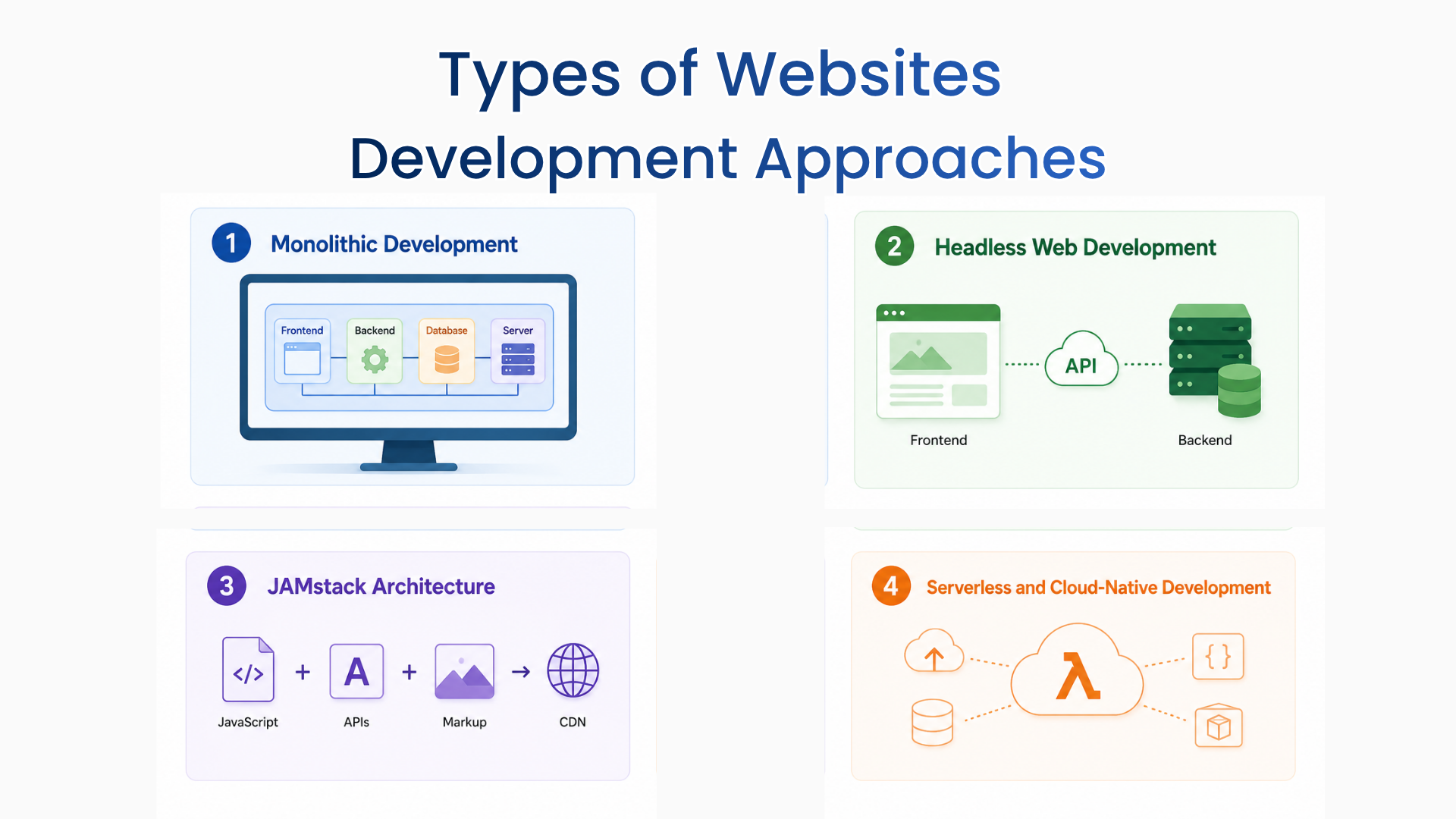
Monolithic setups are where the frontend and backend layers, along with database management, are tightly coupled together in a codebase. Comprehensively, this is simpler to build and deploy. This is why, for smaller business websites, this can be a very practical choice.
However, the downside is that as the system grows, a single change in one layer can affect the others, leading to riskier deployments and possible downtime. So, as a business scales, they need to optimize this approach and allow more flexibility to manage the entire codebase.
2. Headless Web Development
This approach segregates the frontend from the backend entirely. Both of these layers are still connected through APIs to offer better flexibility and performance for simpler and complex projects.
Overall, we can say that this approach provides more operational control, which is needed for eCommerce brands and content-intensive systems. However, it is necessary that teams maintain oversight of content and dynamic SEO features to ensure consistent performance in this approach.
3. JAMstack Architecture
JAMstack stands for JavaScript, APIs, and Markup. This approach focuses on serving pre-rendered content, but with dynamic functions handled through APIs. In practice, this means that the frontend layer shows adaptive content through a CDN, while aspects like managing forms, authentication, and payments are handled externally.
Mainly, this approach is best for dynamic marketing platforms, where multiple APIs are needed to ensure higher performance and system flexibility.
4. Serverless and Cloud-Native Development
Serverless and cloud-native approaches are the new-age approach that teams adopt when they look for managing scalability and performance simultaneously. That being said, here, managing the infrastructure when the traffic is high is not a challenge due to modern cloud capabilities.
However, this approach can be difficult to manage in terms of vendor lock-in and cost factor, which may be high and unpredictable over time. So, keeping an account of the budget for this project is necessary.
Finally, what’s worth keeping in mind is that the right approach should always suit your present and future project needs and scalability.
Key Technologies Supporting Web Development
At this point, to make this research more intensive for decision-makers, let us now define the tech stack that is necessary to build a reliable website architecture in 2026.
This knowledge is shared in a simplified manner in the table below.
| Layers | Descripion | Technology Stack | Where it Works Well |
| Frontend | Focuses on the user interface, rendering, state management, and APIs | React, Vue, Angular, HTML/CSS/JS | Helps in developing interactive apps, dashboards, and modern websites |
| Backend | Ensures the development of the right business logic, API integration, and authentication | Node.js, Python (Django/Flask), PHP, Java | Effective for modern eCommerce and SaaS platforms and other data-driven apps |
| Database Management | Manages data storage, retrieval, relationships, and consistency | MySQL, PostgreSQL, MongoDB, Firebase | Best for structured apps (SQL) and flexible data models (NoSQL) |
| Cloud and Hosting | Ensures scalability, uptime, and better infrastructure management | AWS, Azure, Google Cloud, Vercel, Netlify | Most effective for scalable apps and CI/CD pipelines |
Thus, teams should choose the right technologies that help the app or website to build correctly and scale easily in the future.
How to Choose the Right Type of Web Development
For leaders, there are multiple factors that frame the answer to this key question, i.e., how to choose the right type of web development for a project. Given that every project is unique, decision-makers can focus on the following criteria to correctly make this choice.
Based on the Business Model
The first and foremost thing is to understand and define what you expect your system to perform in terms of output and operational workflows.
Based on that, we can say that:
- A service-based company can work on an SPA and MPA development to offer users more dynamic features while ensuring higher SEO performance.
- For SaaS platforms, SPAs, which are easy to manage and dynamic in terms of development, can be an effective choice.
- Ecommerce platforms can consider dynamic websites and progressive web apps to efficiently manage a higher load of transactions.
Financial Resources
Secondly, it is necessary to analyze how fast you need to launch the platform and what the range of investment is that a company can make for this project. This always has to be a pre-planned decision, and not a last-minute call.
- For low-budget projects, a monolithic and CMS-focused development is helpful.
- While for a more extensive project with higher investment, a headless approach can be more effective.
Scalability Needs
Focusing on scalability is another key criterion that can help development teams decide the right type of web development framework and approach. It mainly focuses on allowing the system to handle higher traffic when needed.
- That being said, if lower scalability can be equally fine for a project, then simpler architectures can be chosen.
- However, for large-scale complex projects that need higher scalability, custom and headless architectures are necessary.
Thus, teams need to brainstorm and make these decisions, accounting for factors like SEO, performance, scalability, and much more, while also considering the key aspects mentioned in this section.
Final Words
Finally, let us wrap up this research by sharing some key highlights for leaders who are in the process of choosing the right type of web development.
- It is recommended that teams don’t overengineer features into the app or website from day one. While this seems like a tempting choice, it just adds unnecessary complexity to your project, while also adding cost.
- On the flip side, completely ignoring scalability can also create future problems. So, balance speed, cost, and scalability in the right proportion to enable effective app or website creation.
- Thirdly, focusing on only the necessary technologies is a must. What’s more, knowing how to choose the right development company can also significantly help. Otherwise, making the wrong choices here can add complexity and cost to your project in the long run.
Finally, the best web development approach for businesses is to plan this project in a grounded way, keeping the long-term vision intact. Furthermore, choosing the right technologies and approaches will help teams build good-enough platforms that can scale and adapt easily later.
Tags
Categories
Recent Posts
Popular Posts
- How to Choose a Reliable Offshore Development Partner?
- Transforming Web Development with HTMX’s Declarative Approach for Dynamic UIs
- Top 15 Ecommerce Growth Strategies to Maximize Sales in 2026
- What is B2B Web Design? Benefits, Best Practices, and Examples
- Why Your Conversion Funnel Needs a Composable Commerce Solution?