
- Top 10 eCommerce Web Development Trends Shaping the Future of Online Retail
- 1. Voice-enabled Shopping and Conversational Commerce
- 2. Omnichannel Experience Across Web, App, and In-store
- 3. Progressive Web Apps (PWAs) for app-like Performance
- 4. Composable Commerce for Plug-and-Play Enterprise Systems
- 5. AI-driven Personalization and Product Recommendations
- 6. AI-Powered Chatbots and AI Agents for Customer Service
- 7. Headless and API-driven eCommerce Websites
- 8. Blockchain-based Payments and Supply-chain Transparency
- 9. AR/VR try-on Experiences for Immersive Product Discovery
- 10. Hyper-automation in Checkout, Fulfillment, and Support
- Conclusion
Today, we live in the digital age, surrounded by a myriad of gadgets and equipment that make our lives more convenient and vibrant. Whether it’s about sending an email, getting some information, or buying the desired products, it’s a matter of a few clicks to perform these activities.
According to Grand View Research, the global eCommerce market was valued at $25.93 trillion in 2023, and it’s expected to grow to $83.26 trillion by 2030. As eCommerce businesses grow worldwide, online shopping is becoming increasingly ubiquitous across nations. A perfect website is all you need to get the market share for your business. You can implement eCommerce development trends to make a website with an enhanced user experience. It has inspired many entrepreneurs to invest in eCommerce website development.
However, creating the right eCommerce website is not as simple as it appears. You need proper planning and an understanding of the latest eCommerce trends to build a market-ready platform. Trends play a crucial role in website development by highlighting the best ways to create competitive, future-proof digital experiences.
In this blog, we will discuss the top 10 eCommerce website development trends for 2026 to build modern and innovation-intensive eCommerce websites.
Top 10 eCommerce Web Development Trends Shaping the Future of Online Retail
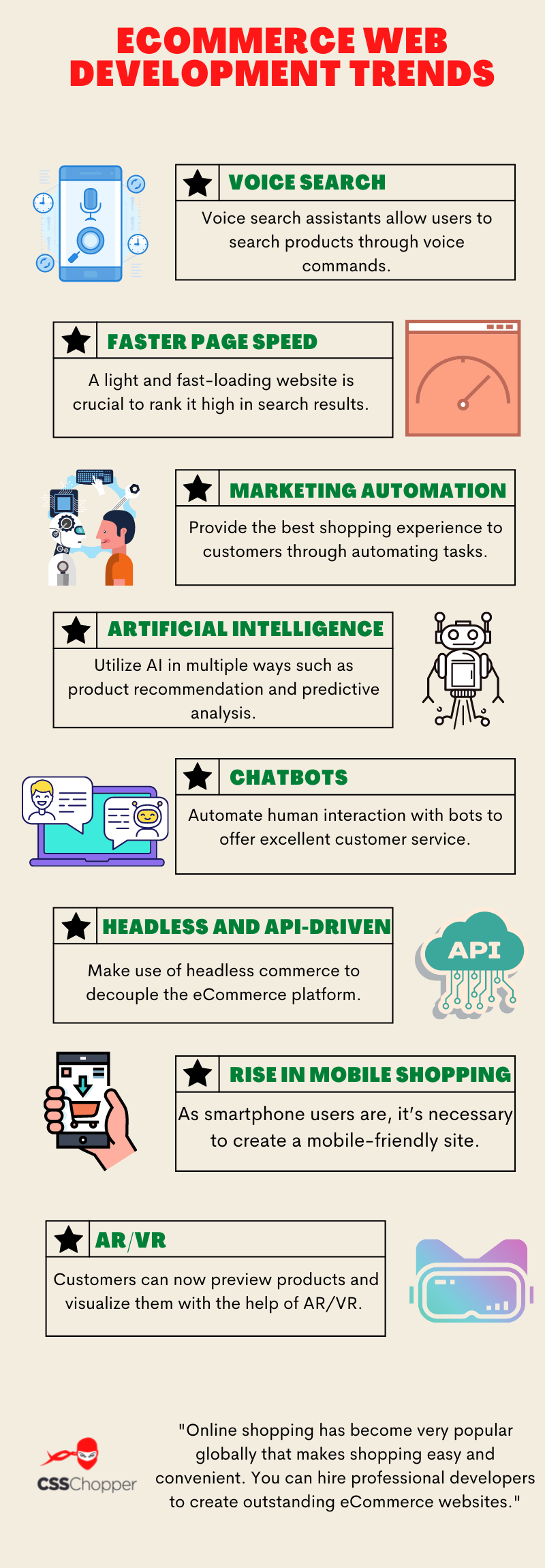
Explore the latest eCommerce trends redefining digital retail and helping brands build faster, more innovative, more personalized shopping experiences.
1. Voice-enabled Shopping and Conversational Commerce
Ever since the advent of smart speakers and voice assistants like Google Assistant, Alexa, Siri, etc., people’s lives have become more convenient and efficient. These technologies have helped users shift from “typing” to “speaking,” making everyday tasks faster and more natural.
Voice-enabled devices are designed to respond to specific commands, allowing users to access a wide range of services with ease. Voice search has become one of the popular eCommerce development trends, and it will remain so in 2026 as well.
Many eCommerce platforms now offer Voice User Interface (VUI) capabilities that let users search for products through simple voice commands. You can successfully enhance your business with Shopify website development, or use any other platform of your choice to optimize your website for voice commerce trends.
2. Omnichannel Experience Across Web, App, and In-store
For online businesses, omnichannel selling has become crucial because it allows them to reach customers across every touchpoint. They can sell through multiple channels, enabling them to handle customers across platforms and devices, including websites, PWAs, social media, and more.
With omnichannel selling, eCommerce businesses can target all kinds of customers, regardless of where they start their buying journey. Thanks to this eCommerce development trend in 2026, shopping online will no longer be tied to specific channels. For instance, today people can buy products on eBay, Amazon, Facebook, or other websites or platforms. It has become a standard practice in the eCommerce industry, helping businesses grow significantly.
Here are some ways you can offer an omnichannel experience:
- Invest in a PWA if your budget allows.
- Optimize your website for mobile devices.
- Use different tools and strategies to strengthen the omnichannel experience.
This is especially important if you are planning for B2B eCommerce development.
3. Progressive Web Apps (PWAs) for app-like Performance
Slow speed and poor user experience have long been the Achilles’ heel of many eCommerce websites. As a result, businesses are actively exploring ways to provide faster, smoother, and more reliable shopping experiences. They aim to offer a significant solution that delivers an equally good user experience across all devices, whether desktop or mobile. Progressive web app development services have proven to be the answer to this need, offering numerous advantages over traditional websites.
A Progressive Web App delivers an app-like interface and functions much like a real desktop or mobile application. However, at its core, it is still a website running inside a dedicated browser window on any device. It has become one of the most essential eCommerce development trends, helping businesses provide an exceptional user experience.
Here are the key features of a PWA:
- A PWA can be installed on desktop or mobile devices like a native app, though the installation process is different.
- It appears on the home screen, allowing users to launch it easily at any time.
- It is discoverable online, enabling you to leverage SEO to improve visibility and accessibility.
- Sharing a PWA is simple because it can be distributed via a regular link.
- It supports many features that native apps offer but are not available in standard websites.
4. Composable Commerce for Plug-and-Play Enterprise Systems
Composable commerce has emerged as a significant trend in eCommerce development, enabling businesses to build flexible, modular, and scalable digital commerce systems. Instead of relying on a single, rigid platform, brands can combine best-of-breed tools and services, such as CMS, payment gateways, search, checkout, and inventory systems, tailored to their specific needs.
This plug-and-play approach empowers enterprises to adapt quickly to market changes, improve performance, and integrate new technologies without rebuilding their entire ecosystem. With composable commerce, businesses gain the freedom to choose, replace, or upgrade components as they grow, ensuring continuous optimization and a future-ready architecture.
5. AI-driven Personalization and Product Recommendations
One of the revolutionary technologies that has emerged during the past few years is artificial intelligence, or AI. It has become a popular technology for eCommerce websites and a top trend in custom website development.
AI helps businesses in multiple ways, like product recommendations and predictive analysis. AI, along with machine learning, is being widely used to improve customer service and eCommerce personalization trends. Here are some applications of AI for eCommerce businesses:
It helps businesses to learn about their customers.
- Companies can use AI to deliver personalized user experiences tailored to their needs.
- Enhance the shopping experience by connecting customer data with real-time insights.
- Automation of tasks like customer service with the help of AI-based chatbots.
- Optimizing pricing and discounting policies.
If you are keen to use these technologies on your eCommerce website, you need to ensure you choose the right eCommerce platform. Finding a suitable platform can be challenging. You can get help making the right choice by going through our blog “How to choose the right eCommerce platform?”
6. AI-Powered Chatbots and AI Agents for Customer Service
Chatbots remain among the most widely adopted trends in eCommerce development. They help businesses automate customer interactions, enabling users to get quick, convenient support directly on an eCommerce website. Customer service has often been a challenge for many online businesses. Still, AI-powered chatbots and AI agents now make it easier to deliver fast, consistent, and helpful support around the clock.
AI chatbots in eCommerce can answer customer questions, guide them through the buying process, and resolve common issues without human involvement. AI agents go a step further by handling more complex tasks such as personalized product suggestions, order management, and multistep problem-solving. They create a more seamless support experience.
The impact is significant: AI-powered customer interactions are expected to influence more than $1 trillion in eCommerce transactions by 2025, underscoring the crucial role automation plays in digital retail.
You can hire a web developer to build a feature-rich website that includes an intelligent chatbot or AI agent to improve customer satisfaction and reduce support workload.
7. Headless and API-driven eCommerce Websites
So far, the elements that we have discussed here are those that customers interact with directly. However, users are unaware of the back-end technical architecture of an eCommerce website, despite its significant impact on the overall user experience.
Headless eCommerce is a solution that decouples the eCommerce platform from the front-end presentation layer. Consequently, online businesses can leverage DXP, CMS, PWA, or other existing or customized front-end technologies in their tech stack. 2026 could see a jump in the use of headless commerce development. In fact, it will see an increase in the adoption of new headless front-end solutions, such as PWA (Progressive Web Apps).
8. Blockchain-based Payments and Supply-chain Transparency
Blockchain in eCommerce is becoming increasingly important because it helps businesses create secure, transparent, and trustworthy digital systems. With blockchain-based payments, transactions move through decentralized networks, which reduces fraud, chargebacks, and data manipulation. It also enables faster cross-border payments with lower processing fees, providing customers with a more reliable checkout experience.
Blockchain also strengthens supply-chain management. It enables businesses to track products at every stage of the journey, from production to final delivery, which ensures complete transparency. Customers can verify product origin, authenticity, and shipment details.
This builds trust and reduces the risk of counterfeit products entering the market. As eCommerce continues to expand, blockchain in eCommerce is expected to play a significant role in eCommerce payment trends and increasing visibility across global supply chains. This level of reliability helps brands build stronger customer confidence and run smoother operations.
9. AR/VR try-on Experiences for Immersive Product Discovery
The implementation of AR/VR technologies is among the major eCommerce development trends that you can observe today on numerous websites. This technology eliminates many hurdles arising in online shopping, making it an absolute boon to the eCommerce industry.
When previewing products or services before purchasing, augmented reality (AR) plays a key role. This kind of visualization helps them decide whether a product would meet their needs. Businesses that offer eCommerce platforms with Augmented Reality (AR) will expand their market horizons.
Several surveys and reviews testify to VR experiences. Consider Airbnb, which allows you to preview a rental before making a reservation. It’s like IKEA showing you how your room would look with a given sofa. VR can be a powerful tool for websites to deliver valuable, engaging content that helps visitors decide whether to buy.
10. Hyper-automation in Checkout, Fulfillment, and Support
Hyper-automation is becoming an essential trend in eCommerce because it helps businesses speed up processes and reduce manual effort across the entire customer journey. With automated checkout systems, brands can offer faster payments, fewer steps, and a smoother overall buying experience. This reduces cart abandonment and improves conversions.
In fulfillment, eCommerce automation tools like smart inventory tracking, automated order routing, and AI-driven demand forecasting. These systems help businesses process orders more accurately and deliver products faster. Customers benefit from real-time updates and consistent delivery reliability.
Support is another area transformed by hyper-automation. AI chatbots, self-service portals, and automated ticket handling help resolve issues quickly and reduce pressure on human support teams. This leads to faster response times and better customer satisfaction.
As online shopping grows, hyper-automation is becoming a key enabler for eCommerce businesses. It allows brands to operate more efficiently, deliver better experiences, and scale without increasing operational complexity.
Conclusion
Online shopping has expanded worldwide, and businesses now rely on professional ecommerce development services to build modern, high-performing stores. With so many platforms available, including cloud ecommerce platforms, brands can easily choose the right technology for their needs. Whether you hire a WordPress or Magento developer, creating a competitive store requires more than basic features. To stay relevant, you must embrace the latest eCommerce trends such as AI personalization, PWAs, omnichannel experiences, hyper-automation, and strong security practices.
Categories
Recent Posts
Popular Posts
- How to Choose a Reliable Offshore Development Partner?
- Transforming Web Development with HTMX’s Declarative Approach for Dynamic UIs
- Top 15 Ecommerce Growth Strategies to Maximize Sales in 2026
- What is B2B Web Design? Benefits, Best Practices, and Examples
- Why Your Conversion Funnel Needs a Composable Commerce Solution?