
- What is Shopify Plus?
- What are the Benefits of Shopify Plus?
- 1. Enterprise-Grade Scalability for High-Volume Growth
- 2. Deep Customization for Complex eCommerce Architectures
- 3. Built-In Security and Global Compliance Standards
- 4. Data-Rich Analytics for Smarter Decisions
- 5. Automated Workflows for Operational Efficiency
- 6. High Availability and Performance Stability
- 7. Unified Multi-Channel and Global Selling
- Key Factors Affecting Shopify Website Development Cost
- 1. Shopify Plus License Fee
- 2. UI and UX Design Complexity
- 3. Custom Theme Development
- 4. Store Setup and Configuration Requirements
- 5. Advanced App Integrations
- 6. B2B and Wholesale Features
- 7. Checkout Customization and Extensibility
- 8. Migration From Legacy Platforms
- 9. Headless Commerce Implementation
- 10. Maintenance and Continuous Enhancements
- How Much Does it Cost to Build a Shopify Website?
- Step-by-Step Shopify Plus eCommerce Platform Development Process
- Why Choose CSSChopper to Develop an eCommerce Store on Shopify Plus
Building an enterprise commerce experience requires more than an attractive design. Companies need scalability, automation, conversion growth, and global performance. This is why more mid-market and high-volume brands move to Shopify Plus every year. Understanding the actual Shopify Plus web development cost is essential for planning budgets, improving ROI, and aligning your digital roadmap with revenue goals.
According to Grand View Research, the global eCommerce market was worth about $25.93 trillion in 2023. It is expected to grow rapidly, reaching $83.26 trillion by 2030, with an annual growth rate of 18.9 percent. Brands that invest in robust architecture outperform competitors in speed, uptime, and customer experience.
Shopify Plus supports this shift with enterprise automations, high-performance infrastructure, and flexible customizations built for omnichannel commerce. This guide explains everything you need to know. You will learn the actual cost ranges, the factors influencing Shopify Plus pricing, the development workflow, and the features that matter for high-growth eCommerce operations.
What is Shopify Plus?
Shopify Plus is the enterprise version of Shopify, designed for brands that need performance, security, custom automation, and support for high transaction volume. If we talk about Shopify development overview, it handles multi-store architecture, global selling, B2B capabilities, and complex checkout experiences. Shopify Plus does not require expensive infrastructure or dedicated DevOps teams.
Top global brands like Allbirds, Heinz, Gymshark, and Kylie Cosmetics use it to scale with confidence. It is simple for business teams and flexible for Shopify Plus developers. It also provides high availability with 99.99 percent uptime during peak traffic.
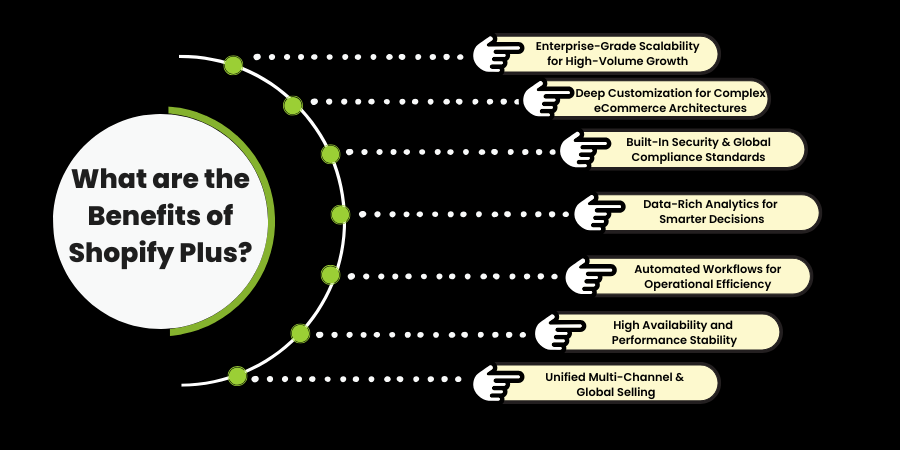
What are the Benefits of Shopify Plus?
Shopify Plus provides enterprise brands with a high-performance foundation built for scale, speed, and operational efficiency. It helps companies grow revenue without increasing technical complexity. Below is a detailed breakdown of its core benefits and why they matter for modern eCommerce operations.
1. Enterprise-Grade Scalability for High-Volume Growth
Shopify Plus handles tens of thousands of checkouts per minute during peak periods such as flash sales, drops, and holiday traffic. Its auto-scaling infrastructure eliminates server management, allowing teams to focus on growth rather than backend stability.
2. Deep Customization for Complex eCommerce Architectures
Brands can customize every layer of their storefront experience. Shopify Functions and Checkout Extensibility enable advanced backend logic, dynamic pricing rules, and shipping validations to reduce Shopify cart abandonment.
3. Built-In Security and Global Compliance Standards
Shopify Plus is PCI DSS Level 1 compliant by default. This protects cardholder data and reduces risk exposure. The Shopify Plus ecommerce platform provides sophisticated fraud analysis, encrypted data transfer, and built-in security patches.
4. Data-Rich Analytics for Smarter Decisions
ShopifyQL Notebooks give leadership teams real-time insights into sales, margins, customer behavior, product performance, and operational efficiency. You can build custom queries, automate reporting, and integrate with BI tools like Looker or Power BI to make informed decisions, optimize campaigns, and improve inventory accuracy.
5. Automated Workflows for Operational Efficiency
With Shopify Flow, Teams can automate repetitive operational tasks, from order tagging to fraud checks to inventory routing. Scripts, Functions, and API integrations extend automation into marketing, CRM, ERP, and fulfillment systems. This reduces manual involvement and drives operational efficiency.
6. High Availability and Performance Stability
Shopify Plus maintains 99.99 percent uptime, even during global sales events. Its distributed hosting infrastructure and dedicated performance optimizations protect brands from traffic spikes and outages. Reliable uptime supports stronger revenue continuity, customer trust, and brand reputation.
7. Unified Multi-Channel and Global Selling
Shopify Plus enables unified selling across online stores, social commerce channels, marketplaces, retail POS, and international storefronts. Shopify Markets supports multi-language, multi-currency, and cross-border tax compliance. In fact, Shopify Plus development helps brands expand globally without having to rebuild infrastructure from scratch.
Key Factors Affecting Shopify Website Development Cost
Below are 10 major factors that influence the cost to develop a Shopify Plus website. These factors are based on market research from 100+ agency quotes, industry reports, and typical enterprise project benchmarks.
1. Shopify Plus License Fee
Shopify Plus starts at 2000 USD per month. High-volume merchants may move to revenue-based pricing after crossing certain thresholds. These fees cover enterprise-grade hosting, security, checkout extensibility, and priority support. This is the baseline Shopify Plus website development cost before any development begins.
2. UI and UX Design Complexity
Design is one of the most significant Shopify Plus website setup cost drivers. Brands need conversion-focused interfaces, advanced navigation, accessibility, mobile optimization, and custom layouts. Enterprise Shopify Plus web design also requires CRO-backed wireframes, prototypes, and brand identity systems. More complex and interactive experiences add to the cost.
3. Custom Theme Development
Your front-end build determines speed, interaction quality, and flexibility. There are two options:
- Custom Shopify theme
- Headless storefront using Hydrogen, Next.js, or Remix
Headless builds provide unlimited customization but are more expensive due to their architectural depth. The more unique the design and logic, the higher the Shopify website development cost.
4. Store Setup and Configuration Requirements
Another significant factor that adds to the cost of building a Shopify Plus store is setup and configuration. Large catalog operations require a detailed setup. This includes:
- Collections
- Tagging systems
- Meta fields
- Search configuration
- Filters
- Product options
- Navigational structures
Enterprise workflows add additional configuration, such as rules, automation, and inventory logic across multiple locations.
5. Advanced App Integrations
Most enterprise stores rely on external systems. Common integrations include:
- ERP (SAP, NetSuite, Microsoft Dynamics)
- CRM (Salesforce, HubSpot)
- PIM and DAM platforms
- Payment gateways
- Shipping and logistics tools
These require API development, middleware, data mapping, and testing. The number and complexity of integrations significantly influence Shopify Plus custom development pricing.
6. B2B and Wholesale Features
Shopify Plus store development includes native B2B features, but enterprises often need customization. Typical requirements include:
- Company accounts
- Tiered pricing
- Contract pricing
- Custom payment terms
- Purchase workflows
- Custom portals
Such enhancements require additional engineering and QA, increasing the development timeline and Shopify Plus cost.
7. Checkout Customization and Extensibility
Shopify Plus is the only version that allows advanced checkout customization. Brands often add:
- Upsell modules
- Branding enhancements
- Shipping logic
- Custom validations
- Loyalty program integrations
These features require custom scripts, Shopify Functions, and rigorous testing. Checkout is also revenue-critical, so you need to hire Shopify Plus developers for hassle-free customizations.
8. Migration From Legacy Platforms
Migrating from Magento, WooCommerce, custom PHP platforms, or outdated systems adds significant effort. Teams need to handle:
- Data cleanup
- Product mapping
- Historical order import
- Customer segmentation
- SEO redirect frameworks
- Content recreation
Complex catalogs or outdated data structures increase the effort, making migration one of the costliest phases for enterprises. Hiring a dedicated Shopify developer is recommended for a smooth migration without data loss.
9. Headless Commerce Implementation
Headless architecture is popular among fast-growing brands. It uses APIs to separate the front-end from the backend. Following are the benefits of headless commerce:
- Better performance
- Omnichannel experiences
- Deeper customization
- Faster rollouts
However, it requires more Shopify Plus developers, separate hosting, custom rendering logic, and high engineering effort. This significantly increases Shopify Plus website development costs.
10. Maintenance and Continuous Enhancements
Enterprise commerce is never static. Brands iterate constantly. Everyday recurring needs include:
- A/B testing
- CRO enhancements
- Performance optimization
- Feature updates
- Security reviews
- Marketing tech customizations
- New automation flows
These activities typically require monthly retainers, increasing long-term cost but improving ROI.
How Much Does it Cost to Build a Shopify Website?
All the factors above influence the Shopify website development cost. Costs vary based on complexity, integrations, custom workflows, and your development partner’s experience level. Most enterprise builds require planning, personalization, and technical depth.
For mid-market and enterprise brands, the overall average cost to create a Shopify Plus website ranges from 25,000 USD to 250,000 USD, depending on design requirements, the number of integrations, headless architecture, B2B features, global expansion needs, and data migration complexity. High-traffic, multi-store, or heavily customized builds may exceed this range.
Shopify Plus Development Cost Breakdown
| Cost Component | Estimated Range (USD) |
| Shopify Plus License Fees | $24,000 – $36,000 (Annual) |
| UI and UX Design | $5,000 – $35,000 |
| Custom Theme Development | $10,000 – $60,000 |
| Shopify Plus Website Setup | $3,000 – $20,000 |
| App Integrations | $5,000 – $80,000 |
| Custom Checkout | $5,000 – $25,000 |
| B2B Capabilities | $4,000 – $35,000 |
| Data Migration | $5,000 – $40,000 |
| Headless Setup | $20,000 – $100,000 (Optional) |
| Ongoing Maintenance | $8,000 – $40,000 (Annual) |
This table helps leadership teams plan Shopify Plus website development cost allocation and understand the real investment required to build a Shopify Plus storefront.
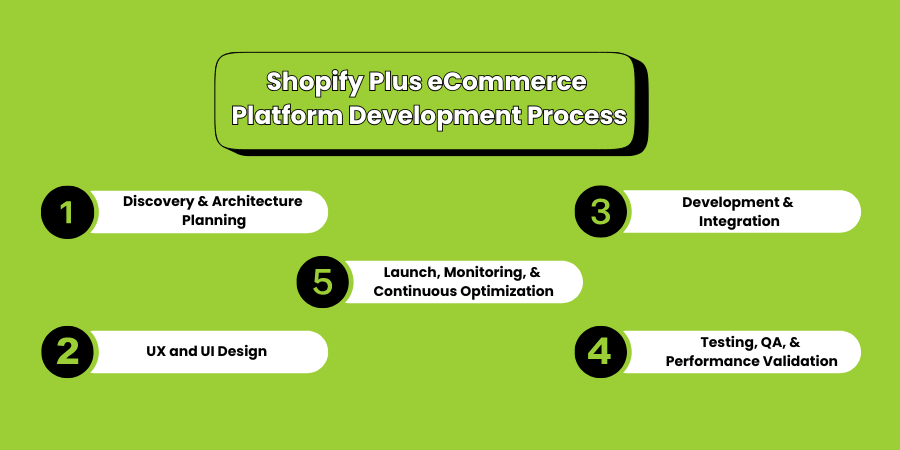
Step-by-Step Shopify Plus eCommerce Platform Development Process
Below is a detailed look at how a typical Shopify Plus development process unfolds. Think of it as the blueprint that ensures your new store is not only beautiful but also fast, stable, and ready for global growth.
Step i. Discovery and Architecture Planning
Every successful Shopify Plus project begins with clarity. The discovery phase helps uncover what your business truly needs. This includes understanding your current challenges, the gaps in your existing system, and the outcomes you want from the new store.
During this stage, the Shopify Plus development experts dive deep into your product structure, markets, customer journeys, backend workflows, and system dependencies. This step ensures your store is built on a solid blueprint rather than guesswork. It sets expectations early and removes surprises later in the timeline.
Step ii. UX and UI Design
Once the foundation is clear, the creativity starts. The design phase focuses on building a user experience that feels intuitive and conversion-friendly. Since Shopify Plus powers high-volume brands, the design must support quick decision-making and smooth checkout flows.
A Shopify Plus development company starts with wireframes to outline how each page should behave. After approvals, UI designers bring the brand to life with visual elements, interactions, product layouts, and mobile-first responsiveness. They also ensure your store meets accessibility guidelines.
Step iii. Development and Integration
With designs ready, Shopify Plus developers step in to bring everything to life. This phase includes front-end development, theme customization, Shopify Functions, automation workflows, and API-based integrations with ERPs, CRMs, PIMs, fulfillment systems, and marketing platforms.
For brands exploring headless commerce, this is where the engineering gets deeper. Developers configure Hydrogen or other frameworks, build server-side rendering logic, and optimize for speed and SEO.
Step iv. Testing, QA, and Performance Validation
Before launch, the store goes through extensive quality assurance. This is where Shopify Plus development agency tests every feature, every interaction, and every integration. Enterprise-level QA includes functional testing, browser compatibility testing, mobile performance testing, load testing, and checkout validation.
If the store connects to multiple systems, integration testing becomes critical. The team checks order syncs, inventory updates, discounts, taxes, and fulfillment logic to ensure everything behaves exactly as expected. Performance teams also optimize page speed, asset loading, Core Web Vitals, and server-side response times.
Step v. Launch, Monitoring, and Continuous Optimization
Once testing is complete and everyone is confident with the results, it is time to go live. The launch process usually includes DNS updates, data syncing, final checks, and coordinated communication between technical and business teams.
But the work does not stop here. After launch, developers monitor the store closely to catch unexpected issues. They also assist with post-launch optimization, including A/B testing, personalization, SEO improvements, and conversion enhancements.
Why Choose CSSChopper to Develop an eCommerce Store on Shopify Plus
CSSChopper is a trusted Shopify development services provider for global enterprises, delivering high-performance Shopify Plus websites. We understand complex architectures, headless builds, B2B workflows, and high-traffic optimization.
Our experts deliver stable storefronts with precise engineering and user-centric design. Our experience in integrating Shopify eCommerce development trends, automation, checkout customization, and global rollouts makes us a reliable partner for enterprise growth. We also support ongoing optimization and new feature development to help brands stay ahead of market shifts.
Categories
Recent Posts
Popular Posts
- How to Choose a Reliable Offshore Development Partner?
- Transforming Web Development with HTMX’s Declarative Approach for Dynamic UIs
- Why Your Conversion Funnel Needs a Composable Commerce Solution?
- How to Outsource Web Development in 2025: Complete Guide
- What are the Top Web Development Trends for 2025?