- What Is Shopify? A Quick Overview
- What Is Shopify Plus?
- The Key Difference Between Shopify and Shopify Plus
- Shopify vs Shopify Plus Features: Full Comparison Table
- Shopify vs Shopify Plus Pricing Breakdown
- Shopify Advanced vs Shopify Plus: Is the Jump Worth It?
- Shopify Plus Benefits You Cannot Get Anywhere Else
- Shopify Plus Development: What Goes Into It?
- Shopify API Integration on Plus vs Standard Plans
- Is Shopify Plus Worth It?
- When Should You Upgrade to Shopify Plus?
- Why Shopify Plus? Use Cases and Real-World Scenarios
- Final Verdict: Shopify vs Shopify Plus
Trying to decide between Shopify vs Shopify Plus? You are not alone. As your store grows, so do your platform needs, and choosing the wrong tier can mean paying too much or leaving critical enterprise features on the table. This guide covers everything: Shopify Plus pricing, exclusive features, upgrade triggers, and the real difference between Shopify and Shopify Plus in 2026.
What Is Shopify? A Quick Overview
Shopify is one of the world’s most popular ecommerce development services platforms, powering over 4 million stores globally. It gives merchants everything they need to launch, manage, and scale an online store: product listings, payment processing, shipping tools, and a wide app ecosystem.
Shopify offers four main plans. Below is a comparison of all plans, including Shopify Plus:
| Area | Shopify Advanced | Shopify Plus |
| Price | $299/month | From $2,300/month |
| Checkout Control | Basic branding only | Full extensibility: custom scripts, upsells, loyalty |
| Automation | None | Shopify Flow + Launchpad |
| B2B / Wholesale | No native B2B tools | Native B2B wholesale channel |
| API Rate Limits | Standard limits | Up to 10x higher limits |
| Staff Accounts | Up to 15 | Unlimited |
| Best Suited For | $500K to $1M annual revenue | $1M+ annual revenue |
What Is Shopify Plus?
What is Shopify Plus? Shopify Plus is the enterprise-grade version of Shopify, designed specifically for high-volume merchants, fast-scaling brands, and businesses with complex operational needs. It was built to handle massive traffic spikes, multi-store management, and sophisticated api integration requirements that standard Shopify plans cannot accommodate.
Unlike the standard Shopify tiers, Shopify Plus is not a self-serve product. Merchants get access to a dedicated Merchant Success Manager, a customizable checkout experience, and a suite of enterprise-only tools such as Shopify Flow, Launchpad, and B2B wholesale channels.
The platform is used by some of the world’s most recognized brands, including Gymshark, Heinz, Red Bull, and Kylie Cosmetics, all of which require the performance and flexibility that only an enterprise ecommerce platform can deliver.
The Key Difference Between Shopify and Shopify Plus
Understanding the difference between Shopify and Shopify Plus comes down to three core pillars: scale, customization, and support. Here is a concise breakdown:
Customization
Standard Shopify limits checkout customization to basic branding. Shopify Plus unlocks full checkout extensibility, including custom scripts, upsells, and loyalty program integrations directly within the checkout flow.
Scalability
Shopify Plus can handle flash sales, product drops, and peak traffic events without performance degradation, thanks to a guaranteed 99.99% uptime SLA and unlimited bandwidth.
Support
Standard plans rely on chat and email support. Shopify Plus merchants receive a dedicated Merchant Success Manager, priority support, and access to the Shopify Plus Partner ecosystem for specialized development work.
Multi-Store Management
Standard Shopify is designed for a single storefront. Shopify Plus allows up to 9 expansion stores, ideal for managing international storefronts, regional pricing, and separate B2B channels.
API Access
Shopify Plus offers significantly higher API rate limits, which are essential for businesses running complex api integration workflows, ERP systems, or custom middleware.
Shopify vs Shopify Plus Features: Full Comparison Table
This Shopify Plus comparison table gives you a side-by-side look at the features that matter most. Use this when evaluating the Shopify vs Shopify Plus features across your key business requirements.
| Feature | Shopify Advanced | Shopify Plus |
| Staff Accounts | Up to 15 | Unlimited |
| Custom Checkout | Basic branding only | Full Checkout Extensibility |
| Transaction Fees | 0.6% (without Shopify Payments) | 0.2% (negotiable) |
| Shopify Flow (Automation) | Not included | Included |
| Launchpad | Not included | Included |
| B2B Wholesale Channel | No | Yes – native channel |
| Expansion Stores | 1 store only | Up to 9 expansion stores |
| Shopify Audiences | No | Yes |
| API Rate Limits | Standard | Up to 10x higher (enterprise-grade) |
| Dedicated Merchant Success Manager | No | Yes |
| SLA Uptime Guarantee | Standard uptime | 99.99% SLA |
| Custom Reporting | Advanced reports | Full custom reporting + Shopify Analytics |
| Abandoned Cart Recovery | Yes | Yes (with advanced automation) |
| Shopify Functions | Limited access | Full access |
| Priority Support | Chat + Email | 24/7 Priority + Dedicated Manager |
As the Shopify vs Shopify Plus features table shows, the gap between Advanced and Plus is not just about numbers. It is about the depth of control, automation, and enterprise infrastructure available to your team.
Shopify vs Shopify Plus Pricing Breakdown
Shopify Plus pricing and Shopify Plus cost are among the most searched questions from merchants evaluating their upgrade options. Here is how the two sides of the coin compare.
Standard Shopify Plans
| Plan | Monthly Price | Annual Price | Transaction Fee |
| Basic | $29/month | $19/month | 2.00% |
| Shopify | $79/month | $49/month | 1.00% |
| Advanced | $299/month | $299/month | 0.60% |
Shopify Plus Pricing Structure
| Pricing Tier | Details |
| Revenue-Based (up to $800K/month) | Flat fee of approximately $2,300/month covering your primary store and all enterprise features |
| Custom Pricing (above $800K/month) | Approximately 0.25% of monthly revenue, negotiated directly with Shopify, with a price ceiling |
| Transaction Fee | 0.2%, significantly lower than all standard plans |
Shopify Advanced vs Shopify Plus: Is the Jump Worth It?
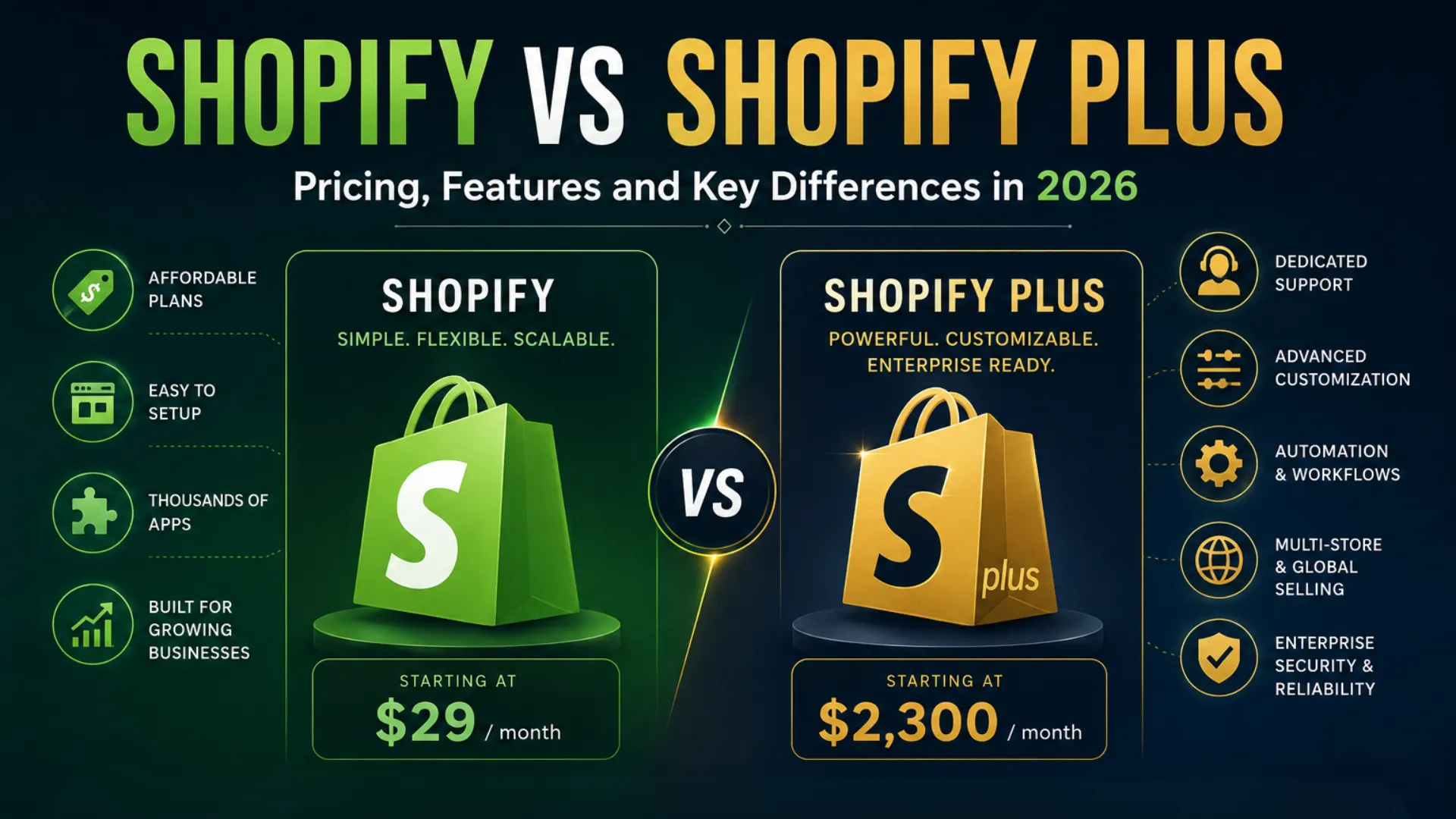
One of the most common crossroads for growing merchants is the Shopify Advanced vs Shopify Plus decision. Advanced Shopify costs $299/month and unlocks custom reporting and third-party calculated shipping. Shopify Plus at $2,300/month delivers a fundamentally different tier of capability.
| Area | Shopify Advanced | Shopify Plus |
| Price | $299/month | From $2,300/month |
| Checkout Control | Basic branding only | Full extensibility: custom scripts, upsells, loyalty |
| Automation | None | Shopify Flow + Launchpad |
| B2B / Wholesale | No native B2B tools | Native B2B wholesale channel |
| API Rate Limits | Standard limits | Up to 10x higher limits |
| Staff Accounts | Up to 15 | Unlimited |
| Best Suited For | $500K to $1M annual revenue | $1M+ annual revenue |
Shopify Plus Benefits You Cannot Get Anywhere Else
The most compelling Shopify Plus benefits go beyond features listed in a table. They represent a shift in how your business operates at scale:
- Checkout Extensibility: Customize every step of the checkout with upsell blocks, custom fields, loyalty point displays, and branded UI elements. This alone can drive 10 to 30 percent higher average order values for Plus merchants.
- Shopify Flow: A visual automation builder that eliminates repetitive manual tasks. Automate inventory alerts, customer tagging, fraud review triggers, and order fulfillment workflows without writing a single line of code.
- Launchpad: Schedule product launches, flash sales, and price changes in advance. Launchpad automatically rolls back changes after a sale, saving hours of manual work per campaign.
- Multi-Store and International: Manage up to 9 expansion stores from a single admin, with different currencies, languages, and tax rules per market.
- B2B Wholesale: Run a separate B2B wholesale storefront natively within Shopify Plus, with custom pricing, net payment terms, and company account management, all without a third-party app.
- Shopify Audiences: Access Shopify’s proprietary buyer data to build high-intent ad audiences for Facebook and Google, improving return on ad spend significantly.
Shopify Plus Development: What Goes Into It?
Shopify Plus development is a specialized discipline that goes well beyond standard theme customization. Brands on Plus typically work with certified Shopify Plus Partners or dedicated Shopify development services to unlock the full potential of the platform.
What Shopify Plus Development Typically Includes
- Custom Theme Development: Building performance-optimized storefronts using Liquid, Shopify’s templating language, with custom sections, blocks, and metafields for dynamic content delivery.
- Checkout Customization: Using Checkout Extensibility and Shopify Functions to build custom logic for promotions, shipping rules, payment conditions, and post-purchase upsells.
- ERP and CRM Integration: Connecting Shopify Plus to back-end systems like Salesforce, NetSuite, SAP, or custom databases through Shopify’s robust REST and GraphQL APIs. This is where expert Shopify development services add significant value by building reliable middleware and webhook-driven pipelines.
- Headless Commerce: Headless commerce involves decoupling the Shopify backend from the frontend to build lightning-fast storefronts using React, Next.js, or Vue, powered by Shopify’s Storefront API.
- Platform Migrations: Moving from Magento, WooCommerce, or a custom platform to Shopify Plus requires data migration, theme rebuilding, and API rewiring that demands hands-on technical expertise.
Shopify API Integration on Plus vs Standard Plans
Shopify API integration capabilities are one of the clearest performance differentiators between standard Shopify and Shopify Plus. Standard Shopify plans come with a default API rate limit of 2 API calls per second (leaky bucket algorithm), which can bottleneck high-volume order processing, real-time inventory syncing, or bulk product updates.
Shopify Plus unlocks api integration limits that are up to 10x higher than standard plans. This is critical for businesses running:
- Real-time inventory synchronization across multiple warehouses
- Custom order management system (OMS) connections via api integration
- ERP platforms such as NetSuite, SAP, or Microsoft Dynamics
- Third-party logistics (3PL) fulfillment automation
- Customer data platforms (CDPs) and marketing automation tools
For businesses investing in custom Shopify API integration, Shopify Plus also provides access to additional exclusive APIs: the Gift Cards API, Multipass (SSO) API, and the User API. None of these are available on standard plans.
Is Shopify Plus Worth It?
The honest answer to “Is Shopify Plus worth it?” depends entirely on your revenue, operational complexity, and growth trajectory. Use the framework below to assess your situation:
| Shopify Plus is NOT worth it if… | Shopify Plus IS worth it if… |
| Your revenue is under $500K/year | Your revenue consistently exceeds $1M/year |
| You have a single storefront with no B2B needs | You manage multiple international storefronts |
| Your checkout does not need customization | You need a custom, branded checkout experience |
| Your tech stack is simple with few integrations | You rely on complex ERP or CRM integrations |
| You do not run frequent sales events or product drops | You run B2B wholesale alongside direct-to-consumer channels |
When Should You Upgrade to Shopify Plus?
Knowing when you should upgrade to Shopify Plus is often a matter of recognizing clear business signals rather than just hitting a revenue threshold. Watch for these triggers:
- Revenue Milestone: You are consistently generating $80,000 or more per month. At this level, the lower transaction fees on Plus can offset a significant portion of the monthly cost.
- Traffic Spikes: Your store crashes or slows during flash sales, Black Friday, or major product launches. Shopify Plus guarantees performance stability even under extraordinary traffic loads.
- Manual Operations Are Slowing You Down: Your team is spending hours on repetitive tasks like tagging orders, sending emails, or adjusting inventory. Shopify Flow can automate all of this.
- Global Expansion: You are entering new markets and need storefronts in different languages, currencies, and with local tax configurations.
- B2B Requirements: You want to launch a wholesale channel for business buyers without building a separate platform.
- Integration Complexity: Your api integration needs are outpacing the API rate limits of standard Shopify plans.
Why Shopify Plus? Use Cases and Real-World Scenarios
“Why Shopify Plus”? is a question that enterprise merchants ask when comparing it against platforms like Magento, BigCommerce, or Salesforce Commerce Cloud. The answer lies in the balance of power and simplicity that Shopify Plus uniquely delivers.
Unlike open-source platforms that require heavy ecommerce development services to maintain and update, Shopify Plus is fully hosted and managed by Shopify. That means no server costs, no security patch management, and no infrastructure scaling headaches. Your development budget goes toward building customer-facing experiences rather than maintaining the underlying system.
Brands That Use Shopify Plus
Shopify Plus is the platform of choice for brands like Gymshark, Heinz, Allbirds, Red Bull, and Fashion Nova. These brands require the performance, flexibility, and reliability that only an enterprise tier can provide, along with the ability to move fast without depending on expensive platform-level development for every change.
Choosing the Right eCommerce Platform
Ultimately, selecting the Right eCommerce Platform for your business means looking beyond just feature lists. It means evaluating the total cost of ownership, the developer ecosystem, partner availability, and long-term scalability.
For most mid-market and enterprise direct-to-consumer brands, Shopify Plus provides the best combination of managed infrastructure, enterprise features, and a developer-friendly API layer, without the overhead of a fully custom-built solution.
Final Verdict: Shopify vs Shopify Plus
The difference between Shopify and Shopify Plus is not just about price. It is about whether your business has grown to a scale where the operational, technical, and commercial benefits of an enterprise platform outweigh the monthly investment.
Whether you are evaluating the Shopify Plus comparison for the first time or actively planning your migration, the next step is getting the implementation right. Working with experienced ecommerce development services and certified Shopify development services partners ensures you maximize the value of the platform from day one.
If you are still unsure which plan is the Right eCommerce Platform for your specific business model, consult with a Shopify Plus Partner who can assess your revenue, tech stack, and growth goals before you commit.
Categories
Recent Posts
Popular Posts
- How to Choose a Reliable Offshore Development Partner?
- Transforming Web Development with HTMX’s Declarative Approach for Dynamic UIs
- Top 15 Ecommerce Growth Strategies to Maximize Sales in 2026
- What is B2B Web Design? Benefits, Best Practices, and Examples
- Why Your Conversion Funnel Needs a Composable Commerce Solution?