- What Are WordPress, Joomla, and Drupal?
- WordPress vs Drupal: Which CMS Is Better?
- Joomla vs WordPress: Key Differences Explained
- Drupal vs Joomla: Which One Should You Choose?
- WordPress vs Joomla vs Drupal: Side-by-Side Comparison
- Which CMS Is Best for SEO?
- Which CMS Should You Choose?
- Is Drupal Still Relevant in 2026?
- Final Verdict: WordPress vs Joomla vs Drupal
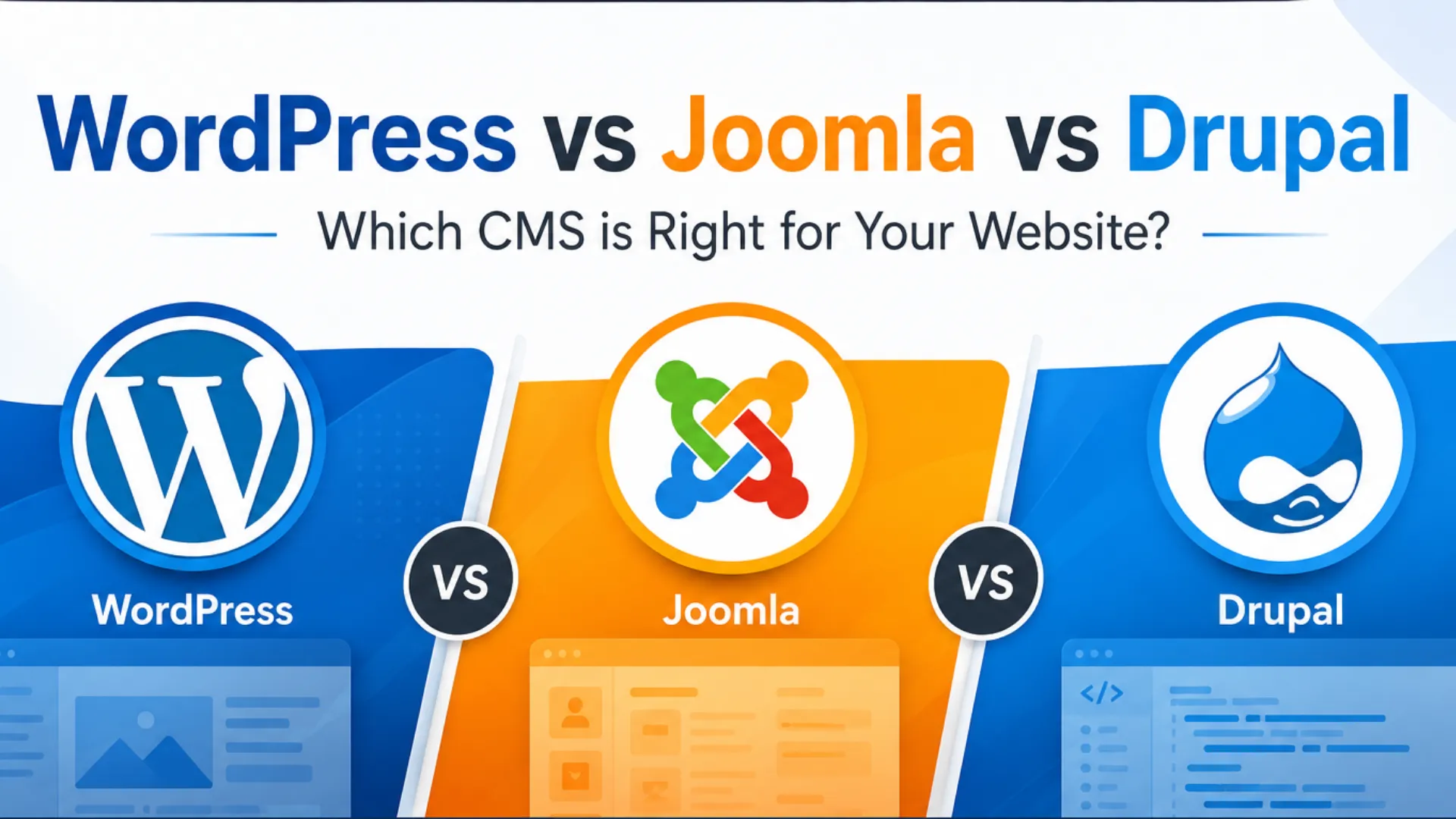
You’re about to build a website, and suddenly everyone is throwing around the same three names: WordPress, Joomla, and Drupal. One person says WordPress is the only platform worth using. Another claims Drupal is far more secure. Someone else insists Joomla is the underrated middle ground.
The problem is that most comparison articles either oversimplify everything or overload you with technical jargon without helping you make an actual decision. So here’s the practical version. Just a clear breakdown of WordPress vs Joomla vs Drupal based on usability, SEO, scalability, security, performance, and the type of websites these CMS platforms are actually built for.
Because when it comes to choosing a CMS, the answer is not about which platform is universally “best.” It is about which one fits your business goals, technical comfort level, and long-term website requirements.
What Are WordPress, Joomla, and Drupal?
All three are open-source content management systems (CMS). That means you can download them for free, customize them however you want, host them on your own infrastructure, and fully control your website without depending on a closed ecosystem. But despite belonging to the same category, these platforms are built very differently.
What Is WordPress?
WordPress started as a blogging platform and evolved into the most widely used CMS in the world. Today, it powers more than 40% of all websites online, including:
- Business websites
- Ecommerce stores
- Blogs
- News platforms
- Portfolio websites
- Educational websites
- Enterprise platforms
That popularity comes down to accessibility. WordPress makes website management significantly easier than most CMS platforms. You can launch a website quickly, manage content without technical knowledge, and expand functionality using plugins and themes.
This is one of the biggest reasons WordPress Website Development has become so popular among businesses of all sizes. Whether you are building a startup website or a large ecommerce platform, WordPress provides flexibility without forcing you into heavy technical complexity.
Many businesses also work with a WordPress Development Company to build custom themes, plugins, scalable architectures, and SEO-friendly websites tailored to their specific requirements.
What Is Joomla?
Joomla sits between WordPress and Drupal in terms of flexibility and complexity. It offers more built-in functionality than WordPress while remaining easier to manage than Drupal. Although Joomla is less mainstream today, it still performs extremely well for:
- Membership websites
- Community portals
- Educational platforms
- Multilingual websites
- Medium-sized business websites
One area where Joomla stands out is native multilingual functionality. Unlike WordPress, Joomla supports multilingual content management directly within the core platform. Joomla also has stronger built-in user management features than WordPress, making it useful for websites with multiple user roles and permission levels.
Businesses that require custom portals or community-driven websites often partner with a Joomla Development Company to build more tailored solutions using Joomla’s flexible framework.
What Is Drupal?
Drupal is designed for highly complex and large-scale websites that require advanced customization, scalability, security, and structured content architecture.
This is why Drupal is commonly used by:
- Government organizations
- Universities
- Healthcare institutions
- Enterprise corporations
- High-traffic digital platforms
- Drupal is not beginner-friendly.
Its learning curve is significantly steeper compared to WordPress and Joomla, but it offers an incredible level of flexibility and control for development teams. Modern Drupal web development focuses heavily on enterprise-grade architecture, API-driven experiences, custom workflows, advanced permissions, and scalable content systems.
For organizations managing large ecosystems with complex operational requirements, Drupal remains one of the strongest CMS platforms available in 2026.
WordPress vs Drupal: Which CMS Is Better?
When businesses seriously compare CMS platforms, the conversation often comes down to WordPress vs Drupal.
- That makes sense because both platforms target completely different audiences.
- WordPress focuses on simplicity, accessibility, and rapid deployment.
- Drupal focuses on scalability, structured architecture, and enterprise-level customization.
- The right option depends entirely on the complexity of your project.
Ease of Use
If usability matters most, WordPress wins comfortably. The dashboard is beginner-friendly, setup is straightforward, and most hosting providers offer one-click installation.
You can:
- Install themes
- Add plugins
- Publish pages
- Optimize SEO
- Manage content
- without needing advanced development skills.
This simplicity is a major reason businesses choose WordPress Website Development for marketing-driven websites and ecommerce stores.
Drupal is far more technical. Its backend structure requires a deeper understanding of website architecture, modules, permissions, and configuration systems. Even experienced users often rely on developers for Drupal implementations.
That does not make Drupal worse. It simply means Drupal is designed for more advanced use cases.
Performance and Scalability
Performance discussions around CMS platforms can be misleading because hosting infrastructure and optimization matter heavily.
Still, Drupal generally handles:
- Large databases
- Enterprise workflows
- Complex content relationships
- High-traffic environments
- Structured data systems
Better than a default WordPress installation. Drupal was built with scalability in mind from the beginning. WordPress can absolutely scale too, but it often requires:
- CDN integration
- Advanced caching
- Database optimization
- Performance plugins
- Premium hosting environments
For small and medium-sized business websites, WordPress performance is usually more than enough. But for enterprise ecosystems with highly structured content and millions of visitors, Drupal often performs better at scale.
This is one reason Drupal web development remains highly relevant for enterprise organizations.
Security
Security is one of the biggest reasons businesses consider Drupal. Drupal has a strong reputation in enterprise and government environments because its security standards are strict and its ecosystem is more controlled. However, WordPress itself is not inherently insecure.
Most WordPress vulnerabilities come from:
- Outdated plugins
- Weak passwords
- Poor-quality themes
- Neglected maintenance
- Cheap hosting environments
Because WordPress powers such a large percentage of the internet, it naturally attracts more attackers. Still, a properly maintained WordPress website can be extremely secure.
The real difference is not whether one CMS is magically safe. It is whether the website is actively maintained and professionally managed.
SEO Capabilities
For most businesses, WordPress is the better CMS for SEO.
Plugins like:
- Yoast SEO
- Rank Math
- All in One SEO
Make optimization significantly easier for non-technical users.
You can manage:
- Meta titles
- Meta descriptions
- XML sitemaps
- Schema markup
- Canonical URLs
Redirects
without requiring development expertise. This accessibility is one reason WordPress dominates content marketing and organic search-focused websites. Drupal SEO is powerful too, but it requires more technical setup and manual configuration.
For businesses with dedicated developers and enterprise SEO teams, Drupal can perform exceptionally well. But for most users, WordPress offers the better balance between SEO power and ease of use.
Enterprise and Large-Scale Websites
Drupal clearly has the advantage when it comes to highly complex enterprise systems.
It supports:
- Granular permissions
- Advanced workflows
- Structured content modeling
- Large multisite architectures
- API-first implementations
more naturally than WordPress.
That said, WordPress enterprise ecosystems have evolved significantly over the years.
Large brands increasingly work with a WordPress Development Company to build scalable enterprise websites using custom architectures and high-performance hosting environments. Still, for extremely complex government or enterprise systems, Drupal remains the stronger long-term foundation.
Joomla vs WordPress: Key Differences Explained
Joomla often gets ignored in CMS discussions, but it still offers some genuinely strong advantages. In many ways, Joomla feels like the middle ground between WordPress simplicity and Drupal flexibility.
Multilingual Support
One of Joomla’s biggest strengths is multilingual support. Unlike WordPress, Joomla includes multilingual functionality directly inside the core CMS. That means businesses targeting multiple countries or languages can manage multilingual content without relying heavily on third-party plugins.
WordPress can absolutely support multilingual SEO too, but it usually depends on tools like:
- WPML
- Polylang
- TranslatePress
For multilingual websites, Joomla offers a cleaner out-of-the-box experience.
User Management and Flexibility
Joomla also has stronger built-in user management compared to WordPress.
If your website involves:
- Membership systems
- User groups
- Restricted content
- Community features
- Role-based access
Joomla becomes a very strong option.
This is one reason businesses sometimes work with a Joomla Development Company when building community-focused or portal-based websites.
SEO Features
WordPress still leads in SEO accessibility. The ecosystem around WordPress SEO is significantly larger, with more:
- Plugins
- Integrations
- Tutorials
- Developers
- SEO-focused tools
Joomla SEO is capable, but configuration tends to feel more manual for beginners.
For businesses heavily focused on content marketing and organic traffic growth, WordPress remains the more SEO-friendly choice overall.
Security and Maintenance
Joomla performs well from a security perspective when maintained properly. Like any CMS, the biggest risks usually come from:
- Outdated extensions
- Weak login credentials
- Poor hosting setups
- Neglected updates
Joomla’s ecosystem is smaller than WordPress, which reduces some exposure, but proper maintenance still matters heavily.
Speed and Performance
Performance differences between Joomla and WordPress are relatively small for standard business websites.
Both platforms benefit from:
- Good hosting
- Caching systems
- Optimized themes
- CDN integration
Neither platform has a dramatic built-in speed advantage under normal conditions.
Drupal vs Joomla: Which One Should You Choose?
If you are comparing Drupal vs Joomla, you probably already know WordPress is not the right fit for your project. The real difference here comes down to complexity and scale.
When Joomla Makes More Sense
Joomla works well for:
- Mid-sized business websites
- Community platforms
- Membership websites
- Multilingual portals
- Businesses needing moderate customization
It offers more built-in flexibility than WordPress while remaining easier to manage than Drupal.
When Drupal Is the Better Choice
Drupal makes more sense when your project requires:
- Enterprise-level scalability
- Advanced workflows
- Structured content systems
- Complex permissions
- API-first architecture
- Heavy customization
This is where Drupal web development truly shines.
For enterprise digital ecosystems, Drupal remains one of the most powerful CMS solutions available.
WordPress vs Joomla vs Drupal: Side-by-Side Comparison
| Feature | WordPress | Joomla | Drupal |
| Ease of Use | Beginner-friendly | Moderate | Advanced |
| SEO | Excellent | Good | Strong |
| Security | Good | Good | Excellent |
| Scalability | Good with optimization | Moderate | Excellent |
| Multilingual Support | Plugin-based | Built-in | Built-in |
| Best For | Blogs, SMBs, Ecommerce | Membership & Community Sites | Enterprise & Government |
| Learning Curve | Low | Medium | High |
| Community Size | Massive | Medium | Medium |
Which CMS Is Best for SEO?
Why WordPress Dominates SEO
- WordPress remains the strongest CMS for SEO-focused websites because it simplifies optimization for non-technical users.
- Combined with strong plugin support and flexible content management, WordPress gives businesses an easier path toward improving organic visibility.
Drupal SEO for Enterprise Websites
- Drupal performs extremely well for enterprise SEO when managed by experienced development and marketing teams.
- Its flexibility allows organizations to create highly customized SEO structures and advanced content architectures.
Joomla SEO Capabilities
- Joomla SEO is solid but less beginner-friendly.
- It works well for businesses comfortable handling more manual configuration and technical management.
Which CMS Should You Choose?
The biggest mistake people make when choosing a CMS is trying to find the single “best” platform overall. That is not how CMS selection works. The right platform depends entirely on your business goals, technical resources, scalability requirements, and long-term growth plans.
Choose WordPress If…
- You want fast deployment
- SEO is a major priority
- You are building a business website or ecommerce store
- Ease of use matters most
- You want access to the largest ecosystem
Choose Joomla If…
- You need native multilingual support
- You are building a membership or community platform
- You want more flexibility than WordPress
- You are comfortable with moderate technical complexity
Choose Drupal If…
- You are building an enterprise-grade platform
- Security and scalability are critical
- Your workflows are highly complex
- You require advanced content architecture
- You have access to developers or enterprise teams
Is Drupal Still Relevant in 2026?
Absolutely.
- WordPress dominates overall market share, but Drupal continues to play a major role in enterprise web development.
- Drupal 10 and Drupal 11 modernized the platform significantly, improving usability, developer experience, and performance.
- For highly customized enterprise ecosystems, Drupal remains one of the strongest CMS platforms available today.
Final Verdict: WordPress vs Joomla vs Drupal
WordPress is the practical choice for most websites because it balances usability, SEO, flexibility, and scalability exceptionally well. Joomla remains the underrated middle-ground CMS for businesses needing stronger built-in functionality without Drupal’s complexity.
Drupal is the enterprise-grade solution for organizations requiring advanced architecture, scalability, and security. No CMS is universally perfect. The right choice depends entirely on your project requirements, technical capabilities, and long-term business goals. Choosing the right platform is ultimately about aligning your CMS with the type of website development services your business needs today and in the future.
Categories
Recent Posts
Popular Posts
- How to Choose a Reliable Offshore Development Partner?
- Transforming Web Development with HTMX’s Declarative Approach for Dynamic UIs
- Top 15 Ecommerce Growth Strategies to Maximize Sales in 2026
- What is B2B Web Design? Benefits, Best Practices, and Examples
- Why Your Conversion Funnel Needs a Composable Commerce Solution?